Most SaaS offerings started with a business user focus, providing applications that zero in on solving specific business problems. It’s become an everyday occurrence for businesses of all sizes to migrate many of their needs to SaaS.
There are also SaaS applications that serve as components of a comprehensive IT landscape. But when we look at creating and maintaining the overall technology infrastructure in an organization, a single SaaS application really isn’t able to provide full-on IT services. So IT has been finding more usefulness in the world of cloud services that have their roots in supporting IT and developers. IT is able to take advantage of cloud-based platforms, such Infrastructure as a Service, for core technology tools.
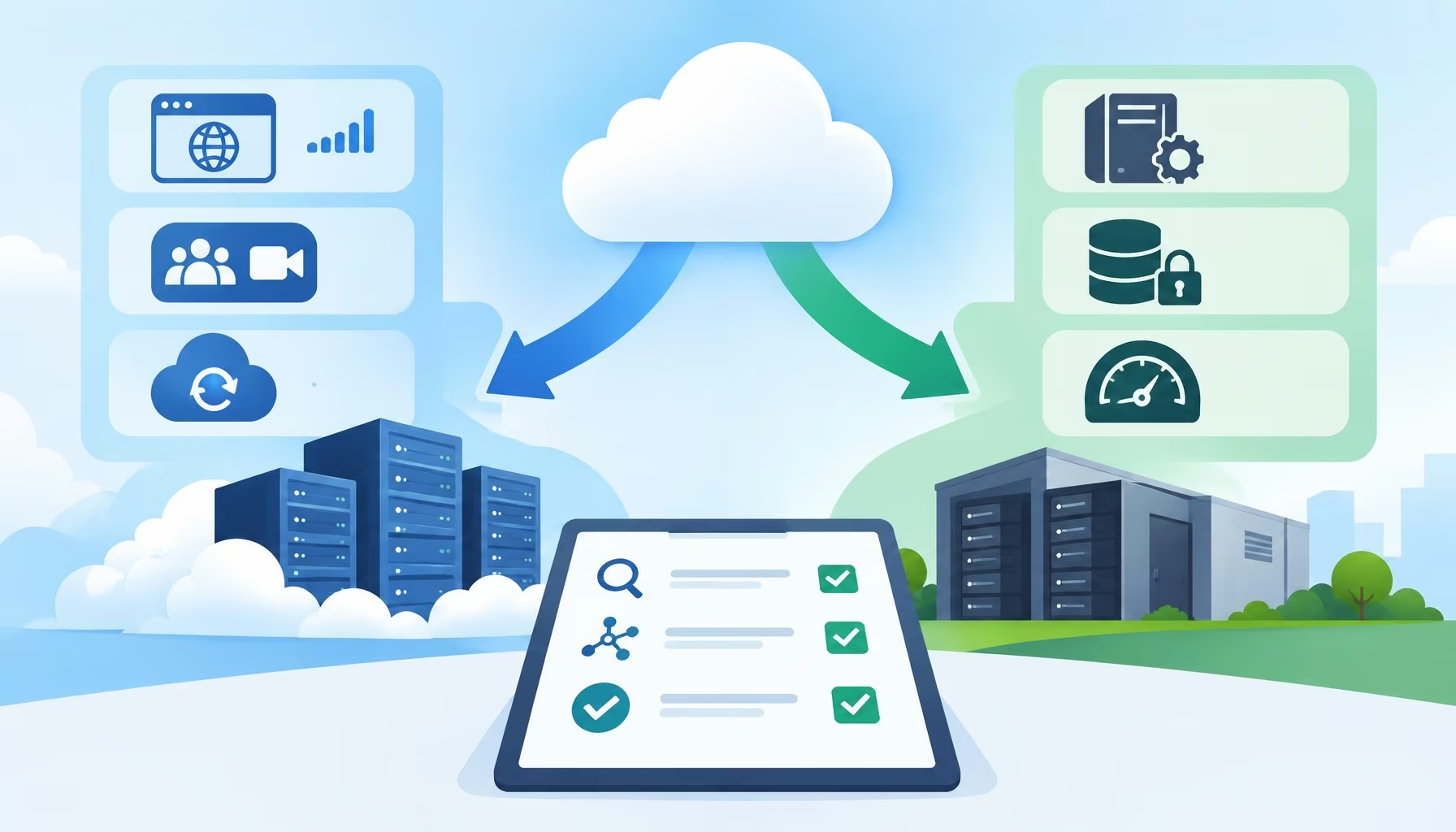
Obviously, in terms of data and technology interoperability, SaaS and cloud services must integrate with the entire IT world, much of which is still on-premises. Business processes and data-flows now run from cloud to on premises and back. Businesses need agile technology tools to handle the increasing hybrid infrastructures of many organizations.
The overlapping of data and application integration has been accelerating, particularly with the growth of cloud-based integration solutions. Out of this convergence has emerged the cloud integration platform iPaaS (Integration Platform as a Service). iPaaS is evolving into a new class of technology that supports hybrid infrastructures, and both business and IT users.

IPaaS has its origins in Data Integration as a Service targeting business users, and in data integration solutions for the proliferating silos of data in the cloud. It has been growing into a platform that also offers services for IT and developers, to more deftly handle multiple integration scenarios. iPaaS often functions as an orchestration hub for complex integration processes. And it is increasingly taking on more “traditional” data integration scenarios.

With iPaaS, business users can handle more of the basic integration tasks through self-service data integration, taking the load from IT and data management teams. And IT is becoming more in tune with the self-service economy, by taking advantage of pre-built, reusable services that speed up the creation of more complex data integration processes. Through a services approach to data and application integration, IT can more quickly keep up with business demands.
For the service economy, iPaaS has to be more than just another development platform for the tech savvy. The ultimate outcome of iPaaS should always be the creation of services – iPaaS itself is a means to an end. The services created contribute to iPaaS serving as an orchestration platform that can accomplish a great deal for organizations:
- Continue to grow the IT-Business partnership by using iPaaS as the means for business users to plan, design and execute integration processes; and by using iPaaS as a collaboration platform for IT and Business to improve any and all integration processes to more quickly meet dynamic business needs
- Utilize iPaaS services to streamline management of integrations and API environments from beginning to end
- Create a single environment where numerous technologies converge and interoperate with centralized management
- Engender the growth of transparency and insight for improved operational intelligence
While iPaaS solutions have evolved tremendously over the past few years, there are still miles to go. Several vendors have realized that with the disparate variety of data and business usage for integrations, critical functions like data quality, data governance and master data management must be added as core services for iPaaS. API management is another critical component, particularly since cloud services have a tight relationship to the development and usage of mobile apps that create and consume large volumes of data.
Image source: http://www.wunderground.com/wximage/canon30dguy/19