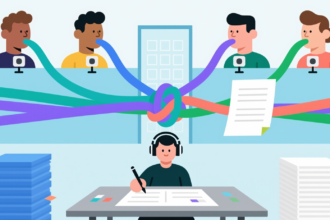
Web 2.0 is now fully entrenched in internet culture—it marked the shift from static, mostly read-only web pages to the interactive and social web, with increased user involvement, easily accessible multimedia (YouTube, streaming etc) and mobile support.
What will come to define Web 3.0 is yet to be determined. Many people want to use the term for marketing purposes, but there has yet to be a mass-adopted breakthrough in technology that fundamentally changes the way the web functions like we saw with Web 2.0.
There are, however, several likely possibilities that could merge together, including artificial intelligence and the ‘semantic web’, the ‘ever-present web’ and the decentralized web powered by blockchain technology.
All of this will have implications on how data is accessed, shared, and handled. Let’s have a closer look.
More Read
The Semantic Web
While it won’t necessarily change the way data is collected and stored and the rules on privacy, a ‘semantic’ and artificially intelligent web will change how web users find data and what data they do find.
The idea is to evolve from basic keyword searches and to assign deeper meaning to queries. It is about understanding the intent of a search, taking in to account the language around the keywords, and to provide more personalized results. It also aims to better understand the relationship between queries.
It’s the realization of what most people assumed Ask Jeeves was, when in reality Jeeves never answered questions directly.
Today a Google search for “who is the dancer in the chandelier video?” doesn’t just return results for dancers and chandeliers or the chandelier video itself, but knows the answer is Maddie Ziegler and that she starred in “the 2014 video for ‘Chandelier’ by Sia, who discovered her on Dance Moms” — showing this snippet from Wikipedia.
It’s a direct response to the question with other relevant information.
Coupling this with natural language processing, in Web 3.0, computers will understand information like humans and as more search data is collected, the AI gets better at interpreting what searchers are actually looking for. Goodbye spam results.
The Always Present Web
Another element of the emerging Web 3.0 is the ‘ever-present’ web and the encompassing range of interconnected devices. We no longer just go to our desktop PCs to access the traditional web with a web-browser.
Our TVs and music devices are hooked up for streaming, we carry smartphones around at all times (some people have smart watches), we use these to pay for goods, check-in to flights and hotels, and manage appliances in our homes; our cars are full of interconnected tech and some are even driverless and everything from our health and fitness to our finances are tracked by apps. (Need to fund your purchase of new smart devices? ElcLoans can help you find loans the same day.)
The web is present in everything we do. This also means the exponential growth in data and the creation of extremely accurate and extensive data-based profiles of everything individuals do.
Democratic and Decentralized Data Sharing
If the idea of data being held about everything from your Netflix viewing to the speed you drive worries you, then the vision of a democratic Web 3.0 might be the solution.
Blockchain technology that emerged with Bitcoin has allowed individuals to take part in private and secure decentralized networks. This can facilitate cryptocurrency transactions, but any kind of data can be stored in the ledger.
Many of the applications we currently use, while agreeing to share our personal data, have been emulated on decentralized ‘crypto’ platforms that keep your information private and no central entity has control.
There are Storj and FileCoin for storage, Experty.io for Skype-style calling, Status for messaging, Akasha or Steemit for social media, Brave for web-browsing, and even emerging operating systems like Essentia.one and EOS to replace iOS and Android.
The brilliance of Essentia is that it unifies all these separate apps with one encrypted key. If you do want to share your personal data with companies, blockchain technology looks to facilitate this in a fair marketplace where the individual is compensated.
Datum is an early example of this and boasts that: “Individuals are in control of their data: how much gets shared and with whom,” and “Developers get built-in security and privacy features saving time and money.”
Exactly how all of this will play out is not clear, but our shift to Web 3.0 is certainly on the horizon! What do you think will define Web 3.0 and how it will handle data? Let us know in the comments below.