We use cookies, including third-party cookies from Google to serve personalized ads through AdSense, to operate this site and understand how it is used. By continuing to browse, you accept this use. See our Privacy Policy and Terms of Use for details, including how to opt out of personalized advertising.
Accept
SmartData CollectiveSmartData Collective
  • Analytics
    AnalyticsShow More
    chatgpt image jul 21, 2026, 04 34 30 pm
    4 Core Benefits of Predictive Maintenance after Vibration Analysis
    10 Min Read
    How Does Data Mining Boost Customer Satisfaction in Logistics? Harnessing Analytics for Results -- AI-generated illustration
    How Does Data Mining Boost Customer Satisfaction in Logistics? Harnessing Analytics for Results
    11 Min Read
    chatgpt image jul 13, 2026, 04 23 45 pm
    How Data Analytics Helps Companies Improve User Engagement
    19 Min Read
    chatgpt image jul 13, 2026, 03 59 46 pm
    How Data Analytics Improves Multi-Location Search Strategies
    10 Min Read
    cybersecurity efforts
    How Behavioral Analytics and AI Are Redefining Cybersecurity for Boca Raton Businesses
    14 Min Read
  • Big Data
  • BI
  • Exclusive
  • IT
  • Marketing
  • Software
Search
© 2008-25 SmartData Collective. All Rights Reserved.
Reading: Governing Data vs Governing People
Share
Notification
Font ResizerAa
SmartData CollectiveSmartData Collective
Font ResizerAa
Search
  • About
  • Help
  • Privacy
Follow US
© 2008-23 SmartData Collective. All Rights Reserved.
SmartData Collective > Big Data > Data Quality > Governing Data vs Governing People
Data Quality

Governing Data vs Governing People

GwenThomas
GwenThomas
4 Min Read
Governing Data vs Governing People
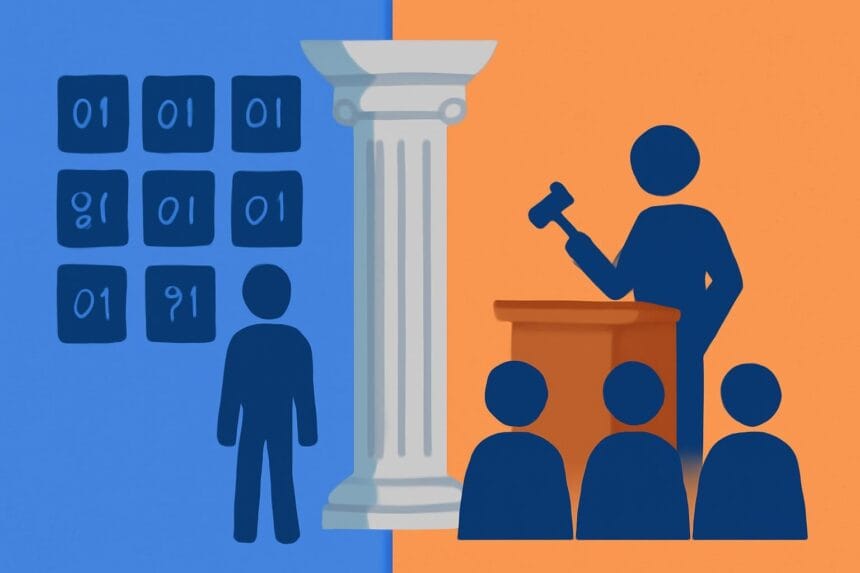
Illustrative image generated with OpenAI gpt-image-1.
SHARE

My friend David Plotkin, who is the Data Governance Manager of AAA of Northern California, Nevada, and Utah, reached out to me recently to restate something I’d said last summer at the MIT Information Quality Industry Symposium. He asked me to tell him again what I’d said about data governance not being about governing data at all.

I don’t know about you, but I’ve slept a whole lotta times since last July. That’s a whole lotta forgetting. But his comment struck a bell – it sounded like something I’d say, but it also sounded like only part of the equation.

So I wrote back about the difference between Big G Governance (people-focused activities such as setting policy, priorities, decision rights, control specifications, etc) and little g governance  (data-focused activities such as implementing and monitoring controls). (Spoiler alert: this meme features strongly in the DGI Data Governance Framework update, to be released in the coming weeks.)

Thanks, David said. But not what our previous discussion was.

More Read

The Importance of Cleaning Up Your Dark Data
Gaining an ‘Unfair Advantage’ with Predictive Analytics
Process & Quality Improvement Change Meme
5 Powerful Ways Retailers Can Leverage Big Data and Hadoop
Data Quality and the Cupertino Effect

David has one of the most important qualities of a Data Governance Manager: gentle persistence. He makes you want to do what is right, and he makes it easy to see what is right. Without ever telling me how he was going to use this new meme, he let me know that he was going to use it, that it would be very useful in an important situation. He made me imagine the impact, knowing that I’d want to help if I could.

So I dug through my memories (argh!!!) until I remembered the context and then the content, and I answered him. I’ve included the answer below. But first, a request: Please help me fill in some blanks. What else do we do to/with/for data that needs to be controlled? Does a list of verbs exist that we can access?

Is Data Governance really about governing data?

Well, on the one hand, we need to control data. hence, the “little g” view that data governance is about governing – or controlling – data.

On the other hand, data doesn’t do much of anything on its own. It behaves according to the choices people have made about how it is to be structured, stored, moved, duplicated, reshaped, contained, labeled, categorized, accessed, shared, protected, distributed, hidden, indexed, transformed, extracted, loaded, captured, collected, accepted, rejected, validated, specified, created, updated, deleted, and so on.

The human side of data governance is about agreeing to the rules and rules of engagement that people (managers, architects, data workers, others) adhere to as they translate policy to practice, designing, implementing, and monitoring data-related controls. It is this human side of data governance that tends to require the attention of our data governance managers, because if we don’t work past human obstacles, we won’t suceed in effectively addressing the “physics” of controling data itself. 

TAGGED:government
Share This Article
Facebook Pinterest LinkedIn
Share

Follow us on Facebook

Latest News

Best VMware Alternatives in Thailand for Private Cloud and HCI Deployments -- AI-generated illustration
Best VMware Alternatives in Thailand for Private Cloud and HCI Deployments
Cloud Computing Exclusive IT
Using Safety Metrics and Incident Data to Reduce Construction Risk and Insurance Costs -- AI-generated illustration
Using Safety Metrics and Incident Data to Reduce Construction Risk and Insurance Costs
Big Data Exclusive
How Business Intelligence Can Help Small Businesses Build Better Decision Rules -- AI-generated illustration
How Business Intelligence Can Help Small Businesses Build Better Decision Rules
Business Intelligence Business Rules Exclusive
Stellar Repair for MS SQL Review: Can It Repair SQL Databases? -- AI-generated illustration
Stellar Repair for MS SQL Review: Can It Repair SQL Databases?
Exclusive Software SQL

Stay Connected

1.2KFollowersLike
33.7KFollowersFollow
222FollowersPin

You Might also Like

Big Data Fights Crime: The FBI’s Next Generation Identification
AnalyticsData MiningData WarehousingSecurity

Big Data Fights Crime: The FBI’s Next Generation Identification

4 Min Read

4 Benefits for the Public Sector when Governments Start Using Big Data

8 Min Read
How to Innovate in a Bureaucratic Culture
Best PracticesBusiness RulesCulture/LeadershipInside CompaniesPolicy and Governance

How to Innovate in a Bureaucratic Culture

4 Min Read
PAW: The High ROI of Data Mining for Innovative Organizations
Data MiningPredictive Analytics

PAW: The High ROI of Data Mining for Innovative Organizations

9 Min Read

SmartData Collective is one of the largest & trusted community covering technical content about Big Data, BI, Cloud, Analytics, Artificial Intelligence, IoT & more.

Chatbots and SEO: How Can Chatbots Improve Your SEO Ranking?
Artificial Intelligence Chatbots Exclusive
The Art of Conversation: Enhancing Chatbots with Advanced AI Prompts
Chatbots

Quick Link

  • About
  • Contact
  • Privacy
Follow US
© 2008-26 SmartData Collective. All Rights Reserved.
Welcome Back!

Sign in to your account

Username or Email Address
Password

Lost your password?