
We use cookies, including third-party cookies from Google to serve personalized ads through AdSense, to operate this site and understand how it is used. By continuing to browse, you accept this use. See our Privacy Policy and Terms of Use for details, including how to opt out of personalized advertising.
Accept
SmartData CollectiveSmartData Collective
  • Analytics
    AnalyticsShow More
    What Kind of Problem-Solving Distinguishes Data Analysts From Software Engineers -- AI-generated illustration
    What Kind of Problem-Solving Distinguishes Data Analysts From Software Engineers
    7 Min Read
    chatgpt image jul 21, 2026, 04 34 30 pm
    4 Core Benefits of Predictive Maintenance after Vibration Analysis
    10 Min Read
    How Does Data Mining Boost Customer Satisfaction in Logistics? Harnessing Analytics for Results -- AI-generated illustration
    How Does Data Mining Boost Customer Satisfaction in Logistics? Harnessing Analytics for Results
    11 Min Read
    chatgpt image jul 13, 2026, 04 23 45 pm
    How Data Analytics Helps Companies Improve User Engagement
    19 Min Read
    chatgpt image jul 13, 2026, 03 59 46 pm
    How Data Analytics Improves Multi-Location Search Strategies
    10 Min Read
  • Big Data
  • BI
  • Exclusive
  • IT
  • Marketing
  • Software
Search
© 2008-25 SmartData Collective. All Rights Reserved.
Reading: The Economic Impact of Cloud Goes Beyond Business Cost Savings
Share
Notification
Font ResizerAa
SmartData CollectiveSmartData Collective
Font ResizerAa
Search
  • About
  • Help
  • Privacy
Follow US
© 2008-23 SmartData Collective. All Rights Reserved.
SmartData Collective > IT > Cloud Computing > The Economic Impact of Cloud Goes Beyond Business Cost Savings
Cloud Computing

The Economic Impact of Cloud Goes Beyond Business Cost Savings

Anand
Anand
4 Min Read
The Economic Impact of Cloud Goes Beyond Business Cost Savings
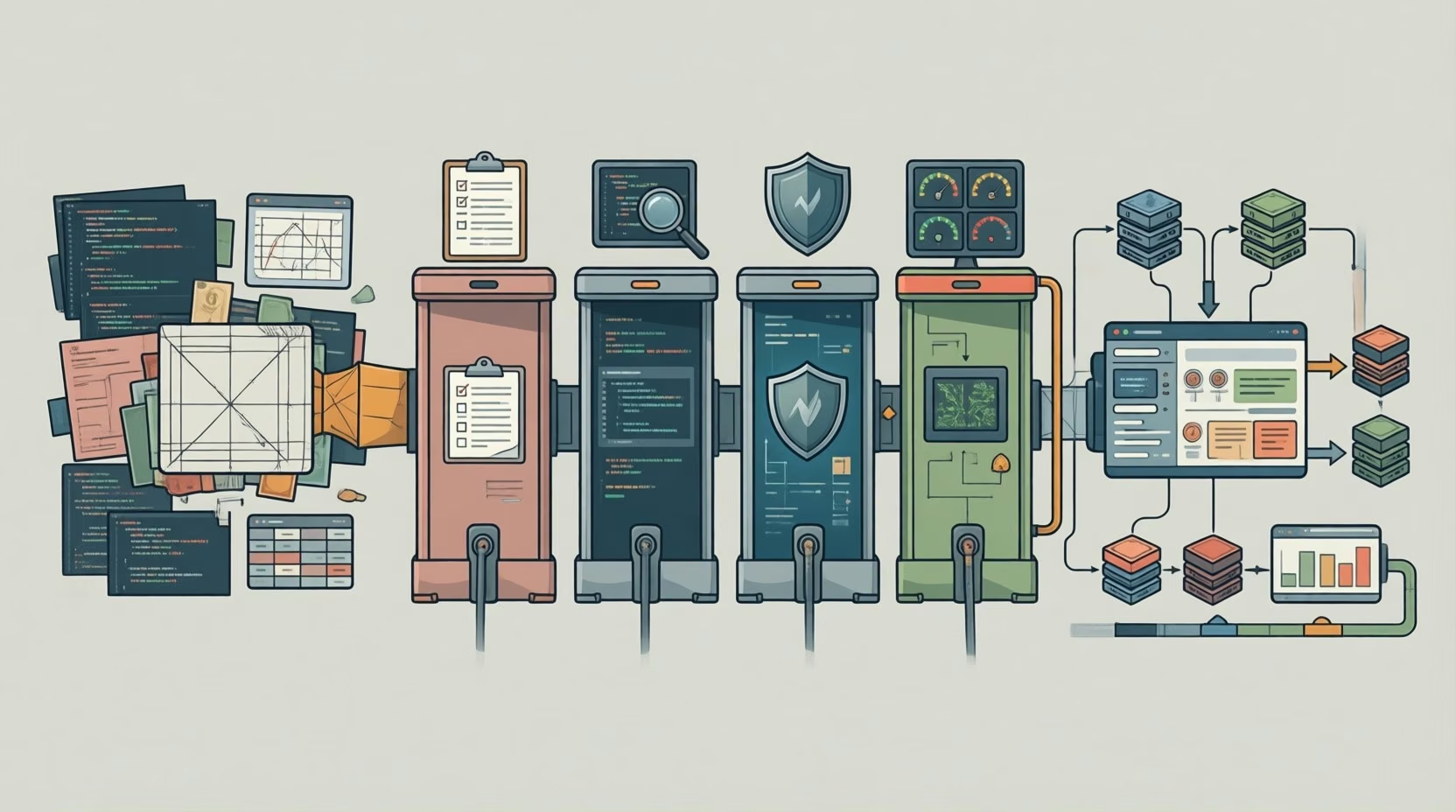
Illustration generated with Qwen Image.
SHARE

RingCentral published a report last year in conjunction with Forrester that looked into the economic impact of adopting cloud.

RingCentral published a report last year in conjunction with Forrester that looked into the economic impact of adopting cloud. According to the study, enterprises, with an average size of 600 employees, tend to save as much as $512,000 over PBX systems, another $95,200 over CRM system integration and could potentially increase revenue by as much as $5.3 million. 

Discussions about the benefit of cloud inevitably talk about the amount of savings that businesses could enjoy through the migration process. Traditional network and data systems require a huge amount of capital expenditure, not to mention the inefficiencies that come with handling these processes. With cloud, the barrier to entry is considerably reduced. As a result, even small businesses today can think of achieving operational efficiencies that were hitherto available only to large businesses. But, the economic impact of cloud adoption goes way beyond just these cost savings. Here are some more economic benefits that cloud computing brings. 

Waste Reduction : 

More Read

Datameer Provides End-user Focused BI Solutions for Big Data Analytics
Building Resilience Strategies to Overcome Cloud Security Issues
The Magic of Moving to Managed Services
AWS IoT Button: Introduction
How The Cloud Can Be Useful In Supply Chain Logistics

An increase in use of cloud services come with a commensurate reduction in conventional technologies. Take the electronic signature industry, for instance. According to an estimate by the Legal Marketing Association of USA, there are close to 1.1 million attorneys in the country, and their per capita consumption is 1000 pounds of paper per year. With an increasing awareness of eSignatures, the amount of resources that the economy wastes in producing paper comes down dramatically. Similar benefits are brought about the growing number of cloud-based services for documents, photos and music. 

Efficiency Through Consolidation Of Labor 

There is often a misconception that cloud computing brings down the number jobs in the organization. This is partly true since a good number of workers employed for managing IT may no longer be required. However, truth is that there is merely a consolidation of labor. Cloud and SaaS does not change the technological aspects of a product – it only changes the way it is delivered. Consequently, people are still required to manage networks and handle software – except that they are now employed by the cloud service providers and not by the individual companies. This is consolidation of labor that is good for the individual workers as well as the businesses involved. 

More Jobs 

There is no doubt that cloud computing brings about an increase in job opportunities. Just a cursory look at the software engineering job positions will tell you the number of positions that have been created due to the cloud. But we are barely scratching the surface here. As noted earlier, cloud computing has lowered the entry barrier for start-ups to do bigger things that earlier required higher capital. What this means is that there is more competition in the industry today. This means better products for consumers, more jobs and overall, a healthier economy.

This is not all. All cloud computing products and services need physical infrastructure to operate. This implies greater demand for the raw materials, assembling labor and in totality, an overall growth for the supply chain system involved. Research agencies in the industry would do good if an overall economic impact study report is published to analyze the positive implications of cloud computing. Until then, we are bound to see articles like these blaming cloud computing for the economy.

Share This Article
Facebook Pinterest LinkedIn
Share
ByAnand
Follow:
Anand Srinivasan is the founder of Hubbion, a suite of business apps. The Hubbion Project Management app was ranked among the top 20 in its category for 2017 by Capterra.

Follow us on Facebook

Latest News

Flat editorial illustration: The article's core relationship is the engineering transition from an AI prototype to a production-r
From AI Prototype to Production: Observability and Scalability Requirements for Data-Heavy SaaS Applications
Artificial Intelligence Exclusive
Preparing Data Systems and Governance for a Scaling Global Gaming Brand -- AI-generated illustration
Preparing Data Systems and Governance for a Scaling Global Gaming Brand
Big Data Infographic
How Restaurant POS and Ordering Data Reveal Generational Customer Patterns -- AI-generated illustration
How Restaurant POS and Ordering Data Reveal Generational Customer Patterns
Exclusive Infographic
From Trucks To Data: How Telematics Can Improve Freight Transportation -- AI-generated illustration
From Trucks To Data: How Telematics Can Improve Freight Transportation
Big Data Exclusive Infographic

Stay Connected

1.2KFollowersLike
33.7KFollowersFollow
222FollowersPin

You Might also Like

Enterprise Integration
Cloud ComputingComputingData Management

Why Custom Enterprise Integration Demands Cloud Services

4 Min Read
The Future of Cloud-Based Team Collaboration Software in 2020
Cloud ComputingSoftware

The Future of Cloud-Based Team Collaboration Software in 2020

8 Min Read
Why Is Citrix Becoming So Popular?
Cloud Computing

Why Is Citrix Becoming So Popular?

5 Min Read
What the Sharing Economy Means for Cloud Computing
Cloud Computing

What the Sharing Economy Means for Cloud Computing

4 Min Read

SmartData Collective is one of the largest & trusted community covering technical content about Big Data, BI, Cloud, Analytics, Artificial Intelligence, IoT & more.

Artificial Intelligence for eCommerce: A Closer Look
Artificial Intelligence
ai chatbot
How AI Website Chatbots Improve Customer Support and Lead Generation
Chatbots Exclusive

Quick Link

  • About
  • Contact
  • Privacy
Follow US
© 2008-26 SmartData Collective. All Rights Reserved.
Welcome Back!

Sign in to your account

Username or Email Address
Password

Lost your password?