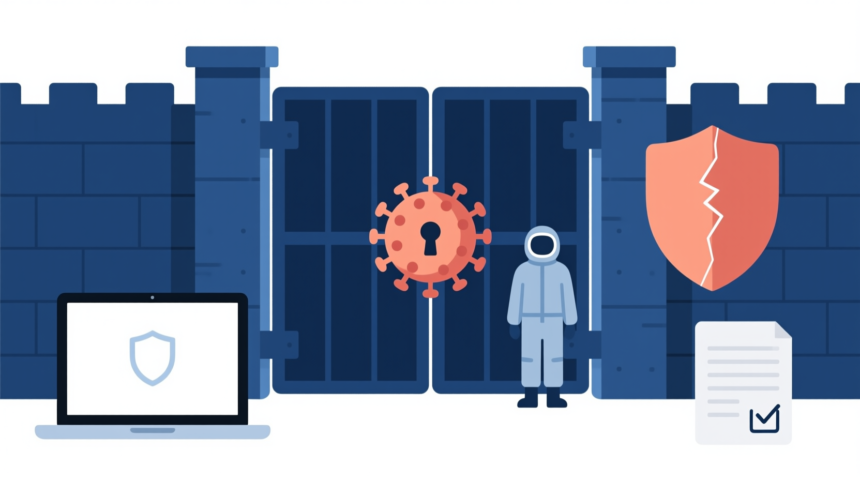
In terms of the coronavirus pandemic, we are all in the same proverbial boat. At this stage there is an insufficient amount of data concerning the health risks, so we must all take the same precautions for our own safety and for the safety of others around us. We are also required to follow the same restrictive measures that attempt to contain or mitigate the spread of the virus. This is at the very least an economic burden for most businesses, with some exceptions.
At this time of global crisis many people have shown a charitable side, through offering services for free or doing things to help others whose needs are greater. Unfortunately, this is not always the case, and the disease that is cybercrime has even shown signs of increasing in the time of COVID-19. This is a cruel turn of fate for communities that are already stricken with the greatest health and economic crisis of the modern era.
EC-MSP, a cybersecurity company based in London, recently published an infographic that has already identified the UK capital as a global hotspot for this new form of crime. To minimise the risks that every organisation is vulnerable to, decision makers should seek expert assistance as an essential precaution.
An unexpected increase in cybercrime
At the end of March, the European Commission President, Ursula von der Leyen, warned in a video message that cybercrime will pose a greater threat to EU citizens. She explained this to be due to more people working from home, and more time being spent online. In addition to this are the new methods of cyber criminals that exploit fears relating to the novel coronavirus. Sadly, crime has not lowered in the wake of the pandemic, and European agencies are also fighting against the trafficking of counterfeit COVID-19 medicines.
More Read

The World Health Organisation (WHO) has warned of the malicious links in emails claiming to be from the WHO. There are many attempts to steal money and data that take advantage of the global pandemic crisis. The WHO itself has also been subject to increased cyber-attacks since the beginning of the coronavirus outbreak.
Medical centres and hospitals have also been the target of cyber-attacks during this time of the coronavirus pandemic. Most of these have been ransomware attacks, which could be extremely damaging. The personal and medical information of thousands of patients of the Hammersmith Medicines Research (HMR) was leaked in March, after the organisation refused to make a payment to the criminal Maze group. In the worst cases, such cyber-attacks can slow down medical resources and cost lives.
For the millions of people who are now forced to work from home, cybersecurity teams are faced with new and greater challenges. There are two major difficulties to overcome in the recent changes. One of these is to ensure the working from home arrangements are completely secure. The other is that consumer-facing network traffic follows the usual standards of confidentiality, integrity and availability (CIA), as extra time at home is causing volumes to surge. Business leaders have found that it is necessary to make changes in their approach to cybersecurity.
Advisable cybersecurity measures
Securing the new working environments and supporting the higher levels of consumer facing traffic should be high priorities for businesses. Here are some of the ways that these can be achieved.
Resilient business processes
- Business processes are not usually aimed at supporting work from home. For this reason, remote working tools need to be completely secured.
- Companies must support incident response and disaster recovery plans, which is possible through remote collaboration and communication tools.
- Home monitoring systems need to be established, and third-party vendors must be secured.
Ensure technological controls are in place
- Security measures like VPNs and multi-factor authentication (MFA) may be necessary to secure a home office.
- Security teams should also review the use of shadow IT and the processes that depend on it. If it is no longer available then a considerable disruption may be caused.
- The use of cloud-based virtualisation could be a workable solution, as these can be easily implemented.
Employee communicate and education
- As is always the case, employees should be made aware of the security risks and the importance of security measures. This includes an awareness of the increased COVID-19 phishing attempts.
- Clear communication is important in reducing security risks, so communication channels and tools must be put in place.
Standardise security processes
- Companies can offer guides for the consumer that explain how to deal with access problems. This is one way of addressing the interruptions to content access.
- Businesses that support financial transactions can integrate fraud analytics with security team workflows for faster inspection and remediation.
- With an increased number of security tools in place for the rise in traffic, security teams must account for the extra security costs.
Make capacity sufficient
- To account for higher traffic and transaction volumes, measures such as SSL certification, a web-application firewall, anti-distributed denial of service, network monitoring and fraud analytics should be in place.
- Web-facing threat intelligence monitoring can be heightened by running tests like passive domain name scans.
- Capacity management can be improved by monitoring application performance for malware and recommending the removal of non-essential features.
COVID-19 has caused a major disruption to life everywhere in the world, and also to business. But cybercrime must not be allowed to thrive in this period of uncertainty. To make sure this doesn’t happen, security protocols must be reinforced, and all potential vulnerabilities avoided.