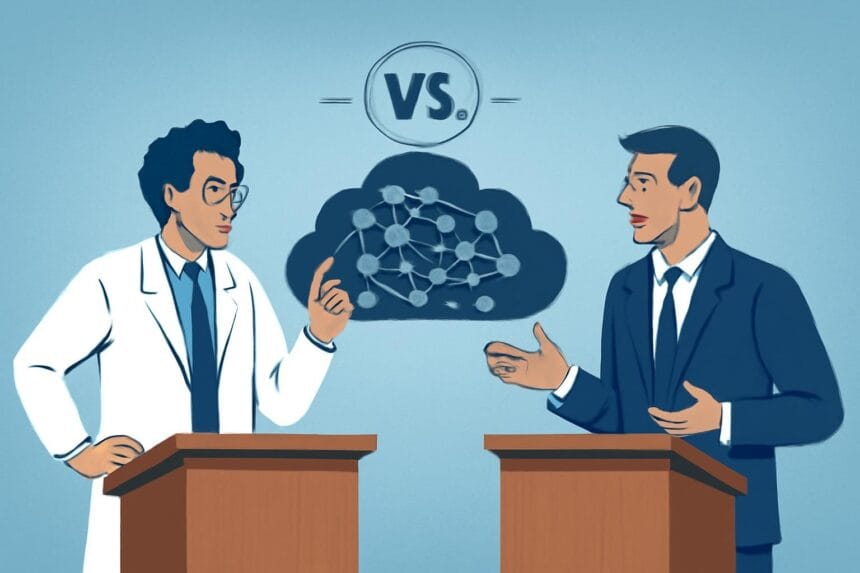
In a recent #GartnerChat, we saw the haute job title “data scientist” meet with some skepticism. Our own Brett Stupakevich (@Brett2Point0) said that “ideally end users should be empowered to explore their own data and seek their own insights through self-service.” Gartner analyst Carol Rozwell (@CRozwell) had a similar take. She wrote, “Shouldn’t the average person be able to derive value from data . . . [even though] some people refuse to see the truth in data?”
Ted Friedman (@tedfriedman), another Gartner analyst, called the job title “a little bit elitist,” despite the emphasis on analytics roles. However, Esteban Kolsky (@ekolsky) said the term “scientist is not elitist; it defines a specific role.”
While the jury is still out on whether you need highly trained scientists to empower your data no matter how big it is, one thing is clear – there’s a focus on analytics and to be competitive, companies need to focus on their data analytics strategies.
You can find a full recap of this Gartner Chat on big data here.
More Read

Are There Real Data Scientists?
It’s clear that education is still catching up to the rapidly emerging technologies in the analytics space and that there is a talent shortage. So, after this chat, we looked around to see if there was a clear definition of data scientist. We came across this list called “The PhenomList of Big Data Scientists.”
This site pulls together a list of the top talent and interesting personalities behind tech products. The authors of the site hope to showcase pros you may not know and to give “young engineers and entrepreneurs” role models. What a noble cause – to make geek cooler for a new generation. And it’s necessary because it’s where the jobs are, especially for Generation Y.
If we were going to put a label on these five data pros, we’d have to lean toward scientist. Each of them has an advanced education – some with PhDs or extended graduate work – in a scientific or research discipline. And a common thread is that each of them has experimented in his or her field to find the right fit. Not a single one got started at a huge tech company. They all took advantage of opportunities – often with startups – in academia or in the public sector. But the thing that truly defines them as scientists is that they use analytics to derive value from the data.
The Top Five Data Scientists
Amy Heineike (@aheineike) – A transplant to the US, Heineike once studied math at Cambridge and is “on leave” from a PhD program at George Mason University. She joined intelligence software startup Quid as its first employee and director of mathematics. Her current work is to “cluster algorithms to quickly understand the trends within a space.” The coolest thing about this data scientista – she and her husband “fell in love over mathematics.”
Michael Driscoll (@medriscoll) – The biodata scientist (he got his start in bioinformation) turned marketing data scientist once sold T-shirts online while in grad school and is now CEO of Metamarkets, an analytics startup in the online media marketing space. Driscoll’s focus in big data is on data visualization. He says that the key to data is asking how we can take “information and make better businesses, better decisions and better products.”
DJ Patil (@dpatil) – A guy who once considered himself a “math dunce” and who had to petition his way into the University of California at San Diego is now the data scientist in residence at Greylock, the venture capital firm behind companies like Facebook, LinkedIn and Pandora. He’s been featured on our monthly Twitter roundup before and has a cool name and very cool job. Patil worked on big data projects at eBay, PayPal, Skype and LinkedIn before turning to “advising portfolio companies on how to think about data.”
Chris Diehl (@chrisdiehl) – The only data scientist at Jive Software, a communication and collaboration software company, Diehl once wrote a letter to the CIA because he wanted to work in intelligence. They sent him a brochure, but he was too young to apply. Although he never went to work for the CIA, Diehl ended up with a career that began at another organization with an equally impressive acronym – the Defense Intelligence Agency (DIA). After working with the DIA and earning a PhD, Diehl worked in various research roles and recently settled in at Jive. His passion is “math and statistics.” And he says “he can’t get enough of that.”
Peter Skomoroch (@peteskomoroch) – The principal data scientist at LinkedIn, Skomoroch got his start in data science in a real science lab studying lizards’ visual systems. A science fair geek turned data pro; he first studied neurology and biology before switching majors to math and physics at Brandeis University. He went on to do graduate work at MIT and then worked with AOL on the company’s search analytics team and started a blog/consultancy called Data Wrangling. Now, he works at LinkedIn on projects such as Skills. His burning question is “How can data tell us who we are?”
Next Steps: Read the full interviews and tweet us your take on the role of the data scientist.
Amanda Brandon
Spotfire Blogging Team