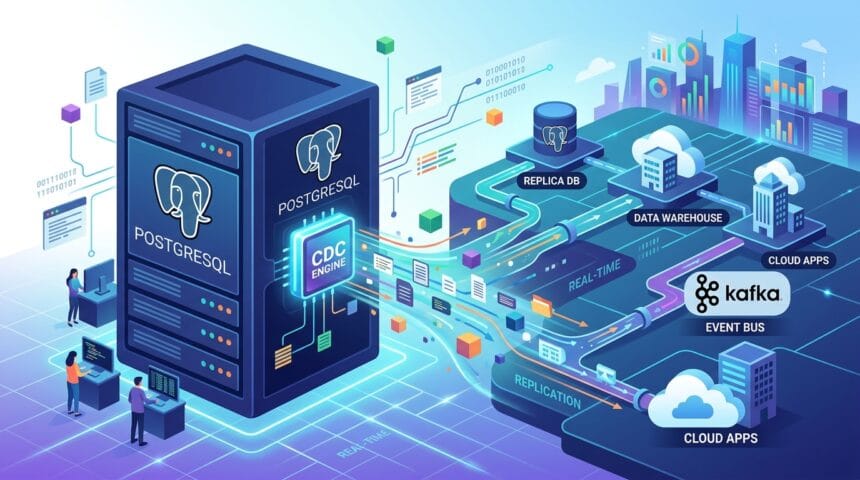
Organizations must treat real-time data flow as a competitive necessity, as the value of operational information decays rapidly from the moment a transaction is committed. Implementing reliable postgres cdc tools allows your team to move information instantly into analytics platforms, machine learning models, or downstream microservices without the traditional latency of scheduled batch jobs.
- At a Glance
- 8 Best Postgres CDC Tools and Software for Real-Time Replication
- 1. Artie
- 2. Debezium
- 3. Airbyte
- 4. Estuary Flow
- 5. Striim
- 6. Fivetran
- 7. AWS Database Migration Service (AWS DMS)
- 8. PeerDB
- Comparing Postgres CDC Approaches
- Why Postgres CDC Has Become the Standard for Real-Time Data Pipelines
- Lower Database Impact
- Real-Time Analytics
- Event-Driven Architectures
- AI and Machine Learning
- Cloud Data Warehouses
- What to Look for in a Postgres CDC Platform
- Frequently Asked Questions
At a Glance
8 Best Postgres CDC Tools and Software for Real-Time Replication
1. Artie
Artie simplifies low-latency PostgreSQL replication by removing the heavy operational lift typically required for pipeline maintenance. The platform utilizes Write-Ahead Log (WAL) streaming to capture every insert, update, and delete, ensuring your data warehousing efforts remain synchronized with production databases.
By automating schema evolution and checkpointing, Artie allows your engineering team to avoid manual fixes when production table structures change. This approach is particularly effective for high-volume environments where reducing database overhead is critical for consistent application performance.
Key features
More Read
- WAL-based PostgreSQL CDC
- Low-latency replication
- Automatic schema evolution
- Reliable checkpointing
- Cloud warehouse integrations
- Fault recovery
- Real-time streaming
2. Debezium
Debezium is an open-source standard for organizations that prioritize control over their event-driven architectures. By integrating directly with Apache Kafka and Kafka Connect, it transforms database transaction logs into a continuous stream of events that your downstream applications can consume instantly.
Because it acts as a lightweight observer, Debezium reads the PostgreSQL WAL to track changes without the high performance costs associated with traditional query-based polling. This makes it a preferred choice for companies building custom big data ecosystems where technical teams manage their own infrastructure.
Key features
- Open-source CDC
- PostgreSQL WAL capture
- Kafka integration
- Initial snapshots
- Schema history
- Fault recovery
- Event streaming
3. Airbyte
Airbyte offers an extensive connector library that makes it easy to integrate PostgreSQL with hundreds of different destinations. Its approach to CDC leverages logical replication, which minimizes the resource footprint on your database while ensuring incremental data synchronization remains accurate.
This platform serves teams that need to balance rapid implementation with the flexibility of an open-source framework. It is particularly useful for organizations looking to standardize their analytics workflows across diverse cloud environments.
Key features
- PostgreSQL CDC
- Extensive connector library
- Incremental synchronization
- Cloud deployment
- Open-source option
- Schema updates
- Warehouse integrations
4. Estuary Flow
Estuary Flow prioritizes a streaming-first architecture that treats data movement as a continuous process rather than a series of batch jobs. It enables real-time data replication across complex environments, including operational databases and cloud-based streaming systems.
The platform differentiates itself by allowing for in-flight data transformations during the replication process. Your team can clean, filter, or reformat data before it reaches its final destination, which is essential for maintaining high-quality inputs for downstream predictive analytics models.
Key features
- Streaming-first architecture
- PostgreSQL CDC
- Continuous replication
- Managed pipelines
- Data transformations
- Monitoring
- Multiple destinations
5. Striim
Striim provides an enterprise-grade platform specifically designed for mission-critical IT environments where downtime is not an option. It combines streaming ingestion and continuous processing, allowing you to synchronize PostgreSQL data while simultaneously performing complex analytical operations.
This tool is built for heterogeneous environments, helping organizations that need to bridge the gap between legacy systems and modern cloud services. It is a powerful choice for digital transformation initiatives where you must maintain synchronization between various databases and cloud messaging platforms.
Key features
- Enterprise CDC
- PostgreSQL replication
- Streaming integration
- Continuous processing
- Monitoring
- High availability
- Cloud connectivity
6. Fivetran
Fivetran stands out for its “set it and forget it” philosophy, providing a fully managed service that handles the entire replication lifecycle. For teams looking to eliminate the burden of infrastructure management, it automates connector configuration, schema drift detection, and monitoring for PostgreSQL pipelines.
By delegating the technical complexities of data integration to a managed provider, your engineers can focus on building value from the data rather than fixing broken pipelines. It is a highly reliable option for scaling data operations without needing a dedicated team to monitor daily pipeline health.
Key features
- Managed CDC
- Automated connectors
- PostgreSQL replication
- Schema adaptation
- Incremental sync
- Cloud warehouses
- Operational simplicity
7. AWS Database Migration Service (AWS DMS)
AWS Database Migration Service provides deep integration with the Amazon Web Services (AWS) ecosystem, making it the natural choice for organizations already committed to the platform. It supports continuous replication, ensuring your data remains in sync during migrations to Amazon Redshift, Aurora, or S3.
Since the service is managed by AWS, it offers high compatibility with native security and networking controls. This allows your team to handle complex, large-scale migrations or hybrid-cloud deployments while benefiting from the reliability of managed infrastructure.
Key features
- Continuous replication
- PostgreSQL logical replication
- AWS integration
- Managed infrastructure
- Migration support
- Multiple destinations
- Monitoring
8. PeerDB
PeerDB is a specialized tool built specifically for high-performance PostgreSQL-to-warehouse replication. By focusing narrowly on this use case, it provides a highly optimized architecture that minimizes replication lag compared to more generalized tools.
This platform is ideal for Business Intelligence teams that require low-latency dashboards and want to avoid the overhead of complex, multi-purpose integration platforms. Its open-source nature provides transparency, while its focus ensures it performs exceptionally well for analytical workloads.
Key features
- PostgreSQL-native CDC
- Warehouse replication
- Low-latency streaming
- Open-source platform
- Incremental synchronization
- WAL-based capture
- Analytics optimization
Comparing Postgres CDC Approaches
While many platforms offer similar core features, the underlying architectural choices significantly impact how your pipeline handles failure recovery and schema evolution. Choosing the right tool depends on your specific requirements for data freshness and operational maintenance.
Why Postgres CDC Has Become the Standard for Real-Time Data Pipelines
Traditional batch-based ETL processes are no longer sufficient for modern businesses that rely on immediate insights. According to a 2023 Gartner prediction, 60% of enterprise data integration platforms will include CDC capabilities by 2026, highlighting its transition into a core engineering requirement.
Lower Database Impact
Polling databases creates unnecessary read workloads that compete with user traffic. By contrast, CDC reads the Write-Ahead Log, allowing your system to capture changes without repeatedly scanning tables.
Real-Time Analytics
Modern BI dashboards require live operational data to be useful. CDC ensures your analytics platforms receive updates immediately after a transaction is committed.
Event-Driven Architectures
Publishing database changes to messaging systems allows your downstream services to react to business events as they happen. This architecture improves responsiveness across your entire technology stack.
AI and Machine Learning
Models for fraud detection and recommendation engines perform best when fed with up-to-the-second data. Continuously refreshed feature stores prevent stale information from degrading your predictive performance.
Cloud Data Warehouses
Platforms like Snowflake, BigQuery, Databricks, and Redshift now support high-frequency streaming. Using CDC lets you maintain these warehouses without disrupting your primary production database performance.
What to Look for in a Postgres CDC Platform
Selecting the best tool requires evaluating more than just price or brand recognition. Focus on these critical factors to ensure long-term stability.
- WAL-Based Replication: Prioritize tools that read the transaction log natively to reduce database performance bottlenecks.
- Exactly-Once Delivery: Ensure the platform handles retries without creating duplicate records in your destination systems.
- Schema Evolution: Select platforms that handle automatic column additions and type changes to avoid manual pipeline fixes.
- Fault Tolerance: Verify that the tool includes robust checkpointing so it can resume after network interruptions without data loss.
- Observability: Look for built-in monitoring that alerts you to replication lag or throughput degradation before they become business-critical issues.
Frequently Asked Questions
What is PostgreSQL Change Data Capture?
PostgreSQL CDC is a technique that captures database inserts, updates, and deletes by reading the PostgreSQL Write-Ahead Log. It provides a real-time stream of committed transactions for downstream systems with minimal performance impact on the production database.
Why is WAL-based CDC preferred over polling?
Polling requires repeatedly querying your database tables, which creates significant load and introduces latency. WAL-based capture reads the database transaction log directly, ensuring that changes are recorded immediately with minimal resource consumption.
How does replication lag affect data pipelines?
Replication lag is the time delay between a transaction committing in PostgreSQL and appearing in your downstream destination. For AI workloads or fraud detection, minimizing this lag is vital, as data that is even a few minutes old may lead to incorrect decisions or outdated reporting.
As you evaluate your options, focus on selecting postgres cdc tools that prioritize both operational ease and high-scale performance. The ability to maintain reliable, real-time data replication is no longer a technical luxury, but a fundamental requirement for staying agile in a competitive market.