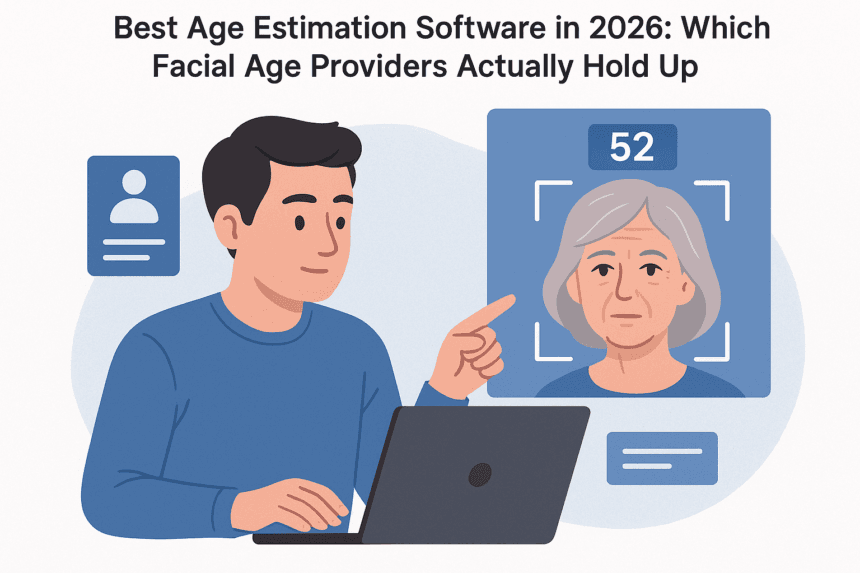
Age estimation software is now a practical way to reduce friction at age gates without asking every adult customer for an identity document. The strongest systems use a selfie to estimate age in seconds, then send only borderline cases to a higher-assurance check such as document verification.
- Why Age Estimation Software Needs Its Own Evaluation Criteria
- What Actually Matters When Comparing AI Age Verification Platforms
- Five Age Estimation Software Platforms Worth Evaluating
- Frequently Asked Questions
- What is the difference between age estimation software and age verification software?
- Can facial age estimation replace ID checks?
- What is a challenge age?
- How should a business assess fairness in AI age verification?
- One Thing to Check Before You Sign
Age verification and age estimation are not the same thing, although vendors often blur the terms. Age verification confirms a date of birth from evidence such as a government document; facial age estimation predicts an apparent age from a face. That distinction matters as platforms respond to age-assurance rules, especially in the United Kingdom, where Ofcom expects services to use methods that are technically accurate, robust, reliable, and fair.
Asking every visitor for a government ID can hurt completion rates. A selfie-first flow creates less friction, but it is still a probability-based decision. That is why facial age estimation has become a specialist category rather than a minor feature inside document verification.
Here is what five providers actually offer, where their claims are supported, and which differences should change your shortlist.
More Read

Why Age Estimation Software Needs Its Own Evaluation Criteria
Facial age estimation does not produce a birth date. It produces a predicted age and an error range, usually expressed as Mean Absolute Error (MAE), which is the average number of years the model misses by.
A model with a two- or three-year MAE across all ages can still be weak where legal decisions are made. The critical range is usually between ages 16 and 20, where thresholds such as 13, 16, 18, and 21 sit close together. A provider can show a strong average result while still estimating a meaningful number of 17-year-olds as adults.
Independent testing matters more here than in most identity categories. The National Institute of Standards and Technology (NIST) Face Analysis Technology Evaluation (FATE) measures age-estimation performance across image quality, age, sex, and region of birth; its first modern assessment found that average error on a shared visa-photo dataset had improved from 4.3 years in 2014 to 3.1 years in 2024, but it also found no single algorithm that led in every condition.
The UK Age Check Certification Scheme (ACCS) is another useful reference, particularly for teams serving the UK market. Vendor accuracy claims still have value, but they should not carry the same weight as a published independent result. No facial system can turn a selfie into a birth certificate.
The 16-to-30 range remains difficult because visual differences between adjacent ages are often subtle. A sensible age assurance software flow uses a challenge age, or buffer, rather than trusting a single threshold. For an 18+ service, a model that could overestimate a teenager by several years may need to route people estimated at 25 or younger to a stronger check.
Bias is another issue that needs direct scrutiny. NIST found that age-estimation results can vary by image quality, age, sex, region of birth, and interactions between those factors. A credible provider should show results by demographic group and age band, not just one blended accuracy figure.
Finally, no facial age estimation model should be the only line of defense. The real product test is what happens when an estimate is inconclusive or falls inside the buffer around a legal threshold.
What Actually Matters When Comparing AI Age Verification Platforms
Every vendor can demonstrate a quick estimate on an obviously adult face. Your shortlist changes when you look at seven less glamorous details:
- Independent accuracy validation. Has the model been assessed through NIST FATE, the UK ACCS, or another credible third-party program, or is the result only vendor-reported?
- Accuracy at the legal threshold. A low overall MAE is useful, but performance around ages 16 to 20 is more important for most regulated services.
- The escalation path. Does a borderline result trigger document verification, human review, another age-assurance method, or a hard block?
- Friction versus certainty. Selfie-only estimation is fast but probabilistic. Document-backed age verification software is slower but can confirm a date of birth.
- Bias testing across demographics. Look for results by skin tone, gender, geography, and age band rather than a single headline number.
- Standalone specialist versus bundled module. A dedicated provider may be simpler for age assurance alone, while a broader know-your-customer platform may suit teams that also need identity and fraud controls.
- What happens to the selfie afterward. Your team should confirm retention, deletion, access controls, and processor obligations before launch. Biometric data policies matter as much as model speed.
For a broader view of how biometric systems influence commercial analysis, see Smart Data Collective’s coverage of big data and facial recognition tools.
Five Age Estimation Software Platforms Worth Evaluating
iDenfy
iDenfy positions age estimation as the first step in a wider identity workflow. Its main advantage is operational: a selfie-based estimate can move directly into full identity verification when the result falls into a defined buffer, rather than forcing your team to connect separate providers.
iDenfy reports that its flow can convert at least 20% more users than a traditional document-based age check. Treat that as a vendor performance claim, but the product design makes sense for businesses that want a low-friction start and a document-based fallback in the same session.
Pros
- Fast initial decision: iDenfy says clear-cut cases can receive an estimate in under one second.
- Clear outcome model: each check returns SUCCESS, UNDERAGE, or UNCERTAIN, so a borderline user is not forced into an artificial yes-or-no result.
- Liveness detection: active prompts and passive signals are designed to identify presentation attacks involving photos, screens, and manipulated media.
- Automatic escalation: UNCERTAIN cases can move to document verification with date-of-birth extraction in the same user journey.
- Broader assurance stack: ISO 27001, SOC 2, and iBeta ISO 30107 liveness testing strengthen its appeal for teams that need more than a simple age gate.
Cons
- The reported age-estimation accuracy figure is self-reported; no public NIST FATE or UK ACCS result was identified for this specific model.
- Age estimation is an add-on to iDenfy’s larger identity verification platform rather than a fully standalone product.
- Industry tuning for iGaming, alcohol, adult content, and pharmaceutical use cases requires configuration.
A closer look at iDenfy’s age estimation service is worthwhile before a demo, especially for its buffer-zone logic and compliance options.
Yoti
Yoti remains the provider most often used as a benchmark for facial age estimation. Its case is stronger than most because it publishes detailed performance data and participates in independent evaluation.
Pros
- Published age-band results: Yoti’s latest white paper reports a 1.1-year MAE for ages 13 to 17 and a 1.3-year MAE for ages 6 to 12.
- Strong challenge-age performance: Yoti reports that 99.3% of 13-to-17-year-olds are estimated as under 21, while 99.0% of 6-to-12-year-olds are estimated as under 13.
- Independent scrutiny: Yoti has submitted a model to NIST FATE, which makes its results easier to compare with other participating providers.
- Bias transparency: its published materials break out results by age, gender, and skin tone rather than relying only on an overall score.
- No document by default: the flow is designed to estimate age from a selfie without asking for an ID.
Cons
- Pricing is not published and requires a sales conversation.
- Organizations that also need broad document-based KYC and anti-money-laundering controls may need another provider or a separate identity stack.
- Even a low MAE does not remove the need for a documented escalation route around a legal threshold.
Sumsub
Sumsub is built for organizations that want age estimation inside a larger compliance workflow. Its product is less about a standalone facial-age tool and more about routing users through the right level of assurance based on risk and estimated age.
Pros
- Liveness in the same flow: Sumsub says its in-house liveness technology can detect video playback, masks, and deepfake attempts during the age check.
- Configurable buffers: teams can use three-, seven-, or 10-year buffers, making the system more practical for parental-consent, gambling, or adult-content rules.
- Workflow control: its no-code Workflow Builder can route users from a selfie check into document verification when needed.
- Broader platform: age estimation sits alongside document checks, biometric analysis, and database lookups.
- Vendor-reported accuracy: Sumsub advertises 99.8% AI age-estimation accuracy, although the metric and test conditions should be reviewed in a procurement process.
Cons
- No public NIST FATE or UK ACCS accuracy report was identified for the age-estimation model; the 99.8% figure is vendor-published.
- The wider KYC and anti-money-laundering suite can be more platform, implementation effort, and cost than a simple age-assurance deployment needs.
- Its strongest fit is regulated onboarding, gaming, and financial-services workflows; retail and social-platform teams may need more configuration.
Veridas
Veridas brings a face-biometrics background to age assurance, and its ACCS certification gives it a clear place on a UK-focused shortlist. The company frames the product around challenge-age decisions rather than a promise to identify a person’s exact age.
Pros
- ACCS-certified challenge-age approach: Veridas states that its ACCS Challenge 25-certified service identifies people aged 18 or younger as under 25 in more than 99.9% of cases.
- Single-selfie flow: facial age verification can work from one selfie with passive or active liveness proofing.
- Inconclusive outcome: the system can return an inconclusive result when it cannot make a reliable decision, rather than presenting a false certainty.
- Biometric depth: Veridas also offers face recognition, liveness, and digital onboarding tools for organizations that need a broader identity program.
Cons
- Its brand visibility is lower outside Europe and Latin America than Yoti, Sumsub, or Veriff.
- Pricing is not published, and the product is generally sold within Veridas’ broader digital-onboarding portfolio.
- Public workflow documentation is less extensive than that of some platforms built around self-service configuration.
Veriff
Veriff’s age-estimation product is designed around conversion. Obvious adults can complete a biometric selfie check in seconds, while the business decides whether a lower-confidence result should be denied or moved into another verification path.
Pros
- No document by default: Veriff estimates age from a selfie without requiring an identity document for every user.
- Real-time checks: liveness and fraud checks run during the selfie capture process.
- Flexible decisions: Veriff returns an estimated age that your business can use to allow access, deny access, or request additional age verification.
- Wider identity infrastructure: the platform can support teams that need identity verification beyond age assurance.
Cons
- No public NIST FATE or UK ACCS age-estimation result was identified for Veriff’s model specifically.
- Pricing is not published and typically requires a sales-led evaluation.
- Businesses seeking only a lightweight facial age estimation tool may find the broader identity platform more than they need.
Frequently Asked Questions
What is the difference between age estimation software and age verification software?
Age estimation software uses facial analysis to predict whether a person is likely above or below an age threshold. Age verification software confirms age using evidence such as a government-issued ID, a digital identity, or an authoritative database.
Can facial age estimation replace ID checks?
Facial age estimation can reduce the number of users asked for ID, but it should not replace a fallback process for people near the legal threshold. The safest design uses a challenge-age buffer and escalates uncertain cases to stronger evidence.
What is a challenge age?
A challenge age is a higher apparent-age threshold used to protect a lower legal threshold. For example, an 18+ service may ask users estimated at 25 or younger to complete an additional check.
How should a business assess fairness in AI age verification?
Your team should request results broken out by relevant age bands and demographic groups, then test the product with real deployment conditions. Ofcom’s framework makes fairness a core requirement: age-assurance methods should avoid or minimize biased and discriminatory outcomes.
One Thing to Check Before You Sign
Every vendor will show you a demo in which a clearly adult face is estimated correctly in under a second. That is the easy case. Ask what happens when a 17-year-old looks 20, or when a 19-year-old looks 16.
Ask for independent evidence first: NIST FATE results, UK ACCS certification, or a comparable third-party assessment. Ofcom’s guidance is direct: age assurance must be technically accurate, robust, reliable, and fair. A vendor statistic without test conditions, demographic detail, and an explanation of the fallback flow is not enough for a high-stakes decision.
Then focus on the escalation path rather than the happy path. Does an inconclusive result move automatically to document verification, go to human review, or block the user outright? That answer determines how much work your compliance team inherits after launch.
The next competitive advantage in age estimation software will not come from shaving another fraction of a second off a selfie scan. It will come from building a defensible decision system: a clear buffer, independent testing, privacy controls, and a fallback route that protects minors without treating every adult customer like a fraud risk.
Teams building that kind of decision system should also follow developments in analytics, because the strongest age-assurance programs depend on measuring real-world outcomes, not simply accepting a vendor’s dashboard claim.