


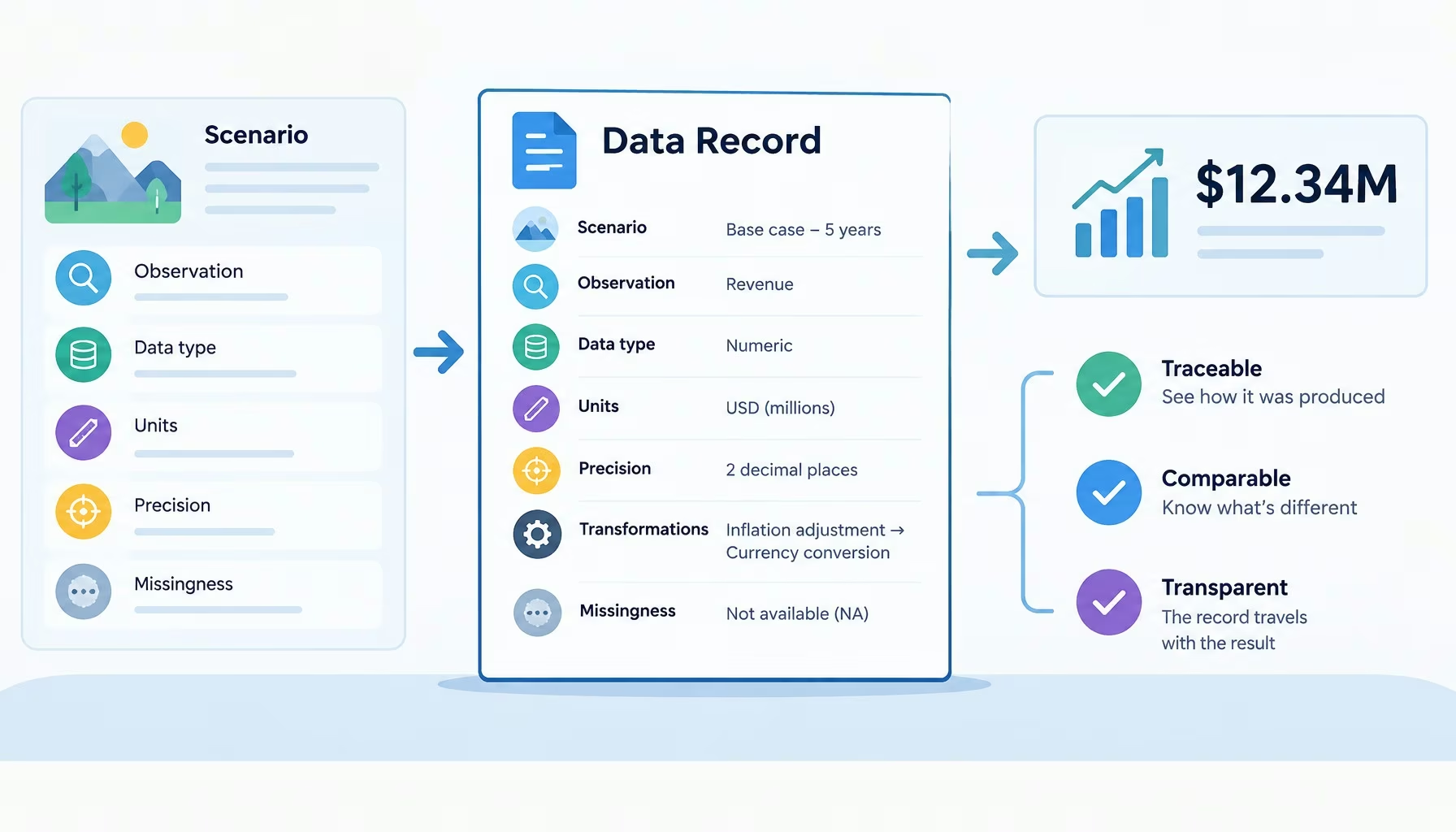
Keep the scenario with the estimate
A financial data record should let a reader reconstruct what an estimate describes: the supplied inputs, their units, the calculation used and the assumptions left outside it. The design proposed here keeps those details alongside the result. Its arithmetic examples are synthetic; this article does not establish how a live account, exchange or calculator behaves.
- Keep the scenario with the estimate
- Define the observation before selecting a data type
- Preserve units through every transformation
- Choose precision for the calculation, not the screenshot
- Make missingness an explicit state
- Keep provenance small enough to maintain
- Test transformations with deliberately awkward records
- Compare records only after their definitions match
- Frequently Asked Questions
An independent crypto liquidation calculator provides a useful worked context. BitcoinMargin estimates a threshold from a defined position scenario; it does not supply an exchange’s complete account state. If an analytics team stores that result, it also needs a record of the inputs, model and exclusions. The following design uses hypothetical records, not live positions or a recommendation to trade.
Define the observation before selecting a data type
Begin the proposed record with a source-type field. Distinguish a supplied observation, a scenario assumption and a calculated estimate. These are editorial categories for this design, not classifications imposed by a database. A value entered to explore a hypothetical position should remain identifiable as an assumption wherever the result travels.
Give each value a definition, too. What quantity does it describe? Which scenario does it belong to? Does its timestamp describe collection or calculation? Keep those meanings explicit so a later reader does not have to infer them from a column name.
Numeric representation is a separate decision. PostgreSQL’s documentation defines precision as the total count of significant digits and scale as the count of fractional decimal digits. Neither definition identifies the financial meaning of a field. Set that meaning before choosing its storage representation.
Preserve units through every transformation
In a synthetic example, an input expressed as 0.5 per cent has a fractional representation of 0.005. Preserve the supplied representation and label the normalized value as a fraction. Recording only the digits would leave the next calculation dependent on an unstated convention.
For this design, attach the unit to the value’s definition and record the transformation connecting the original and normalized fields. That gives a reviewer a specific check: did the calculation consume the fractional representation expected by its formula?
Apply the same approach to proposed currency fields. Store the currency with the amount. If a workflow converts it, retain the source amount, destination currency, rate source and applicable time. Treat the converted amount as a derived value with its own transformation record. These are implementation recommendations, not claims about any calculator’s conversion process.
More Read

Choose precision for the calculation, not the screenshot
PostgreSQL’s numeric-type documentation distinguishes exact numeric storage from inexact floating-point types. That distinction matters when a pipeline must preserve decimal quantities and apply a specified rounding rule. It does not mean one database type can repair an incorrect model or an inaccurate source.
The documentation explains that some values cannot be converted exactly into floating-point storage and are retained as approximations. Storing and retrieving a value can consequently show slight discrepancies. It recommends numeric for monetary amounts and other quantities requiring exactness, while noting that its calculations yield exact results where possible.
For the synthetic input 12.345, document the intended calculation precision and rounding policy separately from display formatting. Keep the calculation value available when preparing a shorter display. The proposed check is whether presentation changes can affect subsequent arithmetic, not whether the screenshot looks tidy.
Make missingness an explicit state
Use a status field to explain why a proposed record has no usable value. Define “missing” as an expected value that was not supplied; “unavailable” as a value that could not be obtained; “not applicable” as a field outside the scenario’s definition; and “invalid” as supplied content that failed a declared validation rule.
These definitions are proposed conventions for the synthetic dataset. They do not describe observed retrieval failures or account outcomes. Keep a reason alongside the status where it helps identify the next operation, such as correcting an input or revising the scenario definition.
Specify which statuses prevent calculation. If a required input is invalid, the proposed workflow should retain that status with the uncomputed result. A downstream reader should be able to distinguish an absent estimate from a completed estimate without inspecting upstream logs.
Keep provenance small enough to maintain
The W3C PROV overview describes provenance in terms of entities, activities and agents. For this example, the input record and calculated result are entities; the transformation connects them; the responsible system or process is identified. A team need not implement the entire specification to benefit from those distinctions.
A compact implementation could retain a scenario identifier, source reference, input snapshot, transformation version and calculation time. These fields are proposed choices; the W3C overview supplies background, not a prescribed financial-record schema.
Define the snapshot’s collection boundary. Retain the inputs and assumptions actually used, and identify exclusions. An input snapshot should not imply that the team captured an entire account. If the model changes, preserve which version produced the existing estimate so a later recalculation remains distinguishable from the original.
“Data architecture and data governance activities can be bolstered by data lineage.”
Eva Sweet, CISA, CISM, ISACA Journal, Volume 5, 2016For a broader discussion of carrying source context into enriched data, see SmartDataCollective’s guiding principles for data enrichment.
Test transformations with deliberately awkward records
Build proposed tests around the synthetic examples already introduced. Follow 0.5 per cent through normalization to 0.005, checking that each representation keeps its unit. Carry 12.345 through storage, calculation, display and export, checking it against the declared precision and rounding policy. These are testing proposals, not documented claims about ingestion or export behavior.
Include records with missing units, invalid inputs and fields marked not applicable. Write the expected handling before running the test. Check both the value and the status: preserving the digits would not satisfy the proposed design if the explanation for an absent result disappeared.
Finally, inspect the exported record independently of the original interface. Confirm that its scenario, units, status and transformation reference remain interpretable. This tests the information delivered to the next reader, including context that may otherwise exist only on screen.
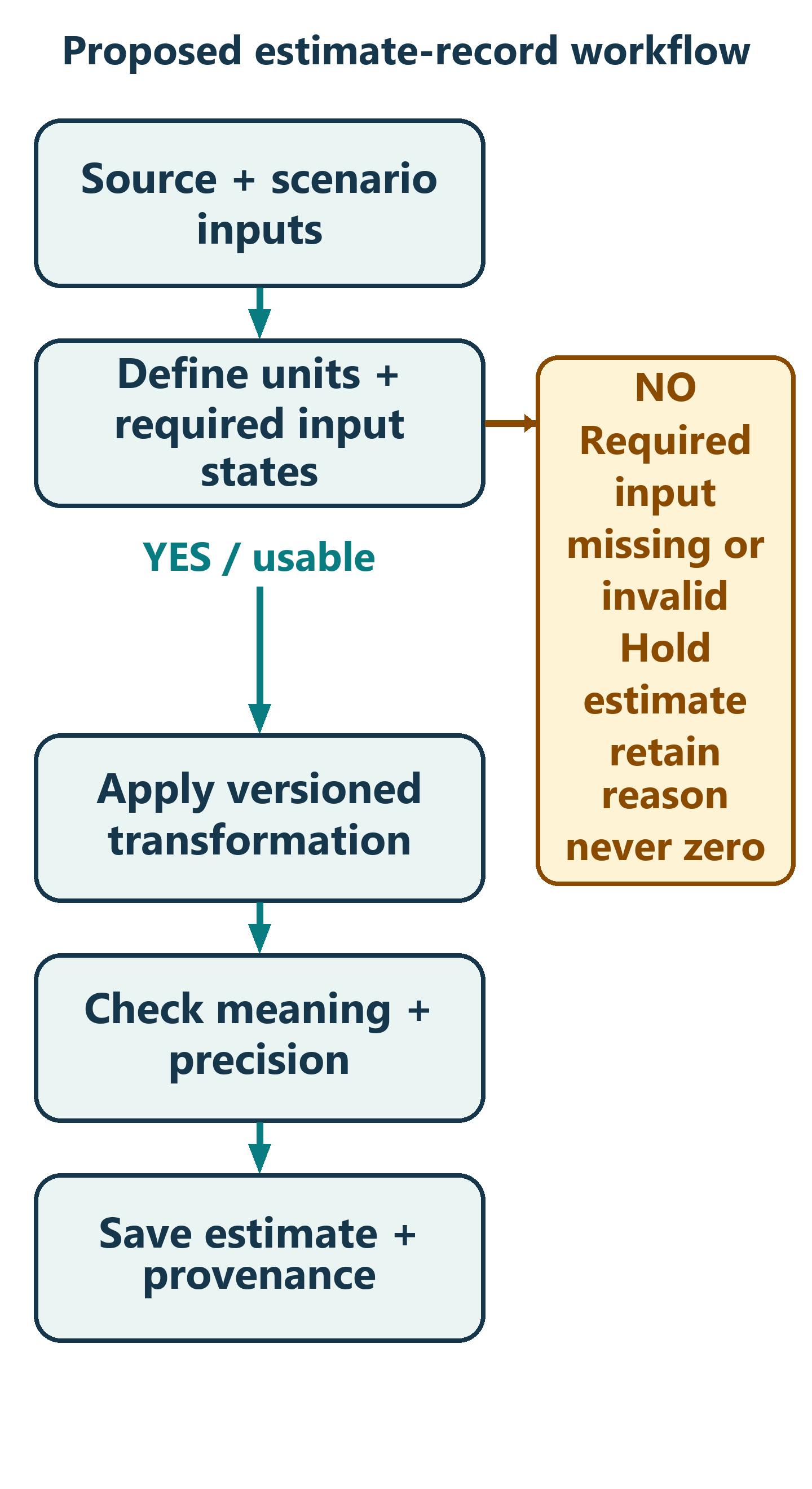
In text: retain the source and scenario; define units and input states; if a required input is missing or invalid, hold the calculation and keep a diagnostic record explaining why; never coerce the missing input to zero. Otherwise apply a versioned transformation, check its meaning and precision, and save the estimate with its provenance.
Compare records only after their definitions match
For the proposed dataset, comparison begins with the scenario definitions. Check whether the estimates describe the same quantity, use compatible units and include the same relevant inputs and exclusions. If those definitions differ, identify the difference before treating a gap between results as meaningful.
Keep statuses visible during selection and aggregation. An unavailable result should remain distinguishable from a calculated value; a scenario assumption should remain distinguishable from an observation. Where a comparison requires another conversion or calculation, preserve its relationship to the original records.
The resulting financial data record is a proposed account of how an estimate was produced, not a verified account state or investment recommendation. Its result should travel with enough context to identify the scenario, trace the transformations and determine whether another estimate is genuinely comparable.
Compare a result-only view with a contextual record
This is a proposed review aid, not a measured comparison of products.
| Review question | Result-only value | Proposed record check |
|---|---|---|
| What does the value describe? | A number alone may not distinguish an estimate from a reported threshold or an observed execution. | Retain the source type and scenario identity. |
| Which unit applies? | The displayed amount can lose its currency or unit context. | Keep the amount with its currency, unit, and input representation. |
| When and from which inputs? | A refreshed row can obscure when its source was observed. | Distinguish observation time from import time and identify the input version. |
| How was it calculated? | The result may not reveal the transformation or exclusions. | Record the calculation version, rule, and relevant exclusions. |
| Is precision being confused with accuracy? | Formatted decimals can suggest certainty the source or model does not establish. | Separate stored precision from display rounding; assess the model and inputs independently. |
| What does an absent input mean? | A blank or failed retrieval can be mistaken for zero. | State whether the input is unavailable, not applicable, or invalid; do not substitute zero. |
| Can a reviewer retrace it? | The value alone may omit the source and transformation path. | Keep a source reference, transformation version, timestamp, and responsible process. |
Frequently Asked Questions
What should accompany a stored financial estimate?
Keep enough context to explain what the value represents: its scenario and source type, units, input state, calculation version, and provenance. These are proposed record choices; the W3C PROV overview provides a vocabulary for provenance relationships among entities, activities, and agents, not a required financial schema (W3C PROV).
Does numeric precision mean an estimate is accurate?
No. PostgreSQL distinguishes exact numeric types from approximate floating-point types and documents precision and scale. Those storage properties do not establish that a financial model, input, or source is accurate (PostgreSQL numeric types).
Why should missing and zero remain different?
Zero is a value; missing, unavailable, not applicable, and invalid describe different input states. Replacing a missing input with zero changes its meaning and can produce a result that looks complete without the necessary evidence.
How can a reviewer retrace an estimate?
To retrace an estimate, a reviewer can follow a source reference, the relevant inputs, the transformation version, timestamps, and the process responsible for the result. The W3C PROV model describes provenance through entities, activities, and agents; the fields in this article are a smaller proposed implementation.
When are financial estimates comparable?
Two financial estimates are comparable only when their scenario, source type, units, input definitions, and calculation rules are understood. If those definitions differ or remain unknown, state the limitation instead of treating a numerical difference as proof that one estimate is correct.