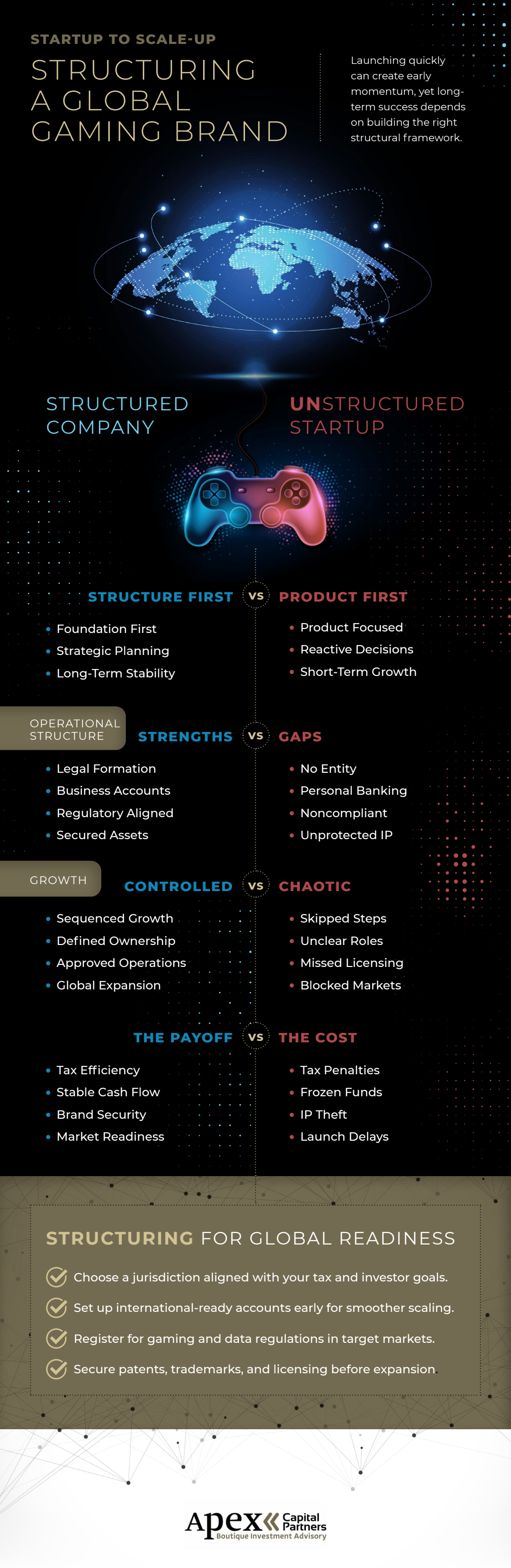
Scaling a global gaming brand requires pairing player growth with an adaptable corporate structure and disciplined data governance. When a game takes off, player accounts, cross-border telemetry, and multi-currency microtransactions multiply overnight. Without an intentional corporate setup, operational snarls quickly follow. Studio leaders must align legal entities, asset rights, and cloud architectures before international traffic overwhelms their baseline systems.
A gaming startup can reach an international audience surprisingly early. Titles distributed through platforms like Steam or the App Store find players across dozens of markets within weeks of launch, and that velocity brings unique commercial friction. Growing studios need operational rails that protect core assets, meet local compliance standards, and maintain clean audit trails for future investors.
Keep Intellectual Property Ownership Clear
Intellectual property is the foundation of studio equity, so every creative contribution demands verified title. When game assets come from remote contractors, disputed ownership can halt a financing round or publisher buyout before terms are signed. Clear IP chains keep creative assets secure.
Creative production rarely stays in one country. Concept art, custom sound design, and custom physics engines frequently originate from independent contractors across multiple regions, while trademarks and proprietary game mechanics also require formal assignment. If these rights remain scattered across informal invoices, proving chain of title becomes an expensive legal scramble during publisher audits.

Clean paperwork matters immediately. Contractor agreements, employment contracts, and IP assignment schedules should explicitly transfer all rights to your primary business entity before production begins. Studios like Riot Games maintain centralized IP holdings. That structure lets them license character assets across titles and merchandising partners without dispute. Investors evaluating your balance sheet will demand proof that the company actually owns the code and characters generating its revenue.
Choose Corporate Structure With Expansion in Mind
Choosing an adaptable corporate structure gives your studio the legal flexibility to manage international payments, live-service data pipelines, and distributed teams without friction. Setting up the right legal entity framework early prevents costly corporate reorganizations when you enter foreign app stores or establish regional servers.
Early-stage studios often start with a simple single-entity setup. Player numbers climb fast. Soon, your business may need a separate legal entity for operational divisions like game development, publishing, or regional marketing, since setting up subsidiaries protects your core IP from operating liabilities in foreign markets.
Jurisdiction selection demands a sober review of the legal environment of business. Founders must weigh executive locations alongside banking access, local employment rules, tax treaties, and cross-border transfer pricing. Options like Nevis company registration frequently surface for studios seeking international asset protection or operational flexibility. However, no jurisdiction should be picked merely for convenience. Banking partnerships, local reporting duties, and long-term regulatory compliance matter across the entire lifespan of your business.
Build Financial Data Around the Business Model
Clear financial data tracks true margins across every monetization channel your game runs. In an industry where live-service games rely on repeated player spending, finance teams must isolate which channels generate actual profit after platform cuts and hosting fees.
Monetization has evolved far beyond packaged software sales. Players spend through battle passes, cosmetic microtransactions, and recurring subscriptions. According to Newzoo’s Global Games Market Report, the worldwide games market generated $188.8 billion in 2025 across 3.6 billion players, and capturing that spend requires tracking unit economics at the individual store level.
Clean attribution protects cash flow. Platform distributors routinely retain 30% of gross sales. User acquisition expenses also vary wildly across regions, so your ledger should separate player acquisition costs from server hosting bills. When financial records blur infrastructure overhead with marketing campaigns, rapid revenue growth can mask disastrous margins.
Prepare Data Systems for More Players
Scaling data infrastructure requires balancing real-time game performance with rigorous regulatory controls. As concurrent player counts multiply, data pipelines must capture behavioral metrics and player telemetry without degrading multiplayer match latency or violating regional privacy laws.
Live-service games generate massive operational logs. Telemetry feeds track player positions, matchmaking pings, and fraud attempts continuously. At peak traffic, Riot Games ingests 20 terabytes of operational data daily on AWS to support real-time matchmaking, anti-cheat detection, and gameplay balance, and small studios need similarly disciplined pipelines to prevent database crashes during surprise viral spikes.
Governance policies belong in code from day one. Implementing tiered access controls protects player accounts, while structured data warehousing helps engineering teams run big data analytics without exposing sensitive payment records. Enforce clear data retention windows. Keeping unindexed gameplay logs indefinitely swells storage costs and multiplies your liability under the General Data Protection Regulation (GDPR) and California Consumer Privacy Act (CCPA).
Structure Operations Before Growth Forces the Issue
Operational structure defines who owns business-critical decisions as your studio expands from a single indie release to an ongoing live-service publisher. Assigning distinct ownership for security, customer experience, and platform uptime keeps teams focused during intense launch cycles.
Small teams manage launches by having everyone wear multiple hats. That scrappy coordination breaks down quickly. When live operations demand round-the-clock uptime across North America, Europe, and Asia, deploying cross-regional customer support requires distinct teams working with coordinated tooling rather than ad-hoc chat channels.
Isolate your core operational lanes. Appoint clear leads for financial reporting, cloud security, and player trust. When your team knows precisely who handles server outages and who manages store compliance, your studio avoids costly finger-pointing during critical patch rollouts.
Building a global brand requires equal parts creative vision and rigorous operational planning. Aligning your company structure, IP assignments, telemetry pipelines, and privacy policies before marketing pushes begin gives your leadership team the visibility needed to scale smoothly. Establish these corporate foundations early. Your studio can then focus on delivering great games rather than untangling technical debt.