
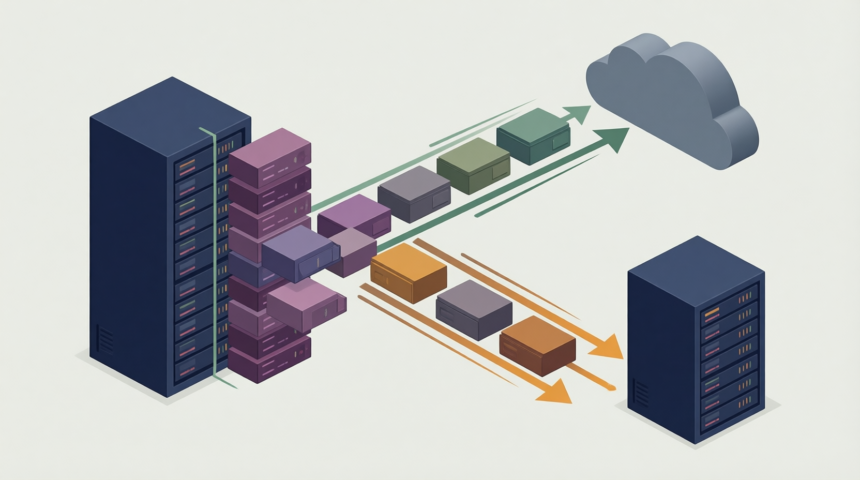
The shift in VMware licensing has fundamentally reshaped how European enterprises approach infrastructure decisions. European CIOs are no longer simply shopping for a VMware replacement; they’re mapping the entire competitive field around VMware, treating the vendor comparison as a data-driven decision process.
- How the VMware Competitive Landscape Has Changed in Europe
- Who are the main competitors to VMware in Europe?
- Leading Global HCI Vendors Competing with VMware in Europe
- Pan-European Cloud Providers as VMware Competitors
- EU Data Sovereignty, GDPR, and Schrems II in Platform Selection
- Licensing and Market Positioning Comparison Among VMware Competitors in Europe
- Five-Year TCO and Exit Costs for a VMware Migration
- Workload Segmentation and Phased Migration Risk
- Vendor Lock-In, Exit Criteria, and Reversibility
- Container-Native Virtualization as a VMware Exit Path
- Why Sangfor HCI Is One of the Best VMware Competitors in Europe
- FAQ
- What are some good alternatives to VMware?
- Why is everyone moving away from VMware?
- Is VMware becoming obsolete?
- Evaluating VMware Competitors for European Enterprise Infrastructure
Choose a VMware alternative by separating workloads that need on-premises HCI from those suited to a European cloud provider. Compare application support, five-year ownership costs, recovery, and data sovereignty requirements before committing. A migration pilot should test both production operation and the ability to leave the replacement platform.
Naturally, the list of credible VMware competitors in Europe that enterprises are evaluating has grown well beyond a simple swap-in alternative. Some of that shift is driven by licensing; some is driven by data sovereignty rules that have nothing to do with virtualization at all. Workload analytics, performance metrics, and migration data now inform these evaluations, giving CIOs a clearer picture of what each platform can actually deliver.
How the VMware Competitive Landscape Has Changed in Europe
Since Broadcom completed its acquisition of VMware, licensing terms have moved toward bundled subscriptions, and per-core pricing has replaced some of the perpetual models that enterprises have budgeted for. The shift didn’t break anything, and VMware’s platform still does what it has always done well. But it did push many infrastructure teams to ask questions they hadn’t asked in years: What’s the alternative solution?
This discussion has also opened the door to a broader set of Broadcom VMware alternatives in Europe that buyers are now considering seriously. This list includes established hyperconverged infrastructure vendors as well as cloud providers that never directly competed with VMware before. Some organizations want a full platform swap. Others are hedging, piloting a second platform in case licensing terms shift again.
Who are the main competitors to VMware in Europe?
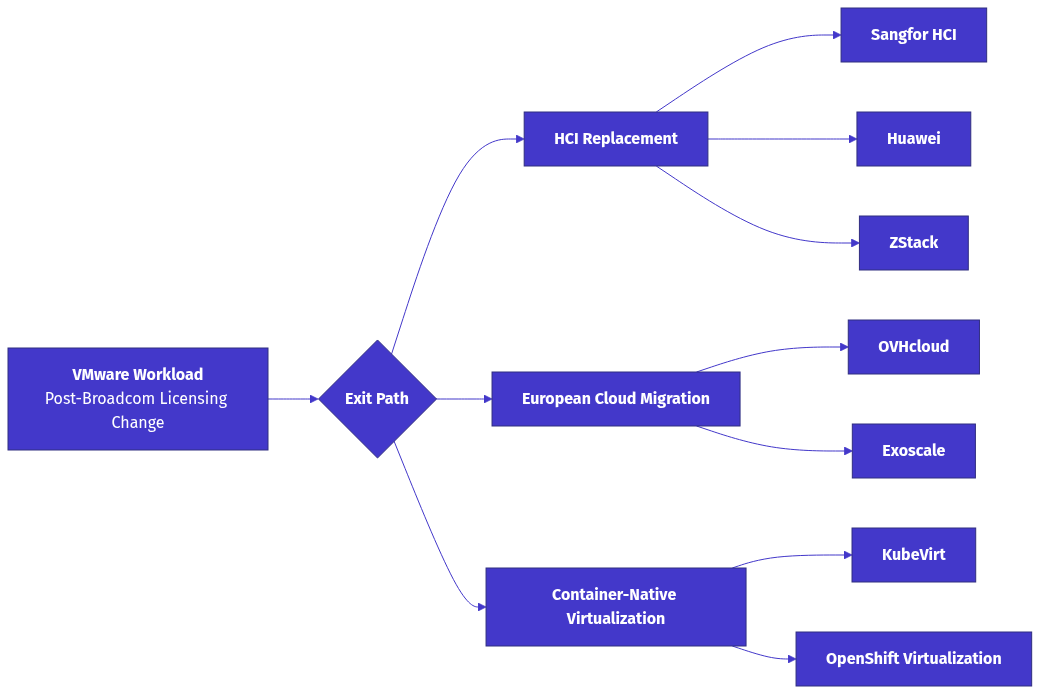
The main competitors include global HCI vendors like Sangfor HCI, Huawei, and ZStack, alongside pan-European cloud providers such as OVHcloud and Exoscale. Each targets a different migration path, from converged on-premises infrastructure to fully managed cloud environments, giving European enterprises multiple routes off VMware.
Leading Global HCI Vendors Competing with VMware in Europe
For workloads staying on your hardware, compare HCI candidates against application support, five-year TCO, recovery requirements, and exit risk. Licensing predictability matters, but so does the cost of changing hardware or retraining the team. Sovereignty requirements should remain part of that comparison, even when the servers stay on premises.
1. Sangfor HCI
Sangfor HCI has become one of the best VMware competitors in Europe that enterprises are putting on shortlists because it combines compute, storage, and networking in a single converged stack. Licensing doesn’t require bolting on separate products to match what VMware ships as add-ons. Security is built into the platform itself, not layered on afterward, which matters to infrastructure teams tired of stitching together point solutions.
Additionally, Sangfor is a global enterprise-grade vendor, not a regional challenger. It operates across APAC, EMEA, and LATAM, and its European enterprise customer base has been growing alongside interest in VMware replacement Europe projects. For teams evaluating a Nutanix vs VMware style decision, Sangfor is increasingly part of that same conversation, and often for the same underlying reason: licensing predictability.

2. Huawei
Huawei brings deep telecom and heavy-infrastructure experience to the HCI conversation, with a global footprint that gives it credibility at scale. Its architecture is proprietary in places, so enterprises should weigh hardware lock-in against the operational depth Huawei offers, particularly where Huawei networking gear is already in place.
3. ZStack
ZStack is the next name in this list of hyperconverged infrastructure in Europe. The company has an extensive HCI and enterprise cloud portfolio backed by Alibaba Cloud. It has picked up analyst recognition in its own published materials. That’s worth noting, though buyers should confirm and judge the value of such claims directly with the brand before treating it as a deciding factor.
Pan-European Cloud Providers as VMware Competitors
Not every VMware alternative is a licensable hypervisor. A separate category of pan-European cloud providers is competing for the same migrating workloads, just from a different angle: infrastructure as a service, not software you deploy on your own hardware.
4. OVHcloud
Headquartered in France, OVHcloud is the largest cloud provider based in Europe, and it’s a natural landing spot for workloads leaving VMware environments that don’t need to stay on premises. But confirm the current service scope against OVHcloud’s own materials, since offerings evolve quickly.
5. Exoscale
Exoscale, a Swiss provider, focuses on secure and sovereign cloud infrastructure, an angle that resonates with European enterprises under regulatory pressure around data residency. As with OVHcloud, current service details are best verified directly with Exoscale before taking a call.
EU Data Sovereignty, GDPR, and Schrems II in Platform Selection
For European workloads with data residency requirements, compare OVHcloud and Exoscale at the service and deployment level, alongside on-premises HCI. Record where production data, backups, and administrative access will reside. Your choice needs to satisfy the workload’s sovereignty requirements as well as its performance and operating-cost limits.
A European sovereign cloud infrastructure architecture post-VMware needs a data-location record that your operations team can actually maintain. Include backup destinations and support access in the same review as the primary region. For GDPR and Schrems II questions, have legal reviewers examine the proposed data flows and contractual arrangements before approving the target service. Keep UK data sovereignty requirements explicit where your company also operates there; do not treat every European workload as identical.
OVHcloud and Exoscale also appear in comparisons of European managed Kubernetes services that consider data residency, relevant when migration includes both VMs and container workloads. Document who can administer each environment and where copies can go, and keep those records connected to your multi-cloud data governance process.
Licensing and Market Positioning Comparison Among VMware Competitors in Europe
Use the comparison below to distinguish software you operate from cloud services you consume. For your infrastructure team, the deciding difference is who runs the platform and how charges accumulate. These licensing categories narrow the shortlist, but they do not replace workload-specific quotes or a migration cost model.
| Category | Market Position | Licensing / Pricing Model | Built-in Security | EU Presence |
|---|---|---|---|---|
| Sangfor HCI | Global enterprise HCI vendor | Simplified, converged licensing | Native, integrated | Established, growing |
| Huawei | Global telecom-rooted HCI vendor | Enterprise licensing, hardware-tied | Varies by deployment | Established |
| ZStack | Enterprise cloud and HCI vendor | Subscription-based | Varies by deployment | Emerging |
| OVHcloud | Pan-European cloud provider | Consumption-based | Provider-managed | Headquartered in France |
| Exoscale | Sovereign cloud provider | Consumption-based | Provider-managed | Headquartered in Switzerland |
The details above are directional. Please confirm current pricing, licensing, and regional coverage against each vendor’s published materials before publication.
Five-Year TCO and Exit Costs for a VMware Migration
Compare staying with VMware against migration using four cost buckets: migration, steady-state operations, hidden operations and skills costs, and exit or reversal. For your finance and infrastructure teams, a five-year model should include overlapping platforms and recovery work, not just the difference between licence quotes.
The enterprise VMware replacement decision framework puts five-year TCO beside application support, migration risk, recovery, skills, and exit criteria. A migration TCO analysis also considers hidden costs, ROI, and break-even timelines. Turn those categories into dated cash flows, so a delayed migration visibly changes the forecast instead of disappearing into an assumption.
- Migration: Budget discovery, application testing, data transfer, temporary capacity, and the period when both platforms remain licensed. Include the staff time needed to rehearse a failed cutover.
- Steady-state operations: Compare subscription and support charges with hardware refresh, storage, backup, and cloud consumption. Price network egress for the expected workload and for a later departure.
- Hidden operations and skills: Include retraining, rewritten automation, changed backup procedures, and time spent resolving unsupported application combinations. Record API rate limits as a constraint to test during bulk migration.
- Exit or reversal: Cost the export, conversion, temporary destination, recovery tests, and contract overlap needed to move again. Keep this separate from the initial migration budget.
Apply the same workload inventory and recovery targets to every vendor above, and calculate break-even from cumulative spending against the stay-on-VMware baseline under both an on-schedule and a delayed cutover. A lower subscription price may not repay the migration within your planning period.
Workload Segmentation and Phased Migration Risk
Group workloads by application support, dependencies, recovery requirements, and migration complexity before selecting the replacement platform. Your team can test low-complexity systems first, then move standard production workloads after recovery checks pass. High-risk and legacy systems need separate decisions, with downtime and rollback limits attached to each migration wave.
Communications of the ACM describes VMware migration drivers that include cost optimization, modernization, disaster recovery, and post-acquisition changes. Those goals do not require the same migration schedule. A disposable test VM and a production database with dependent services should not receive the same cutover plan merely because they share a cluster.
- Low-complexity: Pilot workloads with few dependencies and a documented rebuild procedure. Use them to measure transfer duration and validate your conversion and restore steps.
- Standard production: Move supported applications with known dependencies after testing network access, backup restoration, and application-level acceptance checks.
- High-risk: Reserve a dedicated window for systems with tight downtime limits or closely coupled services. Specify the latest point at which your team can safely roll back.
- Legacy or unsupported: Hold workloads without confirmed application support or a reliable recovery path. Record whether they need remediation, replacement, or continued operation on VMware.
For VMware to KVM live migration failure modes and downtime risk, test whether your selected route supports a live move at all. VMware HCX is described for live migration to cloud-hosted VMware services; that is not evidence that the same route works for a KVM destination. In the rehearsal, check guest boot, storage access, network configuration, and application writes after cutover. Keep the source recoverable until the application owner accepts the result.
Vendor Lock-In, Exit Criteria, and Reversibility
Your pilot should include a return journey for a representative workload. Export it from the proposed platform, restore it to the agreed destination, and compare application records against the pre-export state. Measure elapsed time and staff effort. An export button alone does not demonstrate that your database, network rules, and backup history will be usable after departure.
- Portable workload: Record the export format, required conversion tools, and application support on the destination.
- Recoverable data: Test a restore independently of the original management environment. Record which keys, credentials, and backup components the restore requires.
- Bounded exit cost: Put data-transfer charges, notice periods, overlapping subscriptions, and temporary capacity into the financial model.
- Operational acceptance: Name the person who approves the restored application and specify the record checks and downtime limit they will use.
Keep security acceptance tests attached to the workload, too. Where your team uses Tenable Nessus or Qualys VMDR, include them in the destination pilot instead of assuming the existing checks still work. Confirm with your own compliance team which internal control requirements apply to the acceptance criteria; platform selection alone is not proof of compliance.
Container-Native Virtualization as a VMware Exit Path
Consider KubeVirt or OpenShift Virtualization alongside HCI when your team is already planning for Kubernetes-based operations. This route belongs in the same application-support, recovery, skills, and five-year cost assessment as other replacements. Kubernetes alignment may justify the change, but it does not remove the work of migrating and testing existing applications.
Portworx examines Kubernetes-based alternatives to VMware, while the OpenShift Virtualization comparison focuses on organizations adopting container-based architectures. For a pilot, include an existing VM workload with its backup and recovery requirements, not just a new container application. Have the engineers who will take production calls perform the restore and maintenance tests themselves.
Why Sangfor HCI Is One of the Best VMware Competitors in Europe
Among the vendors covered here, Sangfor HCI is one of the best VMware competitors in Europe that enterprises can evaluate today, and the case is backed by more than just positioning language. Sangfor was recognized in the 2026 Gartner Market Guide for Cloud Infrastructure Sovereign Solutions as a Representative Vendor. This category speaks directly to the sovereignty concerns shaping European infrastructure decisions right now.
Ratings and reviews are visible on Gartner Peer Insights and G2. Compare reviews for the specific product under evaluation, with attention to deployment size, support experience, and recovery procedures, not just an aggregate score.
The ratings and reviews are admirable, but what matters in a decision like this is the offering’s real-world capabilities. Sangfor fares well in this respect. For instance, its partnership with ENAIP Friuli Venezia Giulia, an Italian vocational training institution, illustrates this in practice: the institution faced outdated infrastructure that couldn’t keep up with growing student numbers and demand.
Sangfor stepped in with its HCI and aDesk VDI solutions that improved scalability, performance, and security. It also implements automated backups without redesigning the infrastructure. That kind of track record matters more to a CIO than a lengthy feature list.
Also, Sangfor’s customer base is enterprise, its footprint is global, and for teams weighing VMware alternatives, it’s a name that keeps showing up on serious shortlists.
What is one of the best VMware competitors in Europe?
Sangfor HCI is considered one of the leading VMware competitors for enterprises in Europe due to its global footprint, enterprise-grade architecture, and growing European customer base. Its converged, security-integrated platform addresses many of the same needs VMware environments were originally built to solve.
FAQ
VMware remains a production option, while HCI vendors, European cloud providers, and container-native virtualization offer different replacement paths. For your team, the useful comparison is workload fit, not a universal ranking. Licensing changes explain the renewed interest, but application support, sovereignty, recovery, and migration cost determine whether moving makes sense.
What are some good alternatives to VMware?
Sangfor HCI, Huawei, and ZStack are HCI candidates for enterprise evaluation. OVHcloud and Exoscale offer European cloud paths for workloads that can leave on-premises infrastructure. KubeVirt and OpenShift Virtualization also belong in the assessment where Kubernetes alignment matters.
Why is everyone moving away from VMware?
Not every organization is moving. Broadcom’s shift toward bundled subscriptions and per-core pricing has prompted teams to reassess renewal costs and alternatives. Some are piloting a second platform while keeping VMware in production, especially where an immediate migration would introduce unacceptable application or recovery risk.
Is VMware becoming obsolete?
No. VMware remains a production platform, and the licensing changes do not mean its technical capabilities have stopped working. European enterprises are reassessing it because long-term costs, sovereignty requirements, and alternative operating models can change the case for staying.
Evaluating VMware Competitors for European Enterprise Infrastructure
Choose the replacement only after its pilot meets your application’s support, recovery, and sovereignty requirements at an acceptable five-year cost. Keep migration and exit expenses visible beside the operating run rate. A lower renewal bill does not settle the decision if the application cannot be restored within its agreed downtime.
A VM that boots is not yet an accepted migration. Before retiring its VMware source, have the application owner compare record counts and recent transactions against the pre-cutover state, then restore a backup on the destination. Record the elapsed recovery time and any manual repairs. Put those measured hours into the TCO model, along with overlapping subscriptions and data-transfer charges. Approve the next migration wave only when the workload passes those checks and its data locations match the agreed sovereignty requirements.