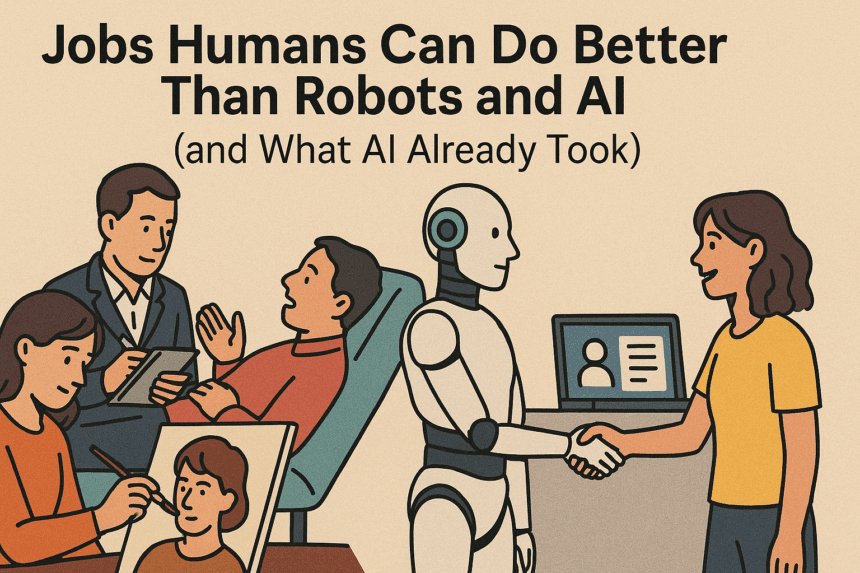
The work humans still do better than AI is not the creative or analytical work people assume. It is accountability for a decision, judgement when a situation is not in the training data, physical dexterity in unstructured space, negotiation between genuinely opposed interests, and care where a person being present is the point. Models have already taken a great deal of the drafting, summarising and first-pass analysis that articles like this one used to list as safe.
- The 11 jobs humans can do better than robots and AI, at a glance
- The hardest call on this list, and how we settled it
- 1. Being answerable for a decision: most durable overall
- 2. Judgement when the situation isn’t in the training data: most durable in operations and clinical work
- 3. Dexterity in unstructured physical space: most durable in trades and field work
- 4. Negotiation with genuinely opposed interests: most durable in complex commercial deals
- 5. Care where being human is the point: most durable in health and education
- 6. Deciding which question is worth asking: most durable in analytics and product
- 7. Taste: picking the right output from many: most durable in brand and editorial
- 8. Moving people who don’t report to you: most underrated on this list
- 9. Generating information that isn’t online: most durable in audit and research
- 10. Diagnosing systems nobody documented: most durable in legacy estates
- 11. Work where a human doing it is the product: most exposed to changing taste
- What didn’t make the list of jobs humans can do better than robots and AI
- How to tell where you stand: five questions
- What jobs will AI replace by 2030
- Will AI replace jobs in your field? Seven straight answers
- Cyber security: will AI replace these jobs?
- Sales: will AI replace these jobs?
- Finance: will AI replace these jobs?
- Accounting: will AI replace these jobs?
- Marketing: will AI replace these jobs?
- Engineering: will AI replace these jobs?
- IT: will AI replace these jobs?
- Frequently asked questions
- What jobs will AI not replace?
- What jobs will AI replace by 2030?
- Which 3 jobs will not survive AI?
- What jobs can robots replace?
- What can humans do that AI cannot?
- Will AI replace cyber security jobs?
- Will AI replace sales jobs?
- Will AI replace finance and accounting jobs?
- Will AI replace marketing jobs?
- Will AI replace engineering jobs?
Start with the honest part, because reassurance is cheap and you can get it anywhere. If most of your week goes into producing a first version of something (a draft, a deck, a summary of a call, a working function, a set of ad variants), a model does a passable version of that now, in seconds, at a cost that rounds to nothing. The jobs humans can do better than robots and AI are not the ones this page argued in 2023. That version said machines couldn’t write, couldn’t design, couldn’t hold a customer conversation and couldn’t synthesise data into a plan. Four claims, four losses. We’re saying so in the article rather than quietly deleting the sentences.
What survived the last three years isn’t “creativity” or “empathy” in the abstract. It’s narrower and harder to dislodge: being answerable, having hands in a place nobody mapped, negotiating when the other side’s interests genuinely oppose yours, and judging a situation that isn’t in anyone’s training data. Those hold for structural reasons, not capability reasons, which is why they’ll still hold when the next model lands.
The 11 jobs humans can do better than robots and AI, at a glance
| # | Human capability | Durability verdict | What AI already does here | What stays with the person |
|---|---|---|---|---|
| 1 | Being answerable for a decision | Most durable overall | Drafts the rationale, assembles evidence, auto-approves inside thresholds | Carrying the consequence when it’s wrong |
| 2 | Judgement when the situation isn’t in the data | Most durable in operations and clinical work | Retrieves playbooks, pattern-matches known incidents | Acting on contradictory signals with no precedent |
| 3 | Dexterity in unstructured physical space | Most durable in trades and field work | Structured picking, palletising, drone inspection, crop weeding | Lofts, roofs, old wiring, animals, mud |
| 4 | Negotiation with genuinely opposed interests | Most durable in complex commercial deals | Benchmarks price, drafts redlines, haggles standard SKUs | Holding authority and absorbing the anger |
| 5 | Care where being human is the point | Most durable in health and education | Triage chat, note-taking, check-ins, scheduling | Presence, touch, and someone accountable in the room |
| 6 | Deciding which question is worth asking | Most durable in analytics and product | Writes the SQL, builds the dashboard, suggests hypotheses | Choosing the problem and defining what “better” means |
| 7 | Taste: picking the right output from many | Most durable in brand and editorial | Produces the options, ranks them against engagement data | Knowing which one to ship and why |
| 8 | Moving people who don’t report to you | Most underrated on this list | Drafts comms, tracks adoption, reports status | Getting a reluctant director to change what his team does |
| 9 | Generating information that isn’t online | Most durable in audit and research | Sensors, meters, satellite, cameras where instrumentation pays | Opening the cabinet and looking |
| 10 | Diagnosing systems nobody documented | Most durable in legacy estates | Explains code, writes tests, scaffolds migrations | Knowing which bugs are load-bearing |
| 11 | Work where a human doing it is the product | Most exposed to changing taste | Synthetic voices, generated music, virtual presenters | Provenance that an audience will pay for |
The hardest call on this list, and how we settled it
The difficult one was creative work. In 2023 it was the safest-looking item on any list like this. It is now the least safe, and pretending otherwise would waste your time. So we split it: production of creative output went to the machines, selection of creative output stayed human, and only the second half earned a place here.
Four questions decided everything else on the list.
- Is the human there for capability, or for accountability? If a regulator, a court or a board needs a name against the decision, model quality is beside the point.
- Does the work happen in a place with unpredictable geometry? Structure is what robots need. Old buildings, farms and disaster sites don’t supply it.
- Would the other party accept a machine in that seat? Consent matters in care, in negotiation and in anything with a signature at the end.
- Is the input in the corpus at all? Nothing generative can observe. If the fact only exists in the room, someone has to be in the room.
One thing we’d concede to the machines outright: reliability. A model does the same task the same way at 4am on a bank holiday, and that consistency is the entire reason organisations buy automation. People are variable. But reliability isn’t answerability, and buyers keep conflating the two.
What this rests on: SmartDataCollective has covered data and analytics since 2008. The judgements here come from documented model and robotics capabilities and from how automation has actually landed in the enterprises we write about. There are no hands-on trials or benchmarks of our own behind this piece. Where a claim would need a displacement statistic we can’t stand behind, we argue the mechanism instead. What would change the ranking: general-purpose humanoids getting cheap enough for small contractors would move item 3 down several places, and a liability regime that lets vendors indemnify automated decisions would gut item 1.
1. Being answerable for a decision: most durable overall
What still holds
Someone has to sign. A lending decision, a drug approval, a structural certificate, a redundancy list. The signature isn’t an information-processing step, it’s the point at which liability attaches to a person or a firm. You cannot attach it to model weights, and no insurer has offered to try.
What AI has already taken
The work around the signature. The evidence pack, the draft rationale, the exception flags, the audit trail. In credit and claims, decisions inside a set of thresholds now clear without a human ever seeing them.
More Read
Where the argument gets thin
Thresholds widen. If your approval consists of reading a summary someone else prepared and clicking yes, you are the cost the finance director will find. Rubber-stamping is not accountability, it’s latency.
Who should act on this now
Anyone whose job title contains “reviewer” or “approver”. Move from approving individual cases to owning the policy that decides which cases auto-clear, and to handling the ones that break it.
2. Judgement when the situation isn’t in the training data: most durable in operations and clinical work
What still holds
Three in the morning. Telemetry contradicts itself, the runbook assumes a component that was decommissioned in March, and the vendor’s status page says everything is fine. Somebody has to decide whether to fail over and eat the data loss. Generative systems interpolate confidently between things they’ve seen. Novelty is exactly where that breaks.
What AI has already taken
Alert correlation, first-hypothesis generation, retrieving the one paragraph of the runbook that matters, and writing the incident timeline afterwards. Agent frameworks like the ones covered in our piece on LangGraph orchestrator agents now chain those steps without a prompt each time.
Where the argument gets thin
Most incidents rhyme with a previous incident. The genuinely unprecedented share of your on-call week is smaller than it feels.
Who should act on this now
SREs, plant operators, clinicians. Write down your reasoning, not just your resolution. The reasoning is the part that isn’t in any corpus, and it’s what makes you the person they call.
3. Dexterity in unstructured physical space: most durable in trades and field work
What still holds
Rewiring a 1930s semi with no two junction boxes alike. Getting a boiler out of a cupboard that was built around it. Handling livestock. Robots are extraordinary inside a cell that was designed for them, and largely useless when the geometry changes every job.
What AI has already taken
Everything structured enough to design for. Warehouse picking, palletising, weld lines, drone-based inspection of pipelines and roofs, camera-guided weeding in row crops.
Where the argument gets thin
Humanoid demos improve visibly year on year, and highway freight is a solvable problem in a way plumbing isn’t. Long-haul driving and yard work will go before anything involving a crawl space. Meanwhile the bigger threat to trades pay isn’t robots at all, it’s how few apprentices are coming through.
Who should act on this now
Nobody in a variable environment needs to retrain this decade. If you run a fleet or a depot, the automation question is real and it arrives from the logistics side first.
4. Negotiation with genuinely opposed interests: most durable in complex commercial deals
What still holds
A union settlement. A two-year renewal where the customer knows your quarter-end. An acquisition where both sides are lying by omission. Concession requires authority, and authority requires someone who can be blamed for granting it. There also has to be somebody on the other side of the table to be angry at, which sounds soft and is not.
What AI has already taken
Price benchmarking, first-pass redlines against a clause library, and automated haggling on commodity SKUs. Freight rates, media buys and cloud commitments are largely negotiated by systems now.
Where the argument gets thin
High-volume low-value negotiation is gone, and a lot of “relationship selling” was really order-taking with a lunch attached.
Who should act on this now
Anyone in commercial roles whose deals are single-threaded and standard-terms. Get onto multi-party deals where the terms are actually contested.
5. Care where being human is the point: most durable in health and education
What still holds
Turning a patient. Sitting with a family after bad news. Holding the attention of thirty fourteen-year-olds who don’t want to be there. The presence is the service, and a person accountable in the room is what makes families accept it.
What AI has already taken
Triage conversations, symptom intake, appointment logistics, ambient note-taking during consultations. And here’s the uncomfortable part: for stigmatised questions, plenty of people prefer a chatbot, because it doesn’t react. Any 2023 claim that machines can’t hold a supportive conversation has not aged well.
Where the argument gets thin
Cost pressure will insert software wherever the human was mostly monitoring rather than doing. Night observations, medication reminders, wellbeing check-ins.
Who should act on this now
Care staff should expect documentation load to fall and caseload to rise. That’s not a reprieve, it’s a redistribution.
6. Deciding which question is worth asking: most durable in analytics and product
What still holds
A model answers the question you typed, brilliantly, even when it’s the wrong question. Churn went up; you can now get twelve cuts of the data in a minute. Deciding that the real issue is a pricing change made by a different team, and that nobody wants to hear it, is a different job. Our piece on why flexibility defines the future of data science makes the same argument from the practitioner side.
What AI has already taken
Query writing, dashboard assembly, cohort summaries, the first pass of exploratory analysis. If your value was translating a request into SQL, that’s been repriced. Watch how the tooling assumptions are shifting in the data trends shaping analytics in 2026.
Where the argument gets thin
Agents now generate and test their own hypotheses in loops. Framing is being encroached on, slowly, from the analysis side.
Who should act on this now
Analysts. Own the metric definition and the decision it feeds. Stop being the person who runs the query.
7. Taste: picking the right output from many: most durable in brand and editorial
What still holds
The cost of a plausible option collapsed. Forty headlines, twelve layouts, six voiceovers, all competent. Scarcity moved to selection: knowing which one fits the brand, which one will embarrass the CEO, which one is technically better and still wrong for this audience.
What AI has already taken
Production. Copy, illustration, retouching, video cutdowns, localisation. Stock and filler content has essentially no market left.
Where the argument gets thin
Where you have real outcome data, a preference model will out-pick a mediocre editor, and does. Taste survives when the outcome is slow, reputational or unmeasurable. It doesn’t survive on a performance ad account.
Who should act on this now
Writers and designers: move upstream to the brief and the standard. The person who decides what good looks like keeps their seat. The person who executes the brief is competing with a subscription.
8. Moving people who don’t report to you: most underrated on this list
What still holds
Every failed data programme has the same postmortem. The technology worked. A regional director kept running his own spreadsheet, sales never changed the intake form, and the finance team quietly maintained a shadow ledger. Nothing in a model changes that man’s mind. Somebody has to sit with him, understand what he loses, and trade something. It’s the reason initiatives like the ones described in engineering trust into enterprise data with smart MDM automation succeed or die on politics rather than architecture.
What AI has already taken
Status reporting, comms drafting, adoption dashboards. The visible artefacts of change management, none of which were the work.
Where the argument gets thin
Very little. This is the most defensible item here after accountability, and the one nobody puts on lists like this because it has no job title.
Who should act on this now
Platform owners and transformation leads. Your leverage is organisational, so document it as such when you’re being assessed.
9. Generating information that isn’t online: most durable in audit and research
What still holds
Models are downstream of a corpus. If nobody observed a thing and wrote it down, it does not exist to them. Counting the stock. Visiting the site. Interviewing the customer who won’t answer a survey. Taking the soil sample. Opening the panel to find that the drawing was wrong.
What AI has already taken
Observation wherever instrumentation pays for itself. Smart meters, fixed cameras, telematics, satellite imagery for crop and construction monitoring. The machine learning companies worth shortlisting are largely competing on what happens after the sensor, not on replacing the site visit.
Where the argument gets thin
Instrumentation spreads relentlessly, and sensor cost keeps falling. The uninstrumented world shrinks each year.
Who should act on this now
Field engineers, auditors, ethnographers. Your defence is that you produce data rather than consume it. Make that visible in how you report.
10. Diagnosing systems nobody documented: most durable in legacy estates
What still holds
The COBOL batch that must finish before 04:12. The 2014 spreadsheet with a hardcoded FX rate that three downstream reports depend on. The plant interlock that trips for a reason lost with a retired engineer. Models read code well. They cannot tell you which broken behaviour is load-bearing because a customer contract now depends on the bug.
What AI has already taken
Code explanation, test generation, migration scaffolding, dependency mapping. Real ground has moved here, as our coverage of AI and machine learning in software development sets out.
Where the argument gets thin
Given repository access and a large enough context, automated legacy translation is improving faster than most other items on this list. Treat this one as a decade, not a career.
Who should act on this now
Legacy maintainers. Either write the tribal knowledge down and become the person who governs the migration, or accept that you’re the last owner of a shrinking asset.
11. Work where a human doing it is the product: most exposed to changing taste
What still holds
A sold-out room. A hand-thrown pot. A boxer. Nobody buys a marathon result from a machine. Provenance is the value, and the audience’s belief that a person did it is not a feature that can be synthesised.
What AI has already taken
Everything where provenance was never checked. Library music, generic voiceover, background illustration, virtual presenters with real followings.
Where the argument gets thin
Taste changes. Some audiences demonstrably don’t care where a track came from, and disclosure norms are weak. This is the least secure item on the list, which is why it’s last.
Who should act on this now
Performers and makers: sell the provenance explicitly, because it’s the only part of the offer that can’t be copied at zero cost.
What didn’t make the list of jobs humans can do better than robots and AI
Several categories that appear on every article of this type have been cut, and it’s worth being specific about why. Roundups that rank sixty-odd job titles by “safety score” are doing something we think is misleading: automation arrives at the task level, so a job title gets hollowed out long before it disappears from the census.
- Creativity, as a category. Too broad to mean anything, and the production half is gone. Split into taste (item 7) and problem framing (item 6).
- Critical thinking, as a category. The phrase covers both “reason through a known problem” and “act sensibly with no precedent”. Models are decent at the first. Only the second earned a place here, as item 2.
- Writing and copy. Draft production is automated. What survives is the standard and the accountability for what got published.
- Translation. Machine translation handles the bulk of commercial volume; humans review high-stakes and culturally loaded work. See how AI learned to speak global languages for how far this went.
- Customer service. Tier-one contact is largely handled by software. The human tier is now escalation, retention and anything with a legal edge.
- Bookkeeping and proofreading. The 2023 version of this page listed both as automatable. That was right, and it has happened.
- Driving. Left off deliberately. Urban delivery remains awkward; motorway freight is being solved. It’s a genuine loss ahead, not a human advantage.
- Reading medical images. Measurement and pre-reads are automated in several modalities. The radiologist’s durable work is the equivocal case and the signature on the report, which is item 1, not a separate skill.
How to tell where you stand: five questions
- If your work were wrong, who gets the phone call? If the answer is you, and a regulator or a customer can name you, that’s structural protection.
- Could a competent stranger do it from a laptop given a good brief? Then a model can attempt it, and the only question is quality tolerance.
- Does it require being somewhere nobody has mapped? Physical variability is the most expensive thing in robotics.
- Whose agreement do you need, and would they accept software in your chair? Consent is a moat that has nothing to do with capability.
- What share of your week is first drafts? Over half, and your role is being repriced right now whether or not anyone has told you.
What jobs will AI replace by 2030
Nobody credible can tell you a headcount number, and anyone quoting one to three significant figures is selling something. Tasks are forecastable; totals aren’t. Here is the task-level view, which is what actually shows up in a reorg.
Going, or largely gone already. Tier-one support tickets and chat. Standalone transcription. Meeting notes and action capture. Invoice matching and expense coding. Routine bank reconciliation. Résumé screening. Appointment scheduling and rescheduling. Ad creative variant production. Standard-form contract first-pass review. Outbound prospecting emails and list research. Localisation drafts. Structured-warehouse picking and sorting. Basic BI report building. Boilerplate SEO content. Unit test writing. Level-one alert triage in the security operations centre.
Being cut in half rather than removed. Junior analysis, where the query and the chart come free and the interpretation doesn’t. Paralegal discovery, where retrieval automates and privilege calls don’t. Bookkeeping, where posting automates and the judgement on what’s capitalisable doesn’t. Copywriting, where the draft is free and the brand decision isn’t. Recruitment, where sourcing automates and closing a candidate doesn’t.
Where the entry rung disappears and the profession doesn’t. This is the real 2030 problem, and it’s badly under-discussed. If first-year work in law, accounting, design or software was the apprenticeship, and that work is now done by a subscription, the pipeline into senior judgement breaks. Nobody has solved this. Firms cutting graduate intake this year are creating a capability gap in 2033 that they will then complain about.
Will AI replace jobs in your field? Seven straight answers
Cyber security: will AI replace these jobs?
No, and this is one of the few fields where demand rises because of AI rather than in spite of it. What’s already automated: level-one alert triage, log correlation, phishing classification, routine vulnerability prioritisation, first-draft incident reports. That was most of a SOC analyst’s shift, and those seats are consolidating. What isn’t automated: deciding to take a production system offline during trading hours, threat hunting against an adversary who is adapting to your defences, and being the person the board questions after a breach. Attackers get the same tools you do, so phishing quality went up and the volume of plausible attacks went up with it. Meanwhile every model deployment your business ships is new attack surface, which is the argument in our piece on the role of artificial intelligence in enhancing data security. What to do: get out of pure alert work and into detection engineering, cloud identity, or securing AI systems themselves.
Sales: will AI replace these jobs?
Partly, and unevenly. Sales development is being gutted. Prospect research, list building, sequence writing and personalisation at volume are automated, and they were the whole SDR job. Transactional inbound sales with standard pricing is going the same way, because a configurator plus a chat agent closes it. What survives: multi-stakeholder deals where six people must agree internally, anything with contested terms, and renewals where a customer is genuinely considering leaving. Also anything requiring someone to sit in a room and absorb an unhappy executive. The uncomfortable implication is career shape: if the SDR rung disappears, the traditional route to account executive disappears with it. What to do: build product depth so you’re consultative rather than coordinating, and get on deals with real negotiation in them. Volume outreach is no longer a skill anyone pays for.
Finance: will AI replace these jobs?
The processing layer, yes. Judgement and answerability, no. Already automated: reconciliations, variance commentary drafts, cash forecasting from ledger data, covenant monitoring, first-pass credit scoring inside policy limits, most of the model-building an analyst used to do in Excel over a weekend. That’s a large share of the FP&A workload. What holds: signing off numbers that go to a market, deciding the assumption set behind a forecast rather than running it, capital allocation where the deciding factor is a view about a market nobody has data on, and explaining a miss to investors. Regulators want a named responsible person, and that requirement is not going away. What to do: move from producing the pack to owning the assumptions and the exception cases. If your month-end is manual, automate it yourself before someone automates you out of it.
Accounting: will AI replace these jobs?
Transaction accounting is on a clear path down. Data entry, coding, matching, standard journal preparation, basic bookkeeping for small entities, first-draft statutory accounts from clean ledgers. All done, or close. Compliance tax preparation for straightforward returns is following. What survives: judgement calls where the standard is ambiguous, revenue recognition on non-standard contracts, going-concern assessments, transfer pricing arguments, and the audit opinion itself, which exists precisely because a firm accepts liability for it. Advisory work grows, because clients who no longer pay for bookkeeping still pay for someone to tell them what to do. What to do: if you’re a practice owner, price advisory rather than compliance hours now. If you’re early-career, get to the judgement work fast, because the years you’d normally spend learning on routine files are being compressed.
Marketing: will AI replace these jobs?
Execution is being repriced hard, and headcount follows. Copy production, creative variants, audience segmentation, bid management, keyword research, email sequences, social scheduling, reporting. All automated to a standard that satisfies most performance briefs. Generic content marketing has no economics left, since supply is infinite and cheap. What survives: positioning, which requires deciding what the company will and won’t be; brand judgement, where the outcome is slow and unmeasurable; partnerships and anything involving relationships; and being accountable for a campaign that offends someone. Also research with real customers, which no model can do because the input doesn’t exist yet. What to do: own the strategy and the measurement, not the production. If your portfolio is executions, rebuild it around decisions you made and why.
Engineering: will AI replace these jobs?
Software engineering, no; software engineering as currently staffed, materially changed. Already routine for models: boilerplate, tests, migrations, documentation, refactors, sizeable chunks of CRUD, and the sort of ticket a graduate used to be handed to learn on. Productivity per engineer went up, and that is being taken as licence to hire fewer juniors. What holds: system design where the constraint is a business commitment, debugging a production failure with contradictory evidence, choosing what not to build, and interface decisions between teams that don’t trust each other. For physical disciplines (civil, mechanical, process) design optimisation and drawing production automate, while site conditions, code interpretation and the professional stamp do not. What to do: get good at review, architecture and reading a system you didn’t write. Typing speed stopped being a differentiator.
IT: will AI replace these jobs?
Service desk work is contracting fastest of anything in this list. Password resets, access requests, provisioning, patch scheduling, standard troubleshooting scripts, endpoint config. Automated, and where it isn’t, that’s an internal maturity problem rather than a capability limit. Infrastructure work shifted years ago from configuration to code, and models write that code competently. What survives: capacity and cost decisions with real money attached, vendor management and contract negotiation, integration of systems that were never meant to talk, migrations of undocumented estates, and physical work in sites and data halls. Also being the person who says no to a business unit that wants an unsupportable tool. What to do: move toward platform engineering, identity, or the AI operations work your organisation is about to discover it needs. Ticket-closing volume is no longer a defensible metric.
Frequently asked questions
What jobs will AI not replace?
Work where a person must be answerable for the outcome, work with hands in unpredictable physical settings, negotiation with genuinely opposed interests, care where presence is the service, and judgement calls with no precedent in the data. Note that these are capabilities rather than job titles. Most real jobs contain a mix, so the honest answer is that parts of your role are exposed and parts aren’t.
What jobs will AI replace by 2030?
Task by task: tier-one support, transcription and note-taking, invoice matching, résumé screening, standard contract review, outbound prospecting, ad variant production, level-one security triage, basic report building, boilerplate content. Whole professions won’t vanish. What disappears first is the entry-level rung inside professions, which is a slower and more damaging problem than mass unemployment headlines suggest.
Which 3 jobs will not survive AI?
If you want three, we’d name first-line phone and chat support, standalone transcription work, and high-volume data entry or basic bookkeeping. All three are already mostly automated in organisations that have bothered. Everything else on the usual doom lists is losing tasks rather than existing, which sounds gentler and isn’t, because pay and headcount fall with the tasks.
What jobs can robots replace?
Physical robots replace work in structured environments: warehouse picking and sorting, palletising, welding, packaging, machine tending, pipeline and roof inspection by drone, row-crop weeding. The determining factor is whether the environment can be engineered around the machine. Lofts, farmyards, old buildings and disaster sites can’t, which is why trades remain expensive and hard to automate.
What can humans do that AI cannot?
Observe something nobody has recorded. Accept liability. Grant a concession with real authority behind it. Be physically present when presence is the point. Act sensibly when the situation resembles nothing in the training data. Note what is not on that list: producing text, code, images or analysis to a competent standard. Models do all of that now, and any article claiming otherwise is describing 2022.
Will AI replace cyber security jobs?
No. It has already replaced most level-one alert triage, and those seats are consolidating, but the same tools have raised attack quality and volume. Detection engineering, cloud identity work and securing your organisation’s own AI deployments are all growing. Move away from queue-clearing and toward the decisions that a breach postmortem examines.
Will AI replace sales jobs?
It is replacing sales development and transactional inbound selling. Complex deals with multiple internal stakeholders, contested terms and genuine churn risk still need a person with authority. The career risk is the missing rung: if nobody works as an SDR, the traditional path to closing roles narrows. Get product depth and get onto contested deals.
Will AI replace finance and accounting jobs?
The processing half, yes: reconciliation, coding, matching, standard reporting, straightforward returns. The judgement half holds, because ambiguous standards, capital allocation and signing off numbers that reach a market all require someone who carries liability. Advisory demand rises as compliance revenue falls. Practices still pricing compliance hours are the ones in trouble.
Will AI replace marketing jobs?
Execution roles, substantially. Copy, creative variants, bid management and reporting are all automated to a standard most briefs accept, and generic content has no economics left. Positioning, brand judgement, partnerships and primary customer research survive. If your portfolio is executions rather than decisions, rebuild it around the decisions you made and the reasoning behind them.
Will AI replace engineering jobs?
No, but it has absorbed the work junior engineers used to learn on, and firms are responding by hiring fewer of them. System design under real business constraints, debugging with contradictory evidence, deciding what not to build and physical site judgement all remain human. Get strong at review and architecture, and at reading systems you didn’t write.