
Mobile BI has been around for a long time. Starting in the late-1990s, the first SMS-enabled telephones became mainstream in Europe, with basic broadcasting of the latest figures available in your BI system (or email, fax, pager, etc.). By the end of the decade, the first telephones with WAP browsers were used to provide interactive BI, quickly followed by connected PDAs with basic HTML browsers.
Here’s what SAP BusinessObjects looked like on the Nokia 7110 in 1999, on a Compaq PDA running Windows Pocket IE, an AvantGo PDA, and a Japanese DoCoMo i-mode phone in 2001:
The arrival of all these new mobile devices was supposed to usher in a new dawn of mobile analytics. Here’s a slide from a presentation a decade ago by then-marketing-VP Dave Kellogg, including the heady prediction that “5-25% of companies indicated they already provide or will provide wireless access to BI within 6-12 months”.
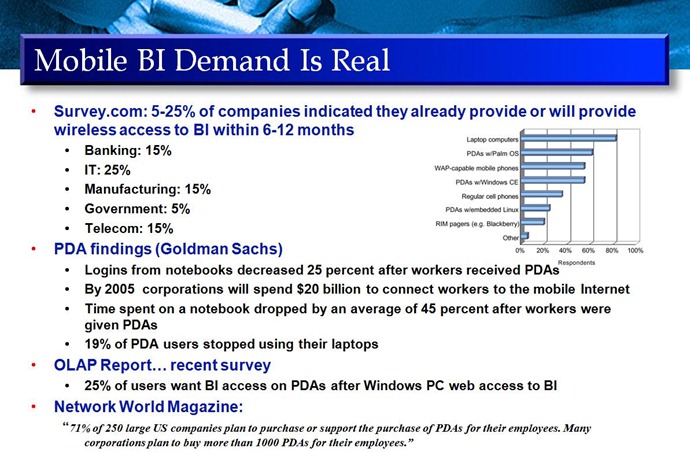

Business Objects launched a big initiative to go after the mobile market, and managed to sell projects to customers including JP Morgan (Palm Pilots) and Zurich Insurance (a mobile extranet for risk managers).
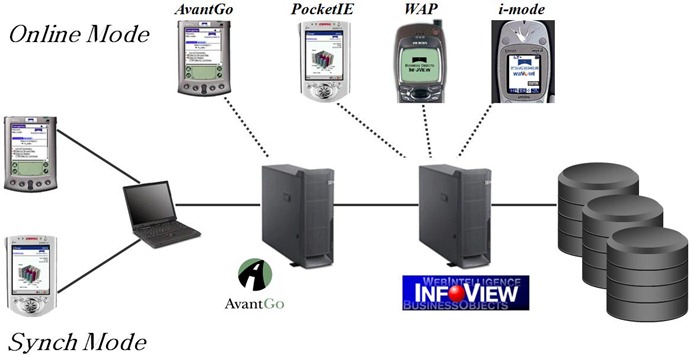
But, clearly, the market didn’t take off – PDAs became more widely used, and phones got better, but they weren’t used much for BI. The user interfaces were too clunky and connection speeds were too slow. Interest in mobile BI did grow slowly over the decade, notably as RIM blackberry devices became ubiquitous, but it took the wide availability of 3G wireless and modern smartphones/tablets to provide truly usable interfaces.
Finally, a decade and a half after the first tentative steps, everybody seems to agree that this is the year that mobile BI will really take off.
2012 Is the Year of Mobile BI
Here’s a taste of the mountain of research data that’s been generated about mobile BI in the last few months:
- Boris Evelson of Forrester says mobile BI will go mainstream this year. “One needs to make decisions when and where they need to be made. Not ‘when I get back to the office,’ which may be too late.” He also says that “professionals must start evaluating and prototyping mobile BI platforms and applications to make sure that all key business processes and relevant information are available to knowledge workers wherever they are.”
- According to Gartner, “by 2013, 33 percent of BI functionality will be consumed via handheld devices.”
- A survey by analyst Howard Dresner indicates that BI has already become the third most in-demand enterprise mobile application, behind only email and personal information management apps such as calendars, and 68 percent of those surveyed rated mobile BI as “critical” or “very important,” up from 52 percent a year earlier.
- A recent survey by Information Week showed that 25 percent of organizations are planning to implement some form of BI this year.
- Sixty-one percent of the participants in a TDWI survey said that they expect users to spend more time accessing BI from mobile devices in the next 12 months.
- Business Intelligence and mobile are the top two technology priorities for CIOs in 2012.
Barriers to deployment
Not every organization is moving forward with mobile BI. Here are the main concerns:
- Security and administration: Organizations are concerned about data getting outside the organization, and the administration overhead generated by managing BI on mobile devices. A mobile device management (MDM) platform (not to be confused with the other MDM) like Sybase Afaria is key.
- Expectations-setting: An easy interface doesn’t mean that the data users want is readily available. New opportunities mean new requirements. Having the right data foundations in the first place, with a robust, standard BI platform in place makes it easier to react fast to user expectations.
- Platform choices: This is perhaps the biggest factor delaying widespread deployment. Just like the operating system wars of last century (remember IBM OS/2?), there’s no one obvious platform to standardize on for rolling out mobile applications. There are three main strategies, all with pros and cons:
- Native applications—mobile applications written directly for iOs or Android. The advantage is optimal ease-of-use and access to the capabilities of the native device. The disadvantage is the cost and complexity of supporting multiple platforms and different user interfaces.
- HTML—accessing mobile BI through a Web browser. The advantage is that you don’t care what device is being used to access the data – at least in theory. In reality, the disadvantage is that browser-based interfaces are generally far behind what’s possible using the native features. There are high hopes that the proposed HTML5 standard will help – but it hasn’tt yet reached maturity.
- Hybrid solution—mobile enterprise platforms such as Sybase Unwired Platform. You create applications once, and then generate different versions of them optimized for different mobile platforms, including HTML. It’s an insurance measure against the turbulent real-life world of changing mobile platforms, but there’s some upfront investment.
An example of today’s mobile BI solutions – SAP BusinessObjects Mobile showing the integrated Google maps pioneered by the Innovation Center.

Of course, most of us just want all these options to be available as part of the standard business intelligence platform – and that’s getting closer…
Next Steps
Gartner predicts that “by 2013, 15% of BI deployments will combine BI, collaboration and social software into decision-making environments”. In other words, mobile BI will become part of an “orchestrated” experience that combines accessing data with acting on it, and we’re starting to see this in the form of mobile medical analytics for doctors or mobile beauty advisor applications.
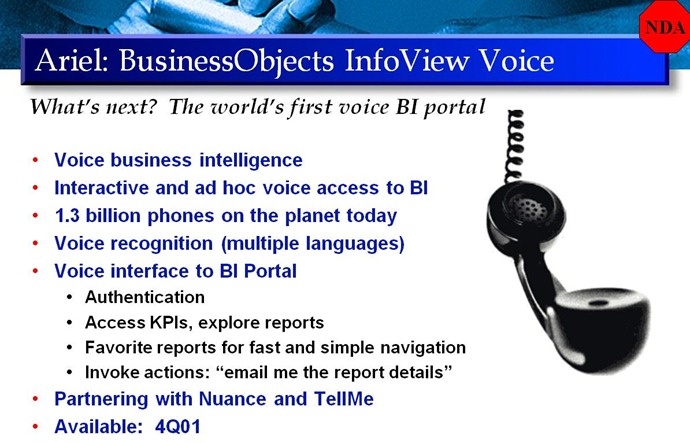
Interestingly, one brand new area of opportunities is the integration of mobile with voice-controlled interfaces such as Apple’s Siri. Business Objects was WAY ahead of the curve with this one, with the project codenamed “Ariel”. It sadly didn’t take off, but anybody who saw it demoed will have fond memories…
—–
Note, this is an adapted, extended version of my post on the SAP Analytics Blog.