Organizations across sectors have experienced the wave of cloud adoption, but edge computing may be the next era of the Internet of Things (IoT) infrastructure. It has been around for a while, but a desire to reduce cloud dependency and localize secure data and assets is increasingly important in a volatile threat landscape. Edge computing in IoT provides several advantages that other frameworks fail to provide comprehensively, making it uniquely relevant to current productivity, security and computing needs.
Federated Learning and Privacy-Focused Artificial Intelligence (AI)
Edge computing assets have been used for inference, powering the already trained models that companies use during operations. However, businesses can also leverage the edge and IoT to train multiple models collaboratively. Data remains local without pooling a seemingly infinite amount of data to central servers. Instead, many devices establish key parameters individually until sending them to the global model in an encrypted format.
This segmentation preserves cybersecurity in multiple ways. It prevents one space from housing all information, reducing the value of a single point of entry for a threat actor. Additionally, it allows companies to practice data minimization, adhering more closely to international compliance recommendations. The IoT needs these enhancements, as the landscape has become known for its poor defenses.
Improved Real-Time Analytics
Edge computing is enabling a more data-first and accurate era of on-device machine learning. For advanced processing in applications such as machine learning, having assets nearby offers numerous advantages, especially for information-hungry devices like IoT sensors. Local analysis enhances responsiveness and reduces delays because data travels a shorter distance. Bandwidth experiences fewer strains because it does not support long-distance journeys to distant cloud infrastructure.
More Read

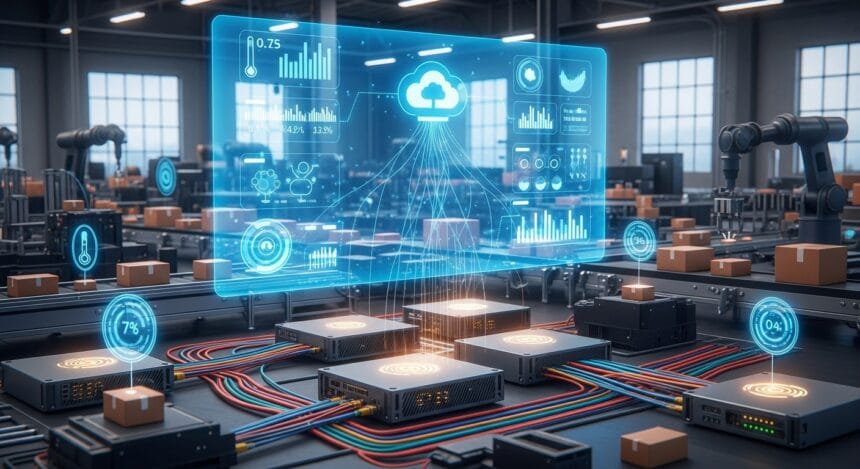
Imagine a robotic camera that is constantly analyzing products on a production line for quality control. Information from its visual sensors is stored locally on edge devices. These nodes could exist within a mesh Wi-Fi structure, which enables smooth data flows across multiple devices and spaces. They contain only site-specific data, rather than combining with other branches of the business.
If there is an influx of defects, the model could detect it more quickly. The machine learning algorithms can process faster because fewer server requests are competing to navigate and enter a busy cloud environment.
Proactive Data Sovereignty and Compliance Enforcement
Cloud infrastructure is difficult to oversee. Because it is universally accessible, the integrity of any implemented data sovereignty measures is called into question. It is even more challenging to enforce these governance structures across all countries where the information may be used. Fortunately, edge computing helps the IoT categorize information that should remain protected on edge devices or be anonymized and sent to the cloud.
For example, international companies need to comply with regulations like the European Union’s GDPR and China’s CSL. Worldwide, each location can host on-site servers that run real-time data processing and AI models. It can keep information, like employee metrics and contractor contracts, safe and local, without jeopardizing it in an unprotected cloud environment. It also becomes simpler to access. This availability is crucial, especially during audits, when site-specific information is essential.
Intelligent Information Curation and Perishable Data
IoT devices are powerful because of the amount of information they can harvest and store, but falling into the data gravity trap can lead to cumbersome organization and maintenance. Managing information becomes expensive, as more time and resources are needed to clean it and back it up. Edge computing in IoT requires companies to be more selective with what they collect, filtering out unnecessary noise. Programmers can tell it to gather only meaningful performance information, such as when it is anomalous or indicates maintenance needs.
Additionally, this gives perishable data more weight, as it can lose its value if not acted on immediately. Short-lived insights that remain in the IoT can muddle data accuracy when companies need it for long-term forecasting. Any data point requiring faster response times can be accessed more easily due to its proximity to edge computing assets.
This allows the device to adjust its association with these perishable data points by recognizing the action taken in relation to this trigger. Then, algorithms more readily understand how these categories need attention in the future, providing more relevant suggestions for maintenance or repairs.
Swarm Intelligence and Device-to-Device (D2D) Collaboration
Typically, an IoT device would send its information into a cloud database — a one-way relationship with minimal inherent value and security. Alternatively, edge computing provides a more value-driven environment for IoT data collection, enabling nodes to communicate without relying on a central hub. These swarms connect via protocols such as 5G to enable low-latency communication directly between devices.
This adaptability would be integral, especially for large-scale manufacturers undergoing digital transformation and adopting technologies such as robotics and automation. A swarm of independent robots intended to work together without supervision need to communicate and respond appropriately if one fails or detects a defect. D2D communication enables the machine to detect these conditions and adjust its routing and tasks accordingly. Test environments demonstrated positive results for these setups, achieving 98% effectiveness while at maximum capacity.
Dynamic Digital Twin Synchronization
A digital twin needs a massive well of current information to create accurate simulations. The IoT is a valuable resource, and edge nodes could make on-site digital twin models even more precise. Cloud data could include things that do not apply to the physical objects and infrastructure within the perimeter.
Edge IoT can use its sensors to curate and compare with what is nearby. For example, a car manufacturer could embed the information for a digital twin in IoT sensors, which constantly analyze the primary model to ensure it remains consistent with key metrics, such as tire pressure and engine temperature.
The Next Age of Edge Computing in IoT
Digital assets and physical hardware are coming closer to home with the edge computing revolution, as it empowers IoT infrastructure. The data points become clearer, relevant and actionable. This attentiveness makes every byte more valuable, providing potentially greater returns on investment for deploying edge infrastructure. Instead of relying solely on the cloud, the edge could offer more opportunities for IoT, making it more secure and dynamic in today’s rapidly developing world.