
A managed IT service agreement should spell out what the provider does, how fast its team responds, and what the buyer pays each month. Leave those details vague, and you’ll likely run into surprise invoices, unclear data ownership, and slow help desk queues.
- The documents behind the agreement
- Scope of work and responsibility boundaries
- Response times, SLA metrics, and escalation paths
- Delivery model, pricing elasticity, and rate locks
- Security, backup, audit logging, and compliance duties
- SLA, security, and offboarding benchmark table
- Onboarding, offboarding, and exit terms
- Practitioner RFP checklist in YAML
- Reporting and account reviews
- Frequently Asked Questions
Put legal liability and data ownership in the master services agreement, asset inventories and exclusions in the scope of work, and measurable uptime, patching, and resolution guarantees in the service level agreement. Verify break-glass tenant control, real-time audit log access, and NIST SP 800-88 data handover before signing.
- Bind sales promises inside written schedules because verbal assurances rarely survive a dispute under the master contract.
- Separate technician first-response clocks from target repair times and attach service credits plus chronic-breach exit rights.
- Retain sole administrative ownership over Microsoft 365, AWS tenants, domain registrars, cryptographic keys, and SIEM audit logs.
- Require transition rate freezes, full credential return, and NIST SP 800-88 Rev. 2 sanitization certificates before any offboarding starts.
Before signing on, audit six core areas: scope, response targets, delivery pricing, data security, exit terms, and reporting governance.
The documents behind the agreement
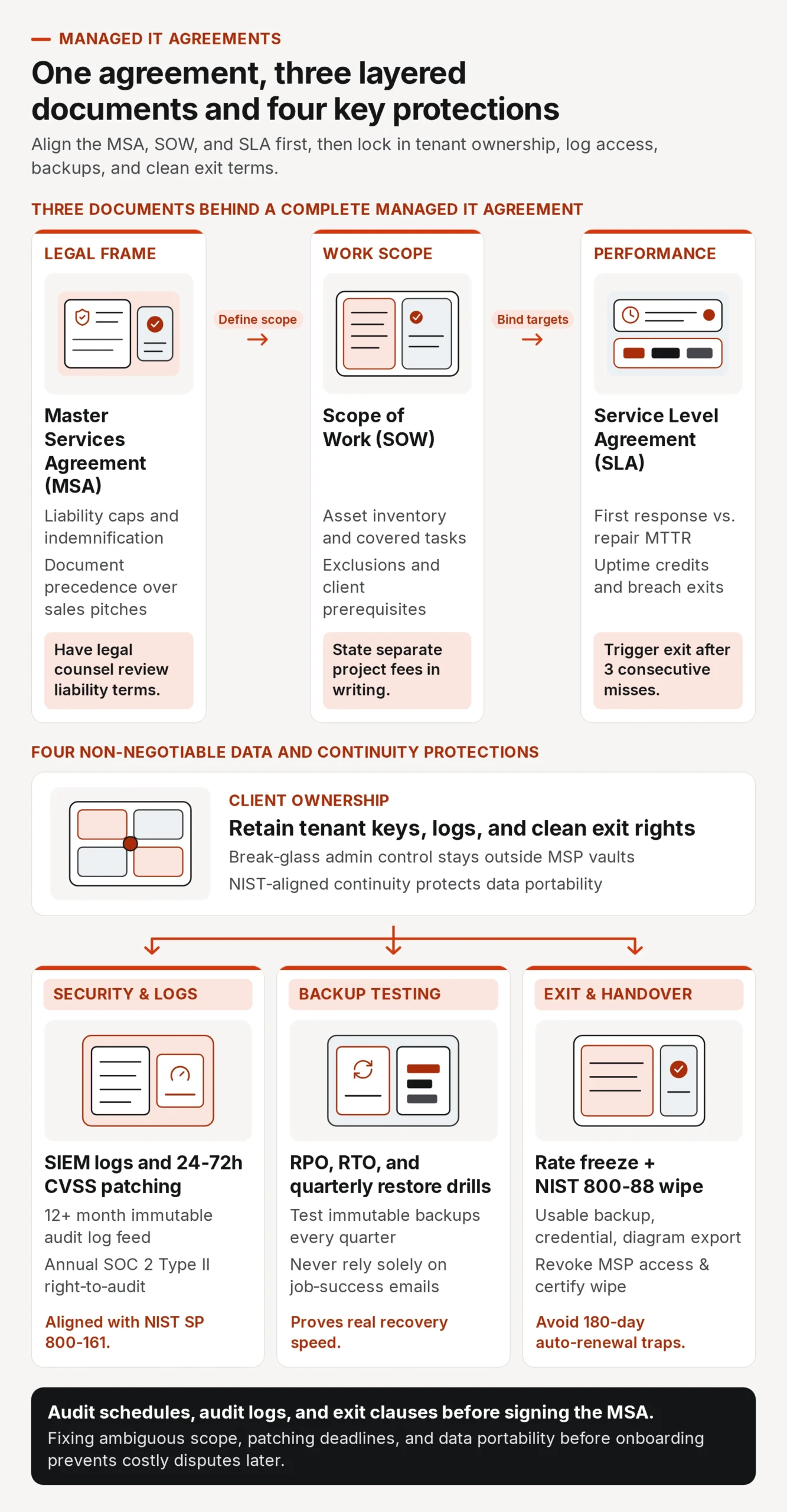
Most managed IT services contracts rest on a master services agreement, which sets the legal frame for liability caps, intellectual property ownership, and dispute resolution. All day-to-day operational obligations and engineering metrics sit in attached schedules.
Your scope of work lists covered systems and included operational duties. The service level agreement defines measurable uptime, response, and remediation targets.
Read all three documents side by side with an explicit precedence clause. A sales proposal promise carries little weight if the signed schedules omit it, since those schedules govern working obligations and billing.
Even when a provider hands over a standard master agreement, schedules and security addenda remain open to negotiation. Have legal counsel review liability caps (commonly 6 to 12 months of fees with cyber insurance carve-outs) and mutual indemnification while IT operations leaders audit the technical schedules.
Scope of work and responsibility boundaries
Defining the scope of IT responsibility starts with naming every covered server, workstation, firewall, cloud tenant, and identity directory. It should also spell out recurring operational tasks like telemetry monitoring, identity provisioning, and user support.
When a provider attaches an asset inventory, check it line by line for accuracy. Match that list against the scope of work, and confirm how newly added endpoints, remote staff laptops, or cloud workloads roll into monthly billing.
More Read

Exclusions and client prerequisites belong in writing, too. Office moves, hardware refreshes, ERP rollouts, and cloud migrations usually carry separate project fees, alongside client duties such as keeping vendor OS licenses current and barring unauthorized shadow IT tools.
Don’t skip the gray areas. Ask how the provider bills work outside the schedule. After-hours maintenance, on-site dispatch, third-party vendor coordination, and emergency hardware swaps frequently create unexpected invoices.
Response times, SLA metrics, and escalation paths
Service level agreements turn verbal support claims into enforceable engineering targets backed by billing remedies. Under standard IBM SLA contract guidance, buyers measure compliance by tracking first response time (when a qualified engineer starts triage) separately from mean time to resolution across P1 through P4 severity levels.
Certain providers reinforce critical tiers with live-answer help desks that connect urgent callers within minutes. Confirm exact P1 response windows (commonly 15 minutes or less), target mitigation hours, and a 48-hour root cause analysis commitment after major incidents.
Spell out how staff reach support across every shift. List standard desk hours, ticketing portals, after-hours emergency hotlines, and the escalation chain when frontline technicians hit a blocker.
Hosted uptime guarantees (such as 99.9% excluding pre-approved maintenance windows) sit in this schedule alongside fee credits for missed marks and a chronic-breach exit clause triggered after three consecutive missed months.
Delivery model, pricing elasticity, and rate locks
Most providers follow either a fully outsourced IT department setup or a co-managed model that backs up your internal engineering team. Your contract should clarify how headcount swings, seasonal contractors, and endpoint retirements adjust monthly fees.
In this second example which is also not at all uncommon, your organizational realignment has now materially altered core volumetrics in your outsourced agreement. Volumes went down as a result so costs should go down as well, right? Not so fast.
Greg Hall in CIOPricing typically runs per user or per endpoint with minimum seat commitments. Check whether onboarding brings a one-time charge, which security licenses sit inside the base rate, and whether downside seat reductions carry collars or early-reduction fees.
Ask whether your quoted price stays locked for the first year and how renewal increases work. For example, Uprite’s management services include a first-year rate lock. Stacking contract terms side by side across providers makes it easier to spot how each one structures rate adjustments.
Fully managed vs. co-managed IT
Operational ownership diverges sharply between full outsourcing and co-managed partnerships, especially around evening escalations, SIEM tooling, and shared admin rights.
| Contract detail | Fully managed IT | Co-managed IT |
|---|---|---|
| Staffing coverage | The provider runs daily IT operations across agreed business or 24/7 hours. | Internal IT leads core systems while the provider handles overflow, nights, or specialty tiers. |
| Security & SIEM tooling | Provider deploys and manages endpoint protection, patching, and central alerting. | Shared RMM, ticketing, and SIEM telemetry specify exact alert ownership per team. |
| Service boundaries | Scope lists covered systems and projects billed at separate hourly rates. | Responsibility matrix maps Level 1 through Level 3 tickets between internal staff and MSP. |
| Internal oversight | Client audits monthly SLA dashboards and retains strategic budget sign-off. | Internal engineering keeps architecture decisions and emergency break-glass keys. |
Security, backup, audit logging, and compliance duties
Modern agreements delegate specific security and telemetry controls to the provider, including endpoint protection, patching, managed detection and response, and role-based access enforcement. Aligning those duties with NIST SP 800-161 Rev. 1 supply-chain guidance prevents blind spots across privileged remote-monitoring agents.
Contract schedules must confirm that your organization retains legal and administrative ownership of Microsoft 365, Google Workspace, cloud accounts, and domain registrars, including verified break-glass global admin accounts stored outside MSP vaults. Require multifactor authentication for every provider technician and least-privilege access across client networks.
Audit log custody needs equal clarity. Specify real-time client access to immutable SIEM, firewall, and remote-access audit logs for 12 months or more, alongside an annual right-to-audit clause requiring current SOC 2 Type II or ISO 27001 attestation and cyber/E&O insurance certificates.
Write concrete patch and disaster recovery deadlines into the security addendum. Set critical zero-day CVSS patch windows within 24 to 72 hours, define immutable backup frequency, retention, RPO, and RTO targets, and require quarterly verified restore drills instead of relying only on backup completion alerts.
SLA, security, and offboarding benchmark table
Comparing these six core schedule clauses before signature exposes hidden billing triggers, unclear downtime exclusions, and vendor lock-in clauses early.
| Agreement clause | Concrete target to include | Contract red flag to negotiate |
|---|---|---|
| P1 critical response & RCA | 15-minute triage, 2-4 hour workaround goal, 48-hour written RCA | Vague “best effort” language or response measured only at ticket confirmation |
| Critical patching SLA | Remediate or mitigate high/critical CVSS flaws within 24-72 hours | Unrestricted patch delays without compensating network isolation |
| Tenant & break-glass access | Client keeps domain/cloud billing ownership and documented break-glass admins | MSP holds sole global admin rights or refuses external audit access |
| SIEM & audit logging | Client owns immutable logs, real-time SIEM feed, and SOC 2 Type II inspection | No log export rights or short 30-day log purging windows |
| Backup RPO/RTO & credits | Tested restore cadence (quarterly), defined RPO/RTO, fee credits + 3-month breach exit | Zero financial remedy for chronic SLA misses or untested backup claims |
| Offboarding & sanitization | 60-day transition rate freeze, usable data handover, NIST 800-88 wipe certificate | 180-day auto-renewal traps, data hostage clauses, or unverified purging |
Onboarding, offboarding, and exit terms
A complete agreement maps both how service launches and how the partnership unwinds cleanly without operational disruption. Onboarding schedules cover network discovery, CMDB asset reconciliation, credential handoffs, and a target cutover date.
Exit clauses deserve close scrutiny alongside auto-renewal language. Cap opt-out notice windows at 30 to 90 days, lock existing monthly rates during notice periods so providers cannot inflate transition assistance fees, and allow termination for cause without early-exit penalties after repeated SLA failures or security breaches.
Mandate full portability at termination: network diagrams, admin credentials, backup images, configuration exports, and license records transferred in standard non-proprietary formats. Once migration clears sign-off, require RMM agent removal, immediate VPN revocation, and a Certificate of Destruction matching NIST SP 800-88 Rev. 2 sanitization guidelines.
Practitioner RFP checklist in YAML
IT procurement and data governance teams can paste this baseline checklist into an RFP evaluation sheet before legal review:
agreement_audit:
  document_hierarchy:
    precedence_order: [MSA, Security_DPA, SLA, SOW]
    oral_sales_promises_void: true
  sla_targets:
    p1_critical_response_minutes: 15
    p1_rca_hours: 48
    critical_cvss_patch_hours: 72
    chronic_breach_exit_months: 3
  data_and_security:
    client_owns_tenants_and_domains: true
    break_glass_admin_access: verified_quarterly
    immutable_siem_log_access: client_realtime_and_12mo_retention
    annual_audit_evidence: SOC_2_Type_II
    rpo_rto_restore_test_cadence: quarterly
  offboarding_exit:
    notice_window_days: 60
    transition_rate_freeze: true
    media_sanitization_standard: NIST_SP_800_88_Rev2
    certificate_of_destruction_required: true
Reporting and account reviews
Regular service reporting proves whether a provider meets its SLA obligations across real production workloads. Monthly or quarterly business reviews should track first-contact resolution, MTTR trends, patch compliance rates, security alerts, and aging ticket backlogs.
Live telemetry dashboards help operations teams monitor queue volume daily, yet dashboards alone accomplish little without scheduled governance reviews that assign owners and firm deadlines to recurring incidents.
Larger agreements often pair those operational reviews with virtual CIO guidance covering hardware lifecycle budgets, cloud spend optimization, and cyber insurance readiness. Confirm meeting cadence and required executive attendees in the schedule before signing.
Compare finalist MSP drafts clause by clause against these benchmarks and write every promised SLA, log export rule, and exit obligation into signed schedules before execution.
Frequently Asked Questions
What is considered a managed service provider?
An external technology vendor operates as a managed service provider when you contract its team to monitor, secure, patch, and support defined infrastructure, cloud tenants, and end-user systems continuously under recurring fees and written SLAs.
What is the format for a service provider agreement?
Standard agreements pair a master services agreement covering legal liability, intellectual property, and termination with attached SOW, SLA, and security schedules, as illustrated in the ScopeStack MSA template.
What is a SaaS service agreement?
A SaaS service agreement governs subscription access to vendor-hosted cloud software and sets application uptime, data processing, and API limits, whereas a managed IT service agreement governs ongoing human engineering, help desk support, patching, and device operations across your own stack.
What happens to company data and admin access when a managed IT contract ends?
Well-drafted offboarding terms require transferring complete backups, network diagrams, and credentials in standard formats, revoking MSP remote access at cutover, and issuing a NIST SP 800-88 sanitization certificate once client migration finishes.