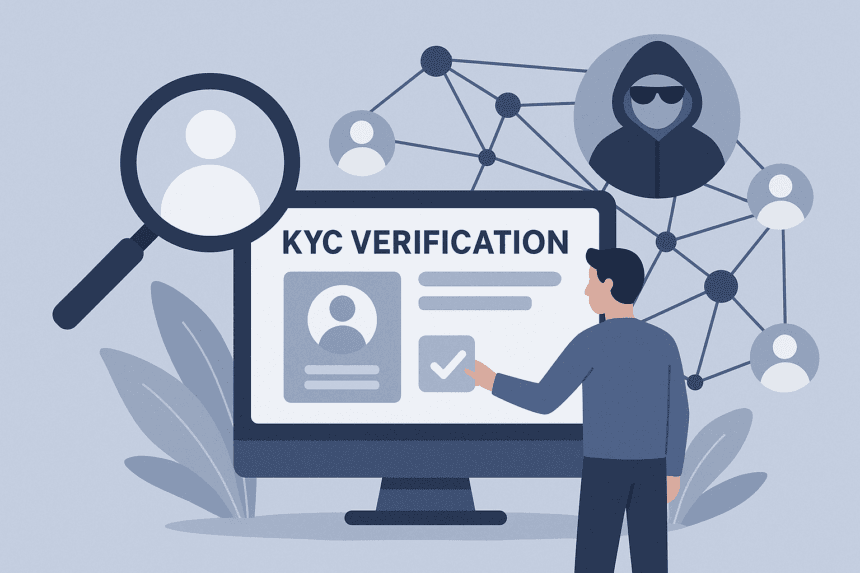
Key Takeaways
- Automation rate is the real cost driver: the share of verifications resolved without human review has more impact on unit cost and onboarding speed than an advertised price per check.
- AU10TIX is notable for network-level fraud detection. Its platform combines document and biometric checks with Serial Fraud Monitor, which looks for repeated patterns across verification traffic instead of judging every session alone.
- KYC is converging with KYB and AML: regulated firms increasingly look for one provider that can handle individual identity checks, business verification, ultimate beneficial owner identification, and screening.
- Coverage claims need testing: support for a country does not guarantee strong production performance for every document type, language, script, or identity database in that market.
The best KYC software helps a regulated business do two things at once: approve legitimate customers quickly and give fraud and compliance teams evidence they can defend later. A weak identity check creates friction for good customers, while an overly permissive one can let synthetic identities, deepfakes, and forged documents into the customer base.
Feature pages from KYC providers can look remarkably similar. The practical differences emerge in automated resolution rates, document coverage, fraud-detection design, manual-review rules, and the audit trail behind each decision. Generative AI has made convincing document forgeries and face manipulation easier to create, so a single document-and-selfie check no longer provides enough protection for every risk level. For more context on the wider threat, see AI technology and online fraud prevention.
The 10 Best KYC Software Vendors in 2026
1. AU10TIX
AU10TIX is a strong fit for organizations that need KYC verification and coordinated-fraud detection in the same operating model. While many identity verification software platforms assess one document, one selfie, and one decision at a time, AU10TIX adds a network view through Serial Fraud Monitor, which identifies repeated documents, actors, and traffic patterns across verification activity.
The company’s airport-security heritage is visible in its document focus. AU10TIX says its platform supports thousands of identity-document types across more than 190 countries, with optical character recognition designed for multiple languages and scripts. A production-like pilot with your highest-volume documents remains essential because a broad country count does not guarantee equal performance across every document series.
More Read

The core flow targets high-volume onboarding. AU10TIX states that fully automated checks can finish in four to eight seconds by combining document-authenticity checks, biometric face matching, and passive liveness detection. Its AnyDoc technology applies more than 150 visual, digital, and data checks to PDFs and image files, but your team should measure latency, false positives, and manual-review rates against real traffic.
Serial Fraud Monitor is the clearest reason to place AU10TIX ahead of a conventional document-checking platform. It searches for repeated templates, conflicting identity signals, and coordinated attacks across sessions and customers. That network-level perspective can expose a fraud campaign even when each individual application appears plausible on its own.
AU10TIX also reflects the move toward consolidated compliance operations. Its portfolio includes Know Your Business (KYB) verification, ultimate beneficial owner (UBO) identification, Anti-Money Laundering (AML) screening, proof of address, age verification, deepfake detection, and Near Field Communication (NFC) checks for electronic passports and identity cards. A shared console can reduce the integrations your compliance team manages, although every module still needs independent testing.
- Global document coverage: thousands of ID types across more than 190 countries, with multilingual OCR
- Serial Fraud Monitor: network-level detection of coordinated and repeated fraud across sessions
- Deepfake and injection-attack defense: designed to identify manipulated faces and media
- 150-plus forensic checks: analysis for tampering in digital documents, PDFs, and image files
- NFC chip authentication: cryptographic checks for compatible ePassports and eIDs
- Built-in KYB, UBO, and AML screening: available through the same platform and API
- Compliance mapping: support for relevant FATF guidance and European regulatory requirements
AU10TIX will not be the right KYC provider for every company. Its edge lies in combining broad document verification with traffic-level intelligence that can reveal coordinated fraud. A business with a simple domestic onboarding flow may find a lower-cost identity verification provider faster to deploy.
2. Sumsub
Sumsub is a broad KYC compliance software platform for teams that want identity verification, AML screening, transaction monitoring, and fraud controls in one environment. Its visual workflow builder lets compliance teams set country- and risk-specific journeys without asking developers to rebuild the whole onboarding flow.
The platform is especially relevant to crypto exchanges, fintechs, and gaming businesses working across several jurisdictions. Verification methods include documents, biometrics, liveness checks, and non-documentary database checks in supported markets.
Sumsub’s value depends heavily on workflow design. A well-tuned flow can remove needless friction for low-risk customers, while a lightly configured deployment can send too many cases into manual review.
- Visual workflow builder: country- and risk-specific onboarding flows
- Bundled AML screening and transaction monitoring: alongside KYC checks
- Non-documentary verification: database checks in supported markets
- Case management: audit trails for compliance operations
3. Jumio
Jumio remains a credible option for large organizations that value an established enterprise track record. The company provides document verification, biometric matching, liveness detection, and AML-related capabilities for sectors including banking, aviation, healthcare, and payments.
Its enterprise scale can help with governance, certifications, and service-level processes. The trade-off is practical: smaller companies may encounter a heavier contracting process, more demanding implementation work, and higher commercial minimums than they would with newer KYC providers.
- Long enterprise track record: across aviation, banking, healthcare, and payments
- Risk scoring: informed by large volumes of verification activity
- Document, biometric, and liveness verification: with integrated compliance tooling
- Mature certifications and SLAs: suited to enterprise procurement
4. Entrust (Onfido)
Entrust completed its acquisition of Onfido on April 9, 2024, bringing Onfido’s document and biometric identity verification into Entrust’s broader identity-security portfolio. The combined offering connects customer onboarding with authentication, payment security, and workforce identity tools. Entrust confirmed the completed acquisition in April 2024.
Onfido’s Real Identity Platform remains the relevant product for customer KYC verification. It combines document checks, facial biometrics, liveness, trusted data sources, and configurable workflows. Before signing, confirm product ownership, support routes, and the roadmap for your market rather than assuming every Entrust identity product uses the same implementation model.
- Atlas AI: document and biometric verification models
- Entrust portfolio integration: links consumer and workforce identity security
- Studio orchestration: conditional verification workflows
- Strong regulated-market presence: especially in banking and Europe
5. Veriff
Veriff is a strong choice when onboarding conversion is the immediate business priority. The company emphasizes the capture experience, using real-time guidance to help customers photograph documents correctly and avoid preventable retries.
Its decision engine combines document checks, face matching, device signals, and network signals. That mix suits marketplaces, mobility platforms, gaming companies, and other consumer businesses where each abandoned verification can directly reduce revenue.
Veriff is less centered on the full compliance stack than vendors such as Sumsub or AU10TIX. Organizations that need extensive AML screening, transaction monitoring, or complex lifecycle controls may pair Veriff with separate KYC services.
- Capture experience: designed to reduce document-submission failures
- Decision engine: combines document, biometric, device, and network signals
- Fast integration: SDKs suited to consumer product teams
- Broad document and language support: for international customer bases
6. Trulioo
Trulioo takes a data-first approach to identity verification. Its GlobalGateway platform connects businesses to government, credit, utility, and other identity data sources, allowing some customers to verify identity without uploading a document in markets with strong electronic records.
When the available data is accurate and closely matched to the applicant, this approach can reduce friction. Database depth and data quality vary by country, so global businesses often use Trulioo’s data checks in stronger markets and document verification elsewhere.
- Data-source verification: government, credit, and utility records in supported markets
- Low-friction flows: verification without document capture where data coverage permits
- KYB business verification: alongside individual identity checks
- Single API: across data, document, and biometric methods
7. Persona
Persona is designed for teams that want to build their own verification logic. Its components include document checks, selfie comparison, database lookups, watchlist screening, and risk-based links between steps. Product and compliance teams can create different flows for different customer types instead of forcing every applicant through the same sequence.
That flexibility appeals to product-led companies and United States startups with strong engineering support. It also puts more responsibility on your team: you decide which checks to run, when to step up verification, and how to document those decisions.
- Composable verification blocks: assembled into risk-based flows
- No-code flow editor: supported by APIs for product teams
- Integration marketplace: for screening, fraud, and data checks
- Granular orchestration: adjusts friction to the user’s risk profile
8. Socure
Socure specializes in predictive identity analytics for the United States. Its RiskOS platform connects details such as name, date of birth, address, phone, email, and device information to identify suspicious patterns before a business asks for a document.
That approach is particularly relevant to United States banks, lenders, fintechs, and public-sector programs dealing with synthetic identities and first-party fraud. Socure’s strongest data-network effects are US-focused, so international businesses may use it as a country-specific layer rather than as their only KYC provider.
- Identity graph and consortium data: supporting predictive risk scores
- Synthetic identity and first-party fraud detection: before document capture
- US financial-services focus: with public-sector use cases
- RiskOS platform: combining verification, fraud, and decisioning
9. iDenfy
iDenfy targets startups and mid-sized companies that want a relatively simple buying and implementation process. Its services include document verification, facial recognition with liveness, AML screening, and business verification.
The company is known for a pay-per-approved-verification pricing model and for combining automated checks with human review. The model can make costs easier to forecast, but teams still need to ask how “approved” is defined and what share of cases will require manual handling at their expected volume.
- Pay-per-approved-verification pricing: aligns cost with successful onboarding
- Document, biometric, and liveness verification: with AML screening
- Human review: supporting automated decisions
- Hands-on support: suited to smaller compliance teams
10. Fourthline
Fourthline was built around the needs of European financial institutions. The Amsterdam-based company provides KYC, AML screening, and ongoing client-lifecycle monitoring for banks, brokers, and fintechs that need to show supervisors how controls operate over time.
Its European regulatory focus is both its strength and its boundary. Fourthline deserves a place on the shortlist for an EU financial-services business, while a non-European company or a business outside financial services may need broader geographic and industry coverage.
- Banking-grade KYC: designed for European regulatory expectations
- Ongoing monitoring and remediation: across the customer lifecycle
- Audit-ready compliance reporting: for regulated operations
- European financial-services focus: across banks, brokers, and fintechs
What Changed in KYC for 2026
KYC software buying decisions now turn on three issues: coordinated fraud, stronger expectations for evidence, and the growing use of digital identity in everyday onboarding. A vendor that only scores a document image is no longer addressing the whole problem.
- Generative fraud has become an operating risk. Deepfake selfies, AI-generated document images, and forged-document networks have pushed identity verification beyond simple pixel checks. Your fraud stack needs behavioral, device, cryptographic, and network signals alongside document OCR.
- Regulators are examining the process as well as the result. The European Banking Authority’s remote customer-onboarding guidelines require risk-sensitive initial customer due diligence and set out how financial institutions should assess the adequacy and reliability of remote onboarding tools. The European Banking Authority’s remote onboarding guidelines are technology-neutral, but they make the institution responsible for the controls it deploys.
- Digital identity can improve access, but assurance still matters. The Financial Action Task Force says reliable digital identity can make customer due diligence easier, cheaper, and more secure. Its digital identity guidance also notes that 1.7 billion adults were unbanked, and 26% cited lack of documentation as the main barrier, showing why flexible identity methods matter commercially as well as technically.
Network intelligence matters because a verification vendor can approve a clean passport and a convincing selfie while missing a pattern across the wider customer base. The same device, document template, address pattern, or synthetic identity may be appearing across dozens of accounts. Businesses assessing KYC providers should therefore test whether the platform can connect those signals before fraud turns into a scaled campaign.
Frequently Asked Questions
What is KYC verification?
KYC verification confirms that a customer is who they claim to be. The process can include document validation, biometric matching, database checks, sanctions screening, and additional review for higher-risk cases.
How long should automated KYC take in 2026?
A straightforward automated check should usually return a decision in seconds. The more important measure is the percentage of cases resolved without human review, because a fast first step does not create efficient onboarding if most applications later enter a manual queue.
What is the difference between KYC and AML?
KYC establishes and verifies a customer’s identity, usually during onboarding. AML is the broader control program, covering sanctions and politically exposed person (PEP) screening, transaction monitoring, suspicious-activity reporting, and ongoing customer due diligence.
Can one vendor cover KYC, KYB, and AML screening together?
Yes. Many modern KYC providers offer individual verification, Know Your Business (KYB), UBO identification, screening, and case management through one API or console. Consolidation can reduce integration work, but one vendor does not remove the need to test each control separately.
How do KYC vendors detect deepfakes and synthetic identities?
Session-level defenses include liveness detection, injection-attack detection, and document forensics. Stronger identity verification software also uses device, network, and consortium signals to connect separate applications that share suspicious patterns.
Do small companies need KYC compliance software?
A small company may need KYC compliance software if it is regulated, handles payments, serves high-risk markets, sells age-restricted products, or operates a marketplace where identity fraud creates material losses. The practical priorities are transparent pricing, fast integration, clear data-retention rules, and a review process your team can manage.
Your next step is a controlled proof of concept, not a feature-counting exercise. Send each shortlisted best KYC software vendor the same mix of genuine, borderline, synthetic, and known-fraud cases, then compare automated resolution, false positives, manual-review load, document coverage, audit evidence, and total cost per approved customer. The provider that identifies the patterns hidden between individual applications will be better prepared for the fraud your business faces next.