
Cookies help us display personalized product recommendations and ensure you have great shopping experience.

By using this site, you agree to the Privacy Policy and Terms of Use.
Accept
SmartData CollectiveSmartData Collective
  • Analytics
    AnalyticsShow More
    predictive analytics risk management
    How Predictive Analytics Is Redefining Risk Management Across Industries
    7 Min Read
    data analytics and gold trading
    Data Analytics and the New Era of Gold Trading
    9 Min Read
    composable analytics
    How Composable Analytics Unlocks Modular Agility for Data Teams
    9 Min Read
    data mining to find the right poly bag makers
    Using Data Analytics to Choose the Best Poly Mailer Bags
    12 Min Read
    data analytics for pharmacy trends
    How Data Analytics Is Tracking Trends in the Pharmacy Industry
    5 Min Read
  • Big Data
  • BI
  • Exclusive
  • IT
  • Marketing
  • Software
Search
© 2008-25 SmartData Collective. All Rights Reserved.
Reading: The Rise of the Intercloud
Share
Notification
Font ResizerAa
SmartData CollectiveSmartData Collective
Font ResizerAa
Search
  • About
  • Help
  • Privacy
Follow US
© 2008-23 SmartData Collective. All Rights Reserved.
SmartData Collective > Uncategorized > The Rise of the Intercloud
Uncategorized

The Rise of the Intercloud

TheodoreOmtzigt
TheodoreOmtzigt
5 Min Read
SHARE

Found a wonderful post by Greg Papadopoulos in which he postulates the trend towards interclouds. Greg argues that Amazon’s AWS BYOS/IaaS (Bring Your Own Stack) is the perfect marriage of simplicity and functionality that it will be with us for a long time. SaaS is the new delivery norm of software, and PaaS is the needed productivity layer to hide the complexity of IaaS. The proliferation of SaaS on top of PaaS on top of IaaS is the wrath of early technology adoption when most of the functionality is still in its infancy.

Found a wonderful post by Greg Papadopoulos in which he postulates the trend towards interclouds. Greg argues that Amazon’s AWS BYOS/IaaS (Bring Your Own Stack) is the perfect marriage of simplicity and functionality that it will be with us for a long time. SaaS is the new delivery norm of software, and PaaS is the needed productivity layer to hide the complexity of IaaS. The proliferation of SaaS on top of PaaS on top of IaaS is the wrath of early technology adoption when most of the functionality is still in its infancy.

As Greg writes:
“Productive and in-production are different concepts, however. And as much as AWS seems to have found the lowest common denominator on the former with IaaS, how at-scale production will actually unfold will be a watershed for the computing industry.

Getting deployed and in production raises an incredible array of concerns that the developer doesn’t see. The best analogy here is to operating systems; basic sub-systems like scheduling, virtual memory and network and storage stacks are secondary concerns to most developers, but are primary to the operator/deployer who’s job it is to keep the system running well at a predictable level of service.

More Read

The Craft of Exploratory Search
Managing Change: Pick Something, and Do It Well
Improving Website and WordPress Performance with Hard-Coded Share Buttons
Melissa Hathaway Op-Ed on Cyber Security
One Hit Wonders

Now layer on top of this information security, user/service identity, accounting and audit, and then do this for hundreds or thousands of applications simultaneously and you begin to see why it isn’t so easy. You also begin to see why people get twitchy about the who, where, and how of their computing plant.

Make no mistake, I have no doubt that cloud (nee network, grid) computing will become the organizing principle for public and private infrastructure. The production question is what the balance will be. Which cloud approach will ultimately win? Will it be big public utility-like things, or more purpose-built private enterprise ones?

The answer: yes. There will be no more of a consolidation to a single cloud than there is to a single network. “

He goes on to say the cloud will organize much like the energy business with a handful of very large networks supported by hundreds of regional and national companies. In this comparison, Greg finds an analogy in the internetworking development. Connecting all these federated entities together has created tremendous value, and thus it is reasonable to expect that the cloud will organize as a federated system as well. But to accomplish that, the cloud community needs to develop the right standards, just like the Internet community did for internetworking so that nobody has to be afraid to become an isolated island.

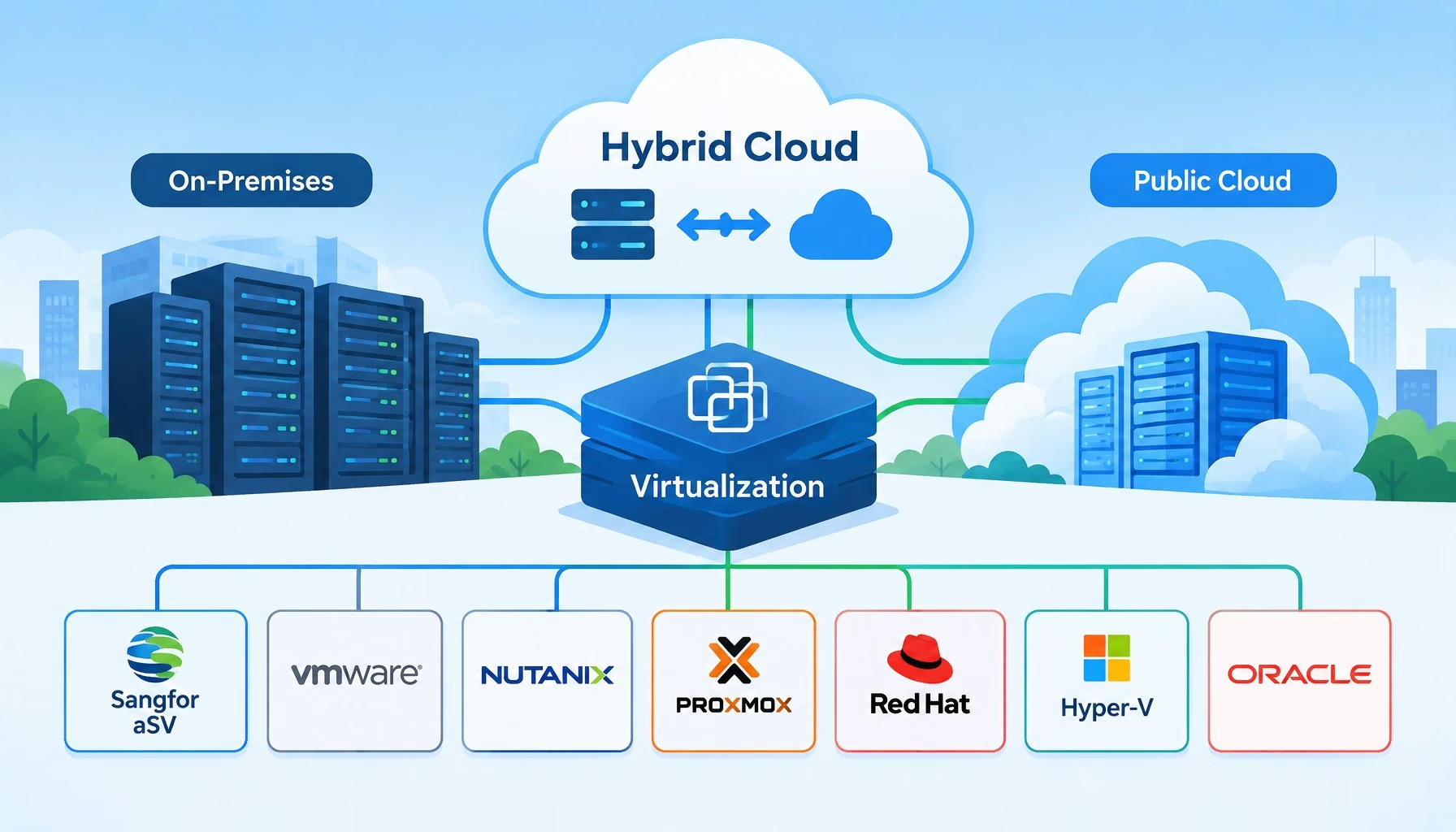
Putting on my developer’s hat, this fear of becoming isolated is what is holding me back to commit to Google Apps or Microsoft Azure: they feel too proprietary in this age of open source and federated clouds. One of my core requirements for cloud applications is that the application could migrate from private cloud to public cloud and vice versa. When the economic value of the application goes up or down I want to be able to allocate it on the right infrastructure to maximize profit or minimize cost. Closed environments like Salesforce.com, Google Apps, or Microsoft Azure are a concern as these environments create a fierce lock-in for my application. Encapsulating it in an OVF virtual appliance provides me much greater flexibility at the cost of not having productive elastic computing services. That capability is maturing as we speak as its value is as obvious as it is needed.
TAGGED:cloud computing
Share This Article
Facebook Pinterest LinkedIn
Share

Follow us on Facebook

Latest News

street address database
Why Data-Driven Companies Rely on Accurate Street Address Databases
Big Data Exclusive
predictive analytics risk management
How Predictive Analytics Is Redefining Risk Management Across Industries
Analytics Exclusive Predictive Analytics
data analytics and gold trading
Data Analytics and the New Era of Gold Trading
Analytics Big Data Exclusive
student learning AI
Advanced Degrees Still Matter in an AI-Driven Job Market
Artificial Intelligence Exclusive

Stay Connected

1.2kFollowersLike
33.7kFollowersFollow
222FollowersPin

You Might also Like

“Freemium’s” broken promises

4 Min Read

Lyzasoft says “power to the people” with free version

6 Min Read

What is Cloud Computing

1 Min Read

Why is there so little innovation in cloud hardware?

5 Min Read

SmartData Collective is one of the largest & trusted community covering technical content about Big Data, BI, Cloud, Analytics, Artificial Intelligence, IoT & more.

data-driven web design
5 Great Tips for Using Data Analytics for Website UX
Big Data
AI and chatbots
Chatbots and SEO: How Can Chatbots Improve Your SEO Ranking?
Artificial Intelligence Chatbots Exclusive

Quick Link

  • About
  • Contact
  • Privacy
Follow US
© 2008-25 SmartData Collective. All Rights Reserved.
Go to mobile version
Welcome Back!

Sign in to your account

Username or Email Address
Password

Lost your password?