At its Business Analytics Analyst Summit (Twitter: #IBMBAS12) this week, IBM unveiled its new release of analytics software for decision management. Over the last 25 years decision support systems have transformed into decision management, in which analytics, rules and optimization methods help organizations use information to guide optimal outcomes. IBM has experience and technology in these areas, most of it acquired, to apply to specific organizational needs in vertical industries. In addition, IBM has advanced its information management technologies to support big data and predictive analytics in operational environments. Its stream- and event-processing technology helps speed routing and analysis of information across business processes. Each of these are critical for supporting decision management technology needs for business processes.
Operational decision management software automates repeatable tasks in business processes and also deals with unique situations in which the right responses are not as certain. IBM uses business rules for processing what is known and what can be managed through workflow. Rules may deal with a range of situations where specific conformance to compliance requirements and applied analytics can flow through predetermined steps. IBM’s Analytical Decision Management uses predictive models that use situational variables such as customer responses to provide analysis to direct actions. Predictive models can minimize risk, optimize customer interactions and optimize responses to situations. IBM has combined its models into a set of services that can be orchestrated into operational activities and business processes. This analytical approach addresses the limitations of business process management, which attempts to map activities into a predefined order without having the ability to embed what I call situational intelligence into the business process. IBM’s environment enables organizations to focus more on operations or analytics as they choose.
This platform of decision services and configurable applications can operate in many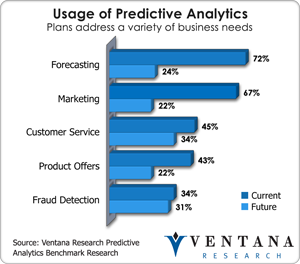 business areas, including insurance claims, financial services transactions and customer service processes. IBM also is using its decision management offering to provide prebuilt application environments it calls Signature Solutions, which reduce the time and skills required to get started for specific purposes. These solutions are available initially in customer, finance and fraud areas, but the same approach can be applied to many industries, and it should help IBM win more opportunities to deploy its solutions and help organizations optimize business through decision management. In fact our benchmark research in predictive analytics found a similar pattern to future needs of the technology. IBM is investing significantly in decision management and has an aggressive product roadmap to make it easier to define and improve existing deployments by editing and refining existing work.
IBM’s work to advance business process decisions should be applauded. However, based on its presentations and approach in communications at the analyst summit, I think it is offering too much high-level information on concepts and theory and not enough specifics on use-case details in real  business processes, on the capabilities its software provides and how it is integrated into existing applications and systems. For example, a customer service organization likely will not use IBM’s decision management software for customer interactions by itself; it will have to work with applications from other providers that are used in agent desktop environments. IBM should give more specific examples on its partnerships and integration points with details so prospects will see it as an evolutionary approach and not a transformational one that requires a complete restart of processes and applications. Our benchmark research found that the integration into information architectures was the highest obstacle in 55 percent of organizations in use of predictive analytics that IBM helps address with its offering. It also should focus on guiding the actions more than the decisions, as improvements in the accuracy of actions will have a much larger payoff for business.

If you have not investigated at how analytics, especially predictive ones, can help improve decision-making within business processes, you should look at IBM’s decision management offerings, which can help operationally and analytically to drive better outcomes.
Regards,
Mark Smith – CEO & Chief Research Officer