
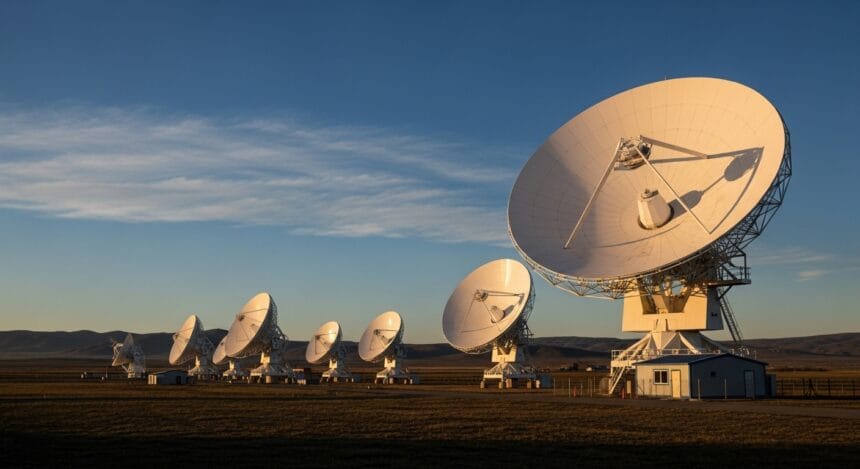
Since Ryan took over as the lead editor at Smart Data Collective, we have expanded this focus even further. These themes now include the growing role of machine learning in monitoring objects that move far above the planet.
- Machine Learning and the Future of Satellite Tracking
- What Is Satellite Object Tracking?
- Why Should Businesses Care About Tracking Space Objects?
- How AI Is Helping In Tracking
- Real-Life Uses For Companies
- It Also Helps In Safety And Security
- Business Planning Gets Stronger
- Using Trusted Platforms and Data
- AI And Cloud Support Make It Even Better
- Future Opportunities Are Growing
There are growing questions about how satellite traffic can be tracked without human analysts missing sudden changes in orbit. Keep reading to learn more.
Machine Learning and the Future of Satellite Tracking
Naveen Kumar of DemandSage reports that 48% of businesses globally use machine learning in daily operations. It is a sign that algorithmic prediction is no longer limited to research labs. You can see the same pattern in aerospace data centers, where models scan orbital paths for unusual motion. These systems flag potential collisions long before radar operators would normally react.
You can think of satellite tracking as a constant stream of coordinates that must be checked for small but meaningful shifts. Errors of only a few seconds can place two objects on a collision course.
More Read

The satellite tracking website Orbiting Now lists 12,149 active satellites in various Earth orbits. It is a scale that makes manual monitoring unrealistic. You depend on automated pattern detection to sort stable paths from risky deviations.
A market research report projects that the global machine learning market will reach $113.10 billion in 2025. There are clear financial signals that companies expect continued demand for predictive systems in fields such as navigation and space traffic control. It is also an indication that software budgets are rising alongside orbital congestion.
You often see tracking models trained on decades of orbital history to identify when a satellite behaves unlike its past pattern. These predictions allow engineers to schedule adjustments before fuel reserves are strained.
It is common for tracking software to combine telescope data, radar signals, and historical trajectories into a single forecast. These blended inputs help narrow the margin of error when satellites pass close to one another.
It is clear that automated prediction has become a safety measure rather than a luxury. You notice the impact in fewer emergency maneuvers and lower operating stress for mission teams. This steady monitoring also supports longer satellite lifespans by reducing unnecessary course corrections. Over time, this stability lowers the chance of debris fields forming in crowded orbital zones.
There are strong reasons for space agencies and private operators to continue refining these systems. Machine learning offers a practical path toward safer navigation as the number of satellites continues to climb.
These days, many companies are using technologies that depend on satellites.
Whether it’s GPS, internet, TV signals, transport tracking, or communication, everything works smoothly only because satellites are doing their job up there.
Now you may think, okay, satellites are there, but how does tracking them help a normal business?
The simple answer is: if you know where satellites and other objects are, and how they’re moving, you can avoid problems and make better decisions on the ground.
Let’s talk about it in simple words.
What Is Satellite Object Tracking?
Satellite object tracking means watching and keeping a record of all the objects moving in space. This includes working satellites, old ones that are not working, small parts from past missions, and even natural objects like asteroids.
Space is big, but also full of fast-moving objects. If any two objects come too close or crash, it can disturb services on Earth.
So scientists and companies keep a close watch on them. These days, with the help of Artificial Intelligence (AI), this tracking has become very fast and accurate.
Platforms like Orb are now available, which allow tracking the orbital path of satellites and other space objects.
Such platforms are easy to access and give the right path data. Even normal users or companies can use them for analysis or planning.
Why Should Businesses Care About Tracking Space Objects?
You might be thinking, All this is fine for space agencies like NASA or ISRO. But now even private businesses are using satellite signals daily.
Let’s say a delivery company wants to track where its trucks are. That GPS signal comes from satellites. Or a company sending shipments across the ocean depends on communication satellites to track its cargo.
Even online banking, air travel, or farming equipment depends on satellite timing and location data. If these services get disturbed even for a short time, businesses can lose time and money.
By using satellite object tracking, companies can stay alert. They can plan better, adjust systems in case of any satellite movement, and stay one step ahead.
How AI Is Helping In Tracking
AI is playing a smart role in this area. Before, teams had to look at big data and do manual tracking, which took time.
Now AI looks at thousands of signals and gives clear results in a few seconds. It checks past movements of objects and predicts where they will be next. This helps companies avoid issues early.
For example, if an internet provider knows that one satellite is about to pass through a risky path, they can quickly shift some of the load to another satellite and maintain service.
AI also reduces human error. It keeps learning from new data and improves over time. This is very helpful for businesses that depend on reliable and quick data.
Real-Life Uses For Companies
Let’s look at some simple examples of how companies can use this. A company that provides GPS devices can use satellite tracking to give more accurate service.
A logistics company can plan its shipment routes better by checking real-time satellite signal health. A weather-based farming business can improve its reports by getting updated data from satellites.
Even a media company that streams live events can avoid interruptions if it monitors the satellite signals in advance. And all of this is possible with platforms like Orb, which make it easy to track and predict orbital movements.
For example, NASA’s Near EarthObject Program also shares useful information about objects in space that can help companies understand how space traffic is increasing.
It Also Helps In Safety And Security
Many companies now work in areas like oil and gas, electricity, transport, or defense. These fields are very sensitive. Any signal delay or error can cause big confusion.
By using satellite object tracking, these companies can stay alert. They can receive early alerts if any object is likely to come close to the satellite that they depend on. With this data, they can take fast action and avoid service problems.
In security areas, some companies also use satellite tracking to monitor the sky for any unknown objects or signals. This makes their operations more controlled and reliable.
Business Planning Gets Stronger
Every company wants to reduce risks and increase profits. For that, they need strong planning.
With satellite object tracking, businesses get another layer of smart decision-making. They can use the data to decide when to launch new services, where to focus more, or how to manage backups. This also helps in future planning.
For example, if a company is planning to use space-based internet, it can check orbital traffic and satellite availability before making any investments. These steps improve their overall system and save costs in the long run.
Using Trusted Platforms and Data
There are many good sources of information available now. NASA, for example, regularly updates information about objects in space.
Private platforms like Orb help by providing clear and trackable data about orbital paths. These platforms make it easy for non-space experts to also use satellite data in their business. And because this information is based on real calculations and AI support, the results are very reliable.
It is no longer something that only scientists can use. Business people, engineers, analysts, and even startups can use this for better planning.
AI And Cloud Support Make It Even Better
Nowadays, everything is connected to cloud platforms. Companies store their data in the cloud, use AI for analytics, and make decisions using dashboards. Satellite tracking fits perfectly in this system.
AI gives real-time updates, cloud stores large amounts of data, and dashboards make it easy to read. This smooth connection helps companies use satellite tracking without changing their full system.
So, it’s easier to adopt and use every day. Some cloud service providers also offer APIs and satellite data platforms that can be added to business systems directly.
Future Opportunities Are Growing
Many small companies are now entering space-related services. Some are building small satellites, some are offering space data services. For all these new businesses, satellite object tracking is not optional; it is basic.
Even for normal companies, the use of this data will keep growing. As more satellites are launched, traffic in space will increase. The need to track objects and avoid delays will become more important.
Companies that prepare early will have an advantage. They can offer better service, stay safe, and make better decisions.
Final Thought
So if you’re running a business that depends on the internet, GPS, shipping, banking, or even media, satellite object tracking can give you an edge. With AI platforms and tracking platforms like Orb, you can stay updated about what’s happening above Earth and use that knowledge to keep your services running strong. You don’t need to be a space agency to use this data. Just using the right platforms at the right time can make a big difference. And when decisions are based on solid information, results are always better.