
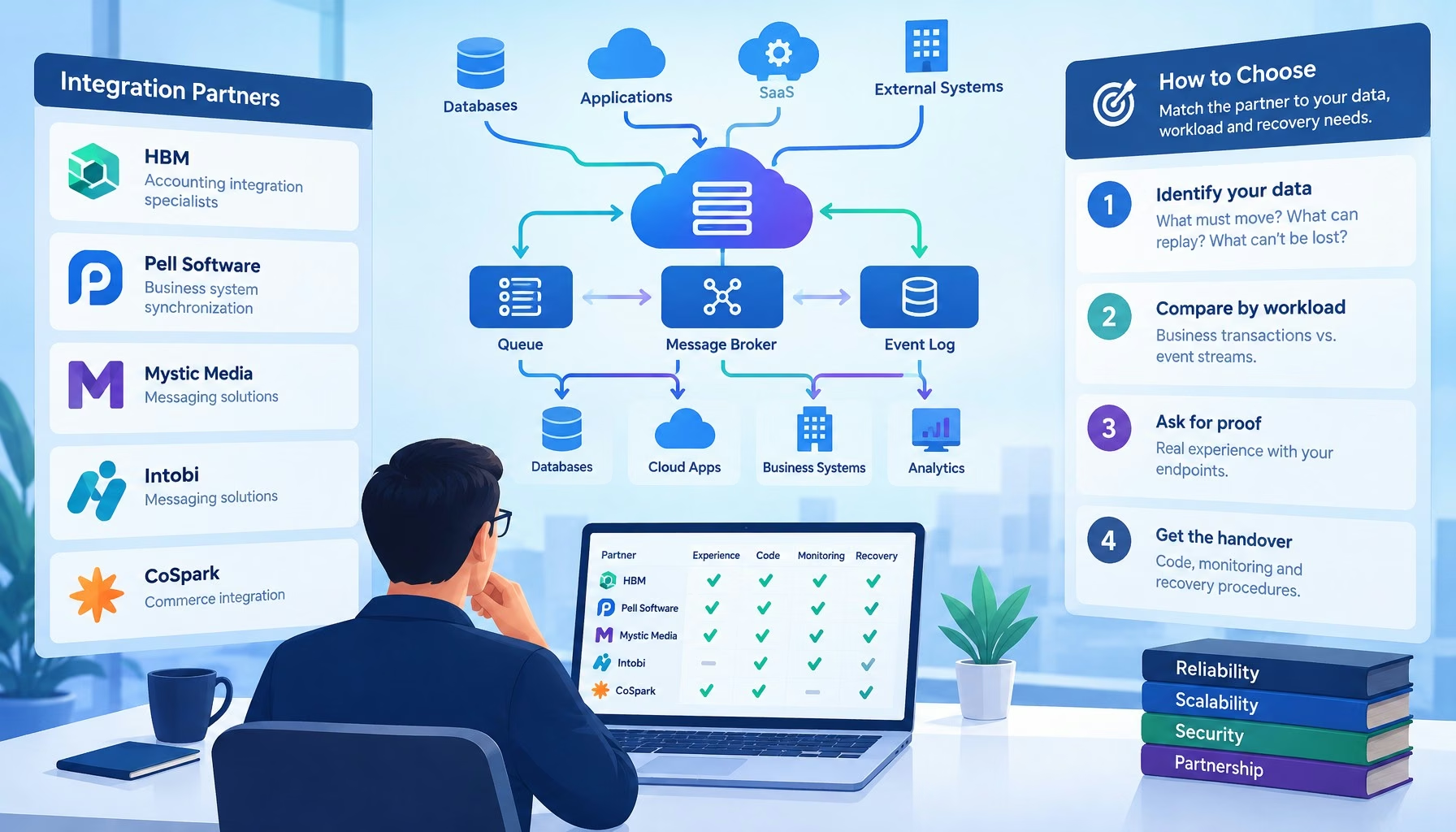
Integration projects are scoped around systems but delivered through protocols. A proposal may simply say, “connect the CRM to the ERP.” In practice, the work may involve a REST API with undocumented rate limits, a SOAP endpoint untouched since 2014, a nightly file transfer that must continue during migration, and a webhook that sends duplicate events when the source system retries.
- Service Bus Development Companies Mentioned in This Article
- Connection Types, and Why They Decide the Shortlist
- Azure-Native Integration, or a Custom Service Bus?
- The List of the Top Service Bus Development Companies
- Inside the Product or as a Separate Layer
- Where Integration Projects Stall
- Checklist Before Kickoff
- Conclusion
This article compares the top service bus development companies based on their experience across this mix of connection types. Delivery problems often come from technical gaps rather than a misunderstanding of the business goal.
Many of these estates already run on Azure, where the integration layer may be built on Azure Service Bus and Logic Apps rather than assembled from scratch. This article covers both routes and the companies that work across them.
Service Bus Development Companies Mentioned in This Article
- HBM. Founded in 2021 in Budapest, with 50 to 249 employees. About 90% of its engineers are seniors, leads, and architects. Works across all the most popular cloud platforms, various message brokers, and connectors for ERP, CRM, e-invoicing, and payments.
- Pell Software. US-based boutique with 29 Clutch reviews. Builds custom CRMs, ERPs, workflows, APIs, and cloud integrations.
- Mystic Media. Salt Lake City firm with 28 Clutch reviews. Projects range from $30,000 to over $750,000 and cover third-party APIs and cloud migration. Hourly rates aren’t published.
- SapientPro. Founded in 2016, with 43 Clutch reviews. Projects range from $5,000 to $150,000, and monthly packages start at $6,400. Focuses on outcome-based delivery.
- Intobi. 53 Clutch reviews. Provides custom software, API development, CRM and systems integration, and ongoing staff augmentation.
- CoSpark. Founded in 2009, with 10 to 49 employees and 21 Clutch reviews. Rates range from $100 to $149 per hour, with projects from $10,000 to over $100,000. Covers a wide range of API integrations.
- Haefele Software. 12 Clutch reviews, with projects from $10,000 to $363,000. Delivers custom software through Azure DevOps with business process support.
Connection Types, and Why They Decide the Shortlist
Connection types drive technical scope. Choose vendors with production experience in current and planned protocols.
- REST APIs. Assess rate limits, pagination, and version changes.
- SOAP and legacy endpoints. Common in ERP, insurance, and banking, these workloads may justify an ESB. Verify production experience.
- Webhooks and event pushes. Support real-time integration and handle duplicate or out-of-order events.
- File and batch exchanges. Architect for both real-time operations and batch reconciliation or migrations.
- Message queues and brokers. Assess volume, ordering, retries, dead-letter queues, and experience with required brokers.
Most estates use multiple connection types, narrowing the shortlist.
| Company | Strongest connection types |
|---|---|
| HBM | Brokers and queues, Azure Service Bus, REST, GraphQL, webhooks, RPC, ERP and e-invoicing endpoints |
| Pell Software | REST between cloud platforms, open APIs, workflow automation |
| Mystic Media | Third-party REST APIs, cloud service integration |
| SapientPro | REST, e-commerce and CRM endpoints |
| Intobi | REST, CRM platform integration |
| CoSpark | REST, SOAP, RPC, Partner API, webhooks, Open API |
| Haefele Software | REST inside custom builds, Azure-hosted services |
Azure-Native Integration, or a Custom Service Bus?
Azure can quickly deliver an integration layer using Service Bus, Logic Apps, Functions, API Management, and Event Grid. The trade-offs are unpredictable usage costs, connector limits, and cloud dependence.
A custom service bus costs more and needs separate monitoring and retry tools but preserves control over routing, transformations, and hosting. Most estates use Azure for standard workflows and custom components for gaps. Vendors should justify both choices.
The List of the Top Service Bus Development Companies
The top service bus development companies listed below differ in their technical focus and delivery models. Each profile covers the connection types the vendor supports, project evidence, and the estates it best fits, so you can compare providers on a consistent basis.
More Read

HBM
Among the best service bus development companies, HBM uses technical discovery to select the integration architecture rather than starting with a fixed pattern. The team evaluates whether the estate needs an enterprise service bus, streaming architecture, serverless solution, or containerized and orchestrated model. Each connector can also run as an independent microservice.
Handles:
- Message queues and brokers: Azure Service Bus, RabbitMQ, Kafka, and Amazon SQS
- ERP endpoints: Dynamics 365 Finance and Operations, Dynamics 365 Business Central, Oracle NetSuite, Visma Business NXT, PowerOffice GO, Tripletex, Xledger, Finago, and Infor LN
- Azure-native integration: Azure Service Bus, Logic Apps, Functions, API Management, and Event Grid
- CRM endpoints: Microsoft Dynamics CRM and HubSpot
- E-invoicing access points: Logiq, Millum, and Mercell
- Payment providers: Stripe, Google Pay, Apple Pay, and Revolut Business
- External data sources: Energy grids, weather services, and map providers
- Cloud platforms: Azure, AWS, GCP, Hetzner, and OVH
- Established and custom service buses, plus repeatable connectors to customer systems for product companies
- Migrations between platforms and from legacy to modern stacks
Also delivers. HBM builds administration portals for configuring and monitoring integrations, customer portals for self-service onboarding, and data lake connections for analytics and machine learning. The team defines security, encryption, scalability, and observability requirements during the early project phases. Its services also cover integration and end-to-end testing, test automation, software development, data management, and AI implementation. Azure Service Bus is one of the brokers HBM runs in production, and the team can either build on Azure-native services or keep the design cloud-agnostic, depending on the estate.
Proof. Published projects include Propell AI, an integration platform for an AI accounting product, and Energi AI, a carbon accounting solution combining several data sources. HBM integrated public grid, payment, and billing systems for OYO Communities and connected IoT hardware for inno2grid.
Fit. HBM is suitable for estates that combine message brokers, ERP endpoints, and external data sources. Its discovery-led approach also suits projects where the technical requirements should determine the choice of broker. HBM is also an integration partner for product companies that need to connect their solutions to each customer’s systems on a repeatable basis.
CoSpark
CoSpark, formerly AnnexCore, works across a broad range of API types, including REST, Open API, Partner API, RPC, SOAP, and webhooks.
Handles:
- REST, Open API, Partner API, RPC, and SOAP interfaces
- Webhook-based integration
- Azure, Heroku, Force, and Linux server environments
- WooCommerce and WordPress integrations
Proof. A private medical practice hired CoSpark for ongoing web development, including PayPal and credit card integration and search functionality. The client reported quick delivery and consistent progress updates. Other industries documented on Clutch include education and real estate.
Fit. Smaller estates that need several API types, including SOAP or partner APIs, without the scope of a large enterprise engagement.
Pell Software
Pell Software is a US-based boutique that builds custom CRM, ERP, workflow, and API solutions for growing companies. Cloud-to-cloud integration appears regularly in its documented work.
Handles:
- REST and open APIs between cloud platforms
- Custom CRM, ERP, and workflow systems
- Process automation
- Data synchronization and deduplication
Proof. In one project, Pell Software connected several cloud platforms through open APIs and prevented duplicate records. The integration also transferred inspection data from a CRM into a digital form-building platform. Reviewers mention clear documentation, well-structured code, and accurate estimates. One client reported that delivery was faster and slightly less expensive than expected. When projects took longer, reviewers linked the delays to added scope and noted clear communication from the team.
Fit. Mid-sized estates connecting cloud platforms with available APIs, particularly when a US-based delivery team is required.
Mystic Media
Mystic Media is a Salt Lake City company that works across mobile applications, custom software, and cloud infrastructure. Its documented services include third-party API integration and cloud migration. The company scopes and prices work by project rather than by the hour.
Handles:
- Third-party API and cloud service integration
- Cloud consulting and systems integration
- Application management and post-launch support
Proof. For one client, Mystic Media migrated the full data environment from on-premises servers to the cloud. The team completed the work outside business hours, coordinated with the previous IT provider, and limited downtime to around 20 minutes per workstation. Another project included API integration for the driver side of a delivery application and an ordering process available through both the application and a web browser. Reviewers describe milestone-based delivery and cite project-based pricing as a reason for selecting the company.
Fit. Estates where integration forms part of a wider cloud migration and the buyer prefers a defined project scope over open-ended hourly billing.
SapientPro
SapientPro has developed software products and provided technology consulting since 2016. The company describes its model as taking responsibility for project outcomes rather than selling development hours.
Handles:
- REST API development and integration
- E-commerce and CRM platform connections
- Application management and support
- Staff augmentation within client teams
Proof. One software company began working with SapientPro in 2019 at around €1,500 per month. As the scope grew, the engagement expanded to more than €10,000 per month, with remote developers working within the client’s team. Reviewers report clear communication and delivery within budget.
Fit. Estates that need continuous integration work and prefer a monthly delivery package over a fixed project quote.
Intobi
Intobi combines custom software and web development with API integration and CRM consulting. It can provide a complete project team or place specialists within a client’s existing engineering group.
Handles:
- API development and integration
- CRM consulting and systems integration
- Application management and support
- Staff augmentation
Proof. Reviewers report on-time delivery, cost-effective work, and flexibility when project requirements change. Several reviews describe relationships lasting multiple years. Intobi also provides AI consulting alongside its software and integration services.
Fit. Teams that need additional development capacity and expect their internal engineers to remain involved throughout delivery.
Haefele Software
Haefele Software builds custom web, mobile, and business applications, with integration built into the product rather than through a separate middleware layer. The company uses Microsoft tools to manage development and delivery.
Handles:
- REST integration within custom applications
- Azure-hosted services
- Azure DevOps delivery pipelines
- Business consulting and process improvement
Proof. Documented projects include auction platforms, web applications, and mobile products. Clients report improved business processes and, in some cases, entry into new markets. Reviews identify Microsoft Teams and Azure DevOps as the main collaboration and delivery tools. One reviewer noted that clearer early scoping could help prevent timeline misunderstandings on complex projects.
Fit. Single-product builds where integration is part of the application and Azure is already the main technology environment.
Inside the Product or as a Separate Layer
Vendors differ on a structural choice that briefs often overlook: whether integration logic sits inside an application, in a separate shared layer, or with an ongoing delivery team.
- Integration inside the product. Haefele Software, Mystic Media, and Intobi use this model. They build connectors as part of a wider application, which keeps the initial scope and cost smaller. If more systems later need the same data, moving the logic out of the application can add cost and complexity.
- Integration as a standalone layer. HBM uses this model by default, while CoSpark supports smaller projects with broad protocol coverage. The connectors remain independent of any single application. This requires more upfront investment but supports reuse as the number of connectors grows. Monitoring, retries, dead-letter handling, and configuration tools also fit naturally into this model. A standalone layer can be built on Azure-native services or on a custom stack; what matters is that the connectors stay independent of any single application.
- Integration as a continuing service. SapientPro and Pell Software are closest to this model, using monthly packages and long-term engagements. The vendor expands the integration layer as the estate changes and retains much of the operational knowledge.
Each model can fit a different need. The risk is choosing one by default before estimating how many systems and connectors the business will need over the next two years.
Where Integration Projects Stall
Integration projects slow down because of technical details that weren’t visible during scoping. Undocumented behavior, missing support tools, and unclear ownership can turn a simple connection into ongoing operational work. These five cases are worth discussing before development begins.
- The undocumented endpoint. Most estates include a system with missing or outdated API documentation. Ask vendors how they confirm the system’s behavior when the documentation is wrong or incomplete.
- The duplicate webhook. Source systems may send the same event again when a request fails. Without idempotency handling, the receiving system can process the same order twice.
- The unowned batch job. A nightly file transfer may predate the current team but remain critical to the business. Map and test it before the new integration layer goes live.
- The lost message. Dead-letter queues are standard in modern brokers. Without an interface to find, inspect, and replay failed messages, each failure may require vendor support.
- The handover skills gap. Classic ESB platforms require knowledge of Java EE, WSDL, XSL transformations, JMS patterns, and vendor-specific tools. These skills can be difficult and expensive to replace, creating key-person risk. IBM also notes that centralized platform teams can become a bottleneck and that maintaining high availability becomes more expensive as traffic grows.
Checklist Before Kickoff
Use this checklist to turn a broad integration brief into clear technical and operational requirements. Agree on each point before development begins.
- List every endpoint by protocol, not only by system name, and identify any missing documentation.
- Confirm which of the five connection types the vendor has deployed to production. Ask what went wrong and how the team resolved it.
- Define the monitoring available from day one and who can inspect and replay failed messages.
- Confirm whether your team can add connectors after handover without the vendor’s engineers.
- Ask what must change if message volume increases tenfold and how much it will cost.
- Decide what happens to every existing batch job before the new integration layer goes live.
- If the estate runs on Azure, ask which parts the vendor would build on Azure Service Bus, Logic Apps, or Functions, and where it would write custom code instead.
Conclusion
The system names listed in a brief are only the starting point. The protocols behind them determine which vendors can deliver the work, how long it will take, and how the integration will operate in its second year.
Map the connection types before creating a shortlist. A vendor experienced only with REST integrations between modern SaaS products may still quote for an estate that includes SOAP services and nightly file transfers. Without an early protocol review, that experience gap may become clear only after the contract is signed.
Vendor fit at a glance:
- HBM: Mixed estates combining message brokers, ERP systems, e-invoicing, payments, and external data sources, whether built on Azure-native services or a custom stack.
- CoSpark: Smaller estates that need broad API coverage, including REST, SOAP, RPC, partner APIs, and webhooks.
- Pell Software: Cloud-to-cloud integrations using REST and open APIs, particularly when a US-based team is required.
- Mystic Media: Fixed-scope integrations delivered as part of a wider cloud migration.
- SapientPro: Continuous integration work supported through monthly packages and embedded developers.
- Intobi: Teams that need additional engineering capacity for API, CRM, and systems integration.
- Haefele Software: Azure-based application builds where integration sits inside the product.