Cookies help us display personalized product recommendations and ensure you have great shopping experience.

By using this site, you agree to the Privacy Policy and Terms of Use.
Accept
SmartData CollectiveSmartData Collective
  • Analytics
    AnalyticsShow More
    data analytics
    How Data Analytics Can Help You Construct A Financial Weather Map
    4 Min Read
    financial analytics
    Financial Analytics Shows The Hidden Cost Of Not Switching Systems
    4 Min Read
    warehouse accidents
    Data Analytics and the Future of Warehouse Safety
    10 Min Read
    stock investing and data analytics
    How Data Analytics Supports Smarter Stock Trading Strategies
    4 Min Read
    predictive analytics risk management
    How Predictive Analytics Is Redefining Risk Management Across Industries
    7 Min Read
  • Big Data
  • BI
  • Exclusive
  • IT
  • Marketing
  • Software
Search
© 2008-25 SmartData Collective. All Rights Reserved.
Reading: Is Cloud Computing Secure for Financial Services Industry?
Share
Notification
Font ResizerAa
SmartData CollectiveSmartData Collective
Font ResizerAa
Search
  • About
  • Help
  • Privacy
Follow US
© 2008-23 SmartData Collective. All Rights Reserved.
SmartData Collective > IT > Cloud Computing > Is Cloud Computing Secure for Financial Services Industry?
Cloud Computing

Is Cloud Computing Secure for Financial Services Industry?

amisra
amisra
4 Min Read
SHARE

Cloud Computing for Financial ServicesMy recent article for Seeking Alpha predicts a significant uptick in cloud adoption in financial services, thanks

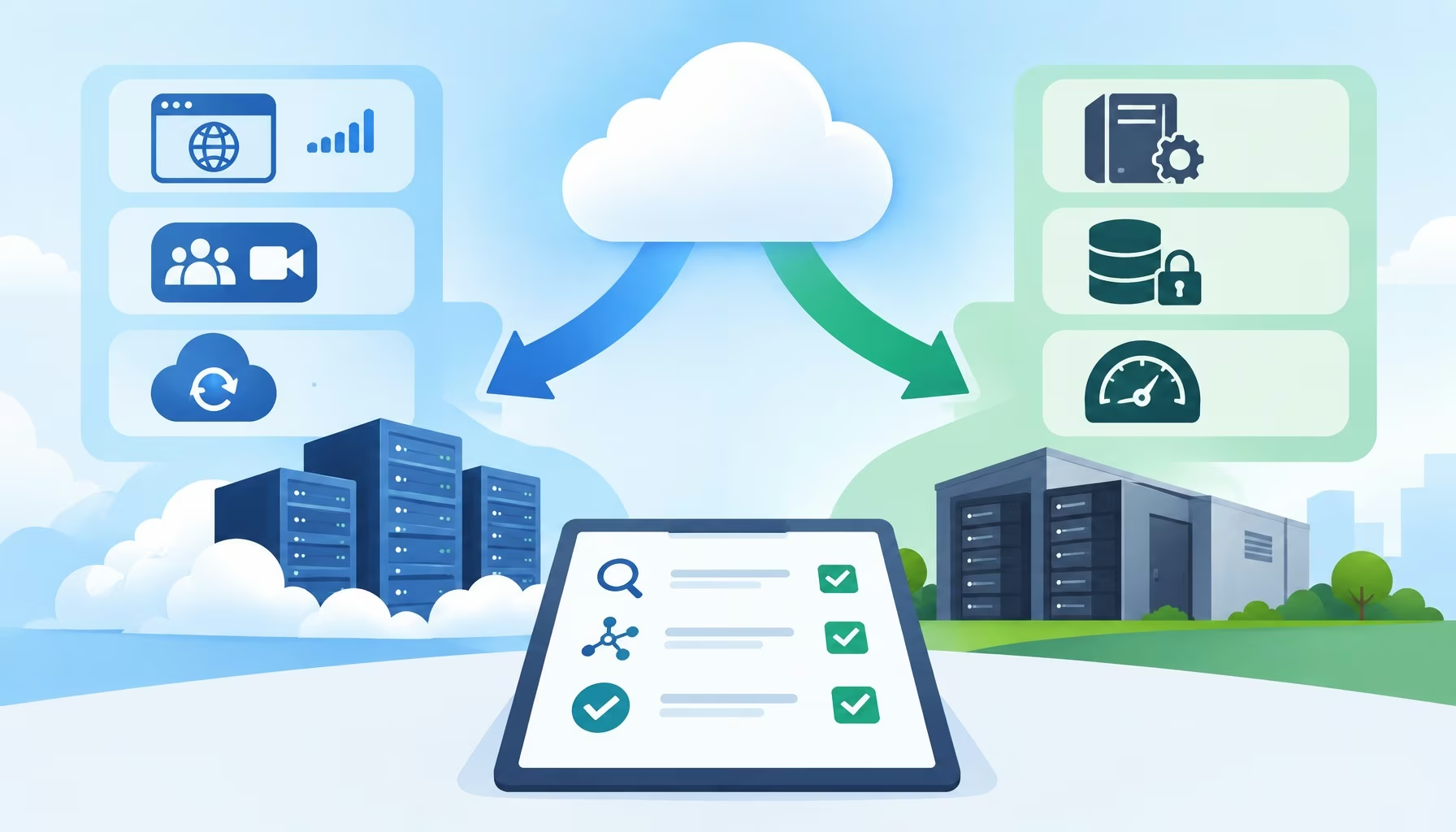
Cloud Computing for Financial ServicesMy recent article for Seeking Alpha predicts a significant uptick in cloud adoption in financial services, thanks to the arrival of industry-focused cloud providers,  improving trust in cloud security, and a bunch of other factors.  Not everyone agrees. Dissenters argue that cloud security cannot be trusted.

Here is an excerpt from one of the comments on the article:

“As a communications programmer, I tell you that most customers have not fully realized the risks inherent in the current implementations of multi-tenant cloud computing. Those can be cleaned up eventually, but they CAN NOT BE CLEANED UP COST EFFECTIVELY. The encryption required means non-trivial CPU usage. So, you’re faced with either doing whatever you’re doing insecurely, or doing it with dedicated hardware. The multi-tenant, elastic model is simply broken from a security and efficiency perspective.”

More Read

Image
3 Cloud Misunderstandings That Can Hamper Migration
Best Practice Linux Guide: Your Cloud Strategy
The Role of SD-WAN and Cloud in Enterprise WAN Transformation
Private Cloud Hosting: Have Your Cake and Eat It, Too
Amazon’s Cloud Computing Giant is Getting Closer to Full Takeover

This is a typical argument we hear from old school IT or legacy vendors such as Oracle. They tell you multitenancy is bad for you, either because they haven’t upgraded their skills (and are fighting to save their jobs) or because they want to sell you dedicated hardware.  CPU power is commoditized and getting cheaper every day, so the “non-trivial CPU usage” claim doesn’t hold water.

In fact, I realized that the case against cloud security now rests heavily on the recent hacking incidents, as some of these comments suggest:

“Target and others are just beginning to learn how difficult it is to do security correctly even on dedicated closed systems.”

“… the most critical data needs to be kept inhouse. The recent string of hacking cases against Target, Niemen-Marcus, and Michael’s should demonstrate that to everybody.”

Clearly, Target’s data was kept inhouse and secured by their internal IT.  Turned out that wasn’t the best security, after all.  Another person, who commented on the article, highlighted the irony:

“The irony here, regarding financial services organizations, is that they are breached constantly. I’ve had every major credit card I own compromised in the past 18 months. These banks also have more down time due to weather, outages, failed upgrades, etc than would never be accepted in the public cloud.

If you understand how public clouds like Amazon Web Services handle availability, you wouldn’t be concerned about outages. For an in house or on premise service to have the same type of capabilities related to availability is cost prohibitive. Banks are already severely wasteful with their data center resources.

The primary reasons banks haven’t moved to public cloud yet is more around Public Relations, sunk investments in under-utilized, owned infrastructure, and, well, complacency.”

Security arguments notwithstanding, Gartner asserts more than 60 percent of banks worldwide will process the majority of their transactions in the cloud by 2016.  Ovum claims capital markets will accelerate their adoption of cloud this year.  And Oracle’s CEO declares that its main rivals are no longer IBM and SAP, but instead they’re Amazon and Salesforce .

All of this suggests that despite the security concerns, the cloud is gathering momentum within the industry. If you are seeing a different trend, would love to hear from you.

TAGGED:banksfinancial sectorsecurity
Share This Article
Facebook Pinterest LinkedIn
Share

Follow us on Facebook

Latest News

protecting patient data
How to Protect Psychotherapy Data in a Digital Practice
Big Data Exclusive Security
data analytics
How Data Analytics Can Help You Construct A Financial Weather Map
Analytics Exclusive Infographic
AI use in payment methods
AI Shows How Payment Delays Disrupt Your Business
Artificial Intelligence Exclusive Infographic
financial analytics
Financial Analytics Shows The Hidden Cost Of Not Switching Systems
Analytics Exclusive Infographic

Stay Connected

1.2KFollowersLike
33.7KFollowersFollow
222FollowersPin

You Might also Like

Image
Uncategorized

How Machine Learning Is Improving Computer Security

6 Min Read

SAP’s New Fraud Management Analytical Application

12 Min Read
IoT Security
ExclusiveInternet of ThingsSecurity

Ensuring Cybersecurity When Rolling Out IoT Across Your Business Operations

8 Min Read
Artificial intelligence can help put tracking tools in your home that are a lot like James Bond. Here's what that means for safety, privacy, and security.
Artificial IntelligenceExclusive

How Artificial Intelligence Puts James Bond Tracking Tools In Your Home

6 Min Read

SmartData Collective is one of the largest & trusted community covering technical content about Big Data, BI, Cloud, Analytics, Artificial Intelligence, IoT & more.

ai is improving the safety of cars
From Bolts to Bots: How AI Is Fortifying the Automotive Industry
Artificial Intelligence
AI and chatbots
Chatbots and SEO: How Can Chatbots Improve Your SEO Ranking?
Artificial Intelligence Chatbots Exclusive

Quick Link

  • About
  • Contact
  • Privacy
Follow US
© 2008-25 SmartData Collective. All Rights Reserved.
Go to mobile version
Welcome Back!

Sign in to your account

Username or Email Address
Password

Lost your password?