


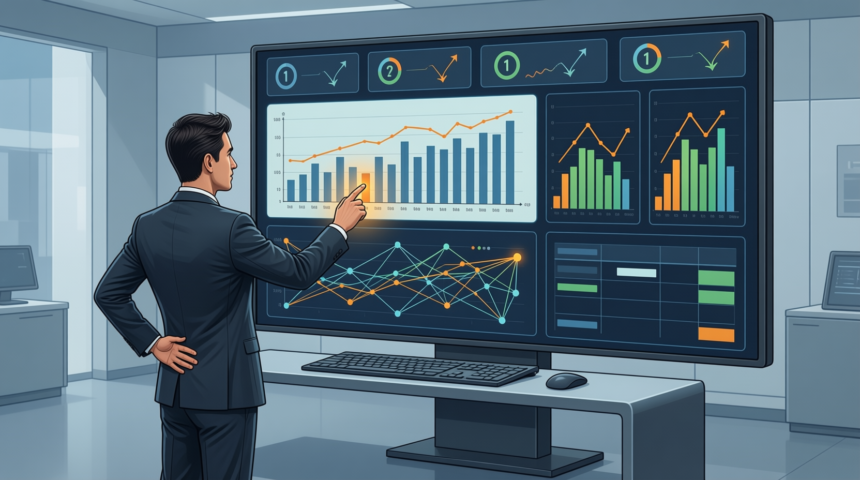
The goal of business intelligence (BI) is to thoughtfully and purposefully collect and analyze past information to support an organization and make better decisions about it. In 2026, business intelligence trends continue to shape the business intelligence tools organizations rely on. Even though the reason why companies engage in business intelligence remains relatively consistent from year to year, the ways those establishments go about it differ over time. Here are six business intelligence trends actually shaping BI now.
- 1. Rising Investment in AI-Powered Analysis
- 2. AI Agents and Real-Time Decision Support Move to the Center
- 3. A Priority Placed on Data Governance — Now Extending to AI
- 4. Small Companies Will Continue to Show Interest in Business Intelligence
- 5. Self-Service BI Becomes the Governed Default
- 6. Data Storytelling Goes AI-Assisted
- How the 2026 BI Trends Compare
- Frequently Asked Questions
- Is self-service BI replacing dedicated data teams?
- What’s the biggest shift in business intelligence for 2026?
- Do small businesses need a dedicated BI platform to benefit from these trends?
- Preparedness Is Essential for BI Success
1. Rising Investment in AI-Powered Analysis
Artificial intelligence (AI) is already taking off, and companies that have not already begun adopting it risk falling further behind in 2026. McKinsey’s 2026 State of AI survey shows 44 percent of organizations now report AI scaling across the enterprise, up from 38 percent a year earlier. Artificial intelligence platforms can evaluate data inputs faster than humans can, plus uncover notable things people may miss without relying on technology. Some types of AI could provide information directly to decision-makers in streamlined ways. For example, AI agents can surface insights directly within BI dashboards. Gartner’s 2026 Top Trends in Data and Analytics names AI agents among this year’s leading shifts. Businesses could glean valuable things from AI agents, particularly by paying attention to the patterns and anomalies surfaced. These developments illustrate how AI is not a fad. Businesses that wait too long to deploy it will be forced to try and catch up later.
2. AI Agents and Real-Time Decision Support Move to the Center
BI is shifting from retrospective dashboards toward real-time signals and agent-assisted analysis that feed decisions as they happen. Dashboards still matter, but the next step is helping teams investigate changes while there is still time to respond.
Gartner’s 2026 Top Trends in Data and Analytics names AI agents, stronger semantic and data governance layers, and converging data-and-analytics platforms as leading shifts reshaping BI. Together, these trends point toward a more active role for analytics within everyday business workflows.

For your team, that can mean an agent flagging an unexpected change, checking related metrics, and preparing an explanation for review. Rather than starting every investigation with a blank query, analysts can assess suggested causes and test the evidence behind them. Real-time signals make this useful when the decision window is short, provided the underlying data arrives quickly enough.
We should distinguish faster analysis from unchecked automation. Agents need consistent metric definitions, clear access permissions, and boundaries around the actions they can take. Human review remains important when a recommendation affects customers, spending, or operational commitments. The goal is not simply more alerts; it is timely context that helps people decide what deserves attention.
This shift is already showing up in how large, data-heavy organizations run their operations. Global advertising group Dentsu rebuilt its reporting architecture on Microsoft Fabric to cut data-sync times from over 45 minutes to under 20 minutes — a 55 percent improvement that turned overnight reporting into a same-day, and increasingly real-time, process.
“Fabric has evolved beyond self-service analytics to a full enterprise-class platform.”
— Patrick Sura, Global Reporting Architect, Dentsu, in Microsoft Customer Stories, 2026His colleague put the ambition even more directly:
“We’re creating a real-time, enterprise-wide decision engine.”
— Ebad Uddin, Director, Enterprise Data & Analytics, Dentsu, in Microsoft Customer Stories, 20263. A Priority Placed on Data Governance — Now Extending to AI
The results from a poll of more than 2,600 respondents associated with business intelligence found that those individuals rated data governance as having above-average importance in their work, a sentiment that has only grown since. More specifically, they gave it an overall rating of 6.2 out of 10, and the emphasis placed on it went up in particular industries, such as banking and telecommunications. Data governance is crucial for any enterprise that hopes to effectively learn valuable things through business intelligence efforts. If the data collected contains duplicate or inaccurate information, the poor quality could cause a lack of confidence in company leaders, making a focus on business intelligence no longer worthwhile. In 2026, that same push for governance extends to shared metric definitions and semantic layers for AI systems, including governing what those systems are allowed to do with that data. Also, with the General Data Protection Regulation (GDPR) in effect in the European Union and the California Consumer Privacy Act (CCPA) in effect since 2020, it’s more important than ever for companies to ensure they do not overlook data governance and can rest assured they are in compliance with all applicable laws.
4. Small Companies Will Continue to Show Interest in Business Intelligence
BI adoption among businesses with fewer than 100 employees has only strengthened since 2018. Embedded and AI-assisted BI features inside everyday software — not just dedicated BI platforms — have made analytics accessible to small teams without a dedicated analyst. That trend means company representatives should not assume that a small size makes BI applications irrelevant. And using BI at a smaller organization can increase the feeling of ownership that each member of a team has towards progress at an organization. The trend of BI software throughout smaller organizations continues in 2026, especially as a growing number of providers make their offerings increasingly accessible and affordable. Even enterprises on shoestring budgets, like startup companies, can fit them into their budgets.
5. Self-Service BI Becomes the Governed Default
By 2026, self-service BI interfaces are better understood as a governed default for organizations, not a hiring alternative. Stronger semantic and data governance layers help balance self-service access with consistent definitions and controls. Companies consider BI as something that differentiates them in the marketplace and helps promote a data-driven culture in organizations. If companies have not already started to use BI, self-service software could be a smart place to start. However, before investing in such tools, businesses must evaluate what they hope to learn from BI and how such insights fit into the company’s overall business operations. That balance becomes clearer when we look at self-service BI in practice.
New Zealand’s largest mobile carrier, One NZ, serves 2.4 million customers and used to rely on Power BI dashboards that lagged behind live call-center activity. Moving to Microsoft Fabric’s Real-Time Analytics cut dashboard refresh times to every 10 seconds — six times faster — and helped bring average call answer time down from 45 seconds to 27 seconds.
“Previously, you needed to be a data engineer or scientist to access and understand customer information.”
— Strathan Campbell, Channel Environment Technology Lead, One NZ, in Microsoft Customer Stories, 2026That’s the governed self-service shift in one line — the goal isn’t fewer data specialists, it’s fewer bottlenecks between a question and an answer:
“Most dashboards are updated every 10 seconds now, which is six times faster than before.”
— Steven Easton, BI Channels Specialist, One NZ, in Microsoft Customer Stories, 20266. Data Storytelling Goes AI-Assisted
In 2026, much of this narrative work is increasingly AI-assisted, with AI-generated executive summaries alongside dashboards. A human still needs to judge whether the story the data is telling is actually the right one. Data storytelling remains essential because of the way it adds vital context to statistics. After all, even the most advanced business intelligence platforms still need people who are skilled in data literacy to interpret figures and translate them into meaningful takeaways for businesses and their stakeholders. In other words, the stories told can answer the “So what?” question that business leaders understandably have when looking at information. Many people can’t see the big picture when staring at spreadsheets full of numbers or detailed bar graphs. But pulling relevant stories from data could make the insights more useful and applicable to businesses of all types.
How the 2026 BI Trends Compare
| Trend | What’s Driving It | Where You’ll See It |
|---|---|---|
| AI-powered analysis | AI scaling across the enterprise (McKinsey, 2026) | AI-embedded analytics platforms |
| Real-time, agent-assisted decisions | Shrinking decision windows | Streaming and real-time analytics engines |
| Governance extends to AI | Need for consistent metric definitions | Semantic layers and data catalogs |
| Small-business BI adoption | Embedded analytics in everyday software | Built-in BI features inside CRM/ERP tools |
| Self-service as governed default | Balancing wide access with control | Self-service BI with governance layers |
| AI-assisted data storytelling | Need for context, not just numbers | AI-generated narrative and summary tools |
Frequently Asked Questions
Is self-service BI replacing dedicated data teams?
No. Self-service BI in 2026 works alongside data teams rather than instead of them. Data specialists now spend more time building the governance and semantic layers that make self-service access safe and consistent, rather than fielding every individual query themselves.
What’s the biggest shift in business intelligence for 2026?
According to Gartner’s 2026 Top Trends in Data and Analytics, the biggest shifts are AI agents working inside analytics workflows, stronger semantic and governance layers, and the convergence of data and analytics platforms into fewer, more connected systems.
Do small businesses need a dedicated BI platform to benefit from these trends?
Not necessarily. Many of these trends, including AI-assisted analysis and embedded reporting, now show up inside everyday CRM, ERP, and productivity software, giving small teams a path into business intelligence without hiring a dedicated analyst first.
Preparedness Is Essential for BI Success
These trends are becoming ever more apparent in 2026. That means businesses should think proactively about how to capitalize on these 2026 business intelligence trends in their establishments and adjust their operations accordingly.


