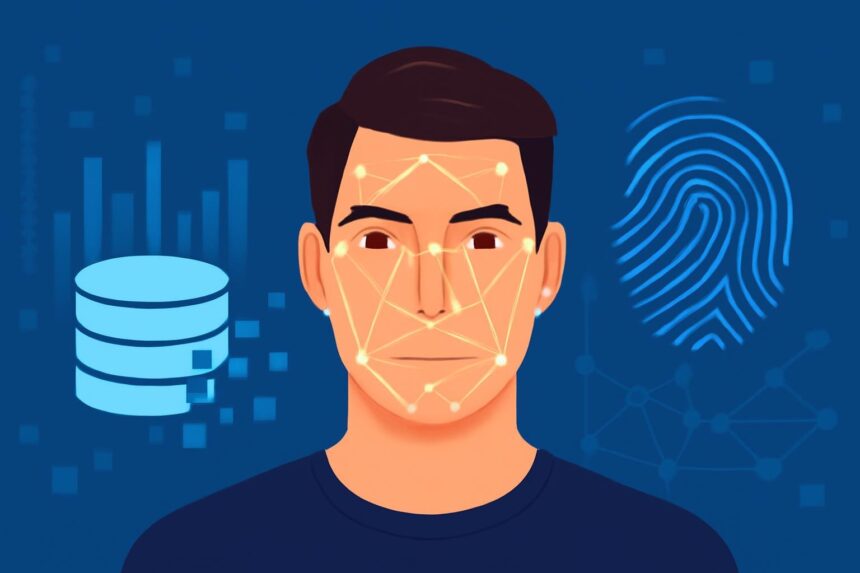
That simple scenario that most of us have encountered is a pretty good illustration of both the benefits and drawbacks of the convergence of biometrics and big data. The face recognition software that makes those Facebook tagging suggestions possible is part of a larger discipline called biometrics that includes fingerprints, retinal scans, and gait recognition, and the field is advancing fast. Combining those capabilities with big data analytics tools allows us to understand who you are simply by looking at you—whether you’re in a photo on Facebook, a video clip, or merely walking around in the world. So, is this good or bad? The answer is probably both.
Benefits of biometrics and big data
Proponents of biometrics talk a lot about security when they talk about their field, and there’s no doubt that reliable, accurate biometrics can be incredibly useful. When your face is your your unique “code” then your pin number or password follows you everywhere and are difficult to be duplicated or hacked. This kind of face recognition is already being used in all sorts of applications, like phones that can be unlocked with a wink, and apartment buildings in New York City that allow residents to enter without a key. Plus, if you’ve watched any police dramas in the past couple of years, you’ll be aware that face recognition software is being used by police departments to compare surveillance videos of crime suspects to their own database of mug shots, the same way they use fingerprints. Some casinos use the same technology to identify big spenders for special treatment (and suspected card-counters for ejection). High schools in the U.S. are also experimenting with the technology, installing face and motion detection software to identify students and, hopefully, keep people out who are not supposed to be there. The system can also recognize students who arrive late, who are out in the halls when they shouldn’t be, and who leave campus unauthorized, aiding administrators in stopping truancy and other problems. And, perhaps most notably, after the September 11th attacks, many industry professionals touted the use of facial recognition software in helping to track terrorists. The technology is already in use at many airports that have eGates where a camera compares your face to that in your ePassport, which speeds up security checks and helps weed out individuals on the no-fly list.
But as with any technology, there are drawbacks
As with so many sectors of our technological society, these advances also come with privacy questions and risks. The New York Times summed up the questions this way: “The fundamental concern about faceprinting is the possibility that it would be used to covertly identify a live person by name — and then serve as the link that would connect them, without their awareness or permission, to intimate details available online, like their home addresses, dating preferences, employment histories and religious beliefs.” And these are not hypothetical risks. Studies have shown that facial recognition software can be used to link people to their social media accounts and even, in some cases, their Social Security numbers. Unlike other forms of biometrics, face recognition software can be used at a distance, without your knowledge or consent. It can scan photos or videos online and link them to your social profiles easily—that’s what allows Facebook or Google+ to suggest names to tag people in photos. An app was recently created for Google Glas that would allow a user to see a stranger walking past them on the street, and that stranger’s name, Facebook account and occupation would pop up on the screen. For now, Google has not authorized apps that use face recognition but the technology is there and working. Many people are fine with police using the photos or fingerprints of criminals as a database to search for suspects, but would not be happy to have their own photos and fingerprints included in the search. Yet some local and federal law enforcement agencies are expanding their databases to include driver’s license photos and even Facebook pictures. And there’s no law or even voluntary code of conduct to guide their actions. In Tampa, FL, police used face recognition software to scan the faces of every single person attending Superbowl XXXV. They identified only a handful of petty criminals and no one was detained, yet many might consider this a breach of privacy. Some stores in Japan have begun employing face recognition software to blacklist shoppers they have identified as shoplifters or “complainers.” And, perhaps most worrying to privacy experts, documents released by Edward Snowden reveal that the NSA intercepts millions of web images daily with “tremendous untapped potential,” for facial recognition purposes. Is this a case of the needs of the many outweighing the needs of the few or an invasion of privacy? Should it be that the “good guys” have nothing to worry about, or should we all be concerned about how our very images are being used for and against us? It’s muddy territory, but ground we will have to cover in the very near future, like it or not.