It’s not hard to understand why people are worried about artificial intelligence taking their jobs. Seems like every month there’s a new warning, a new report estimating just how many workers will be displaced. AI is already changing modern business in the following ways:
- It’s altering administrative tasks: In sectors like manufacturing, AI can spot product defects and pull products from the line
- Automating the Hiring process: Software can analyze applications and score them, effectively narrowing down the pool so that managers can choose from top candidates and save time
- Businesses are revising positions: For positions in which AI can handle the monetary duties, such as bank teller, businesses are changing human roles to focus on sales and other tasks that require emotional intelligence
- Managers are focusing on engagement: Employees who are worried about AI taking their jobs are growing anxious, which makes them disengaged with work
Not surprisingly, millennials are the most worried about losing their jobs: 34 percent fear getting laid off or seeing their job outsourced to a robot. Of the other age groups in the workforce, 27 percent of Generation X and baby boomers combined are worried about losing their jobs to AI.
Millennials Have Understandable Fear of AI Induced Layoffs
Are millennials the most worried because they grew up more engrossed in technology, they’re closer to the issue, and they work the menial jobs that will be displaced? Or is it because they spend more time online reading about what AI will do to their jobs? Probably a bit of both – public opinion about AI is evolving.
Whatever the case, with all this disruption dominating the discussion, it’s worth noting a majority of businesses plan on revising positions to keep human employees onboard. The 2017 Deloitte Global Human Capital Trends survey found that 77 percent of businesses plan on revising existing positions or creating new ones instead of laying employees off. A good example of job revision is banks that train tellers to do sales. Although more than three-quarters of the businesses Deloitte surveyed were optimistic about maintaining human jobs, 20 percent believed AI will do nothing but decrease the number of jobs.
More Read

There’s no doubt AI is affecting work and will continue affecting it to greater extents as the technology progresses. In particular, there are seven industries in which AI will have a profound impact:
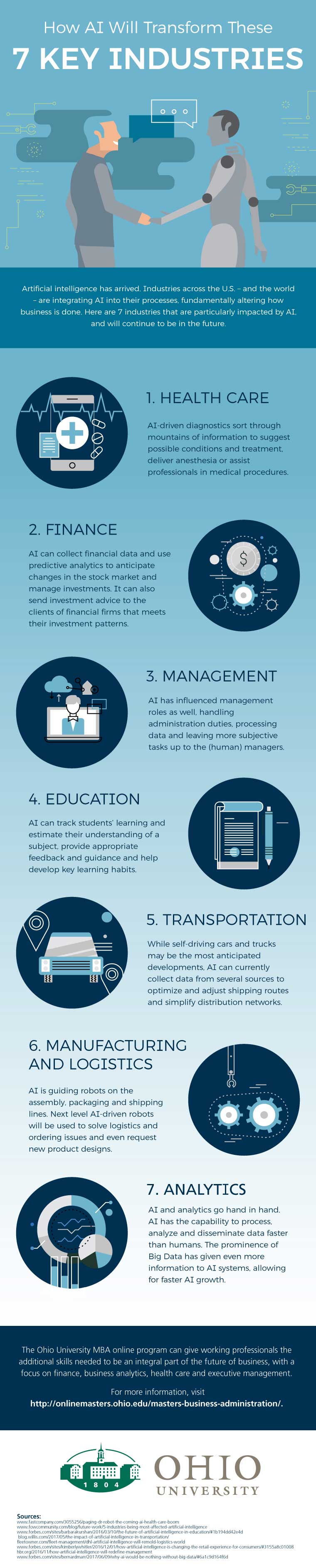
Infographic Source: Ohio University
But it’s not a given that this will automatically translate into a loss of jobs in these industries. The assumption that AI equals job loss is also the assumption that businesses will not innovate with new or revised positions for employees. In a survey by Capgemini of 1,000 organizations, four out of five companies have created new jobs after implementing AI solutions; and two-thirds have seen “no reduction in overall jobs” due to the advent of AI. Of course, Forbes contributor Bernard Marr points out, “The AI that even leading-edge businesses are using today is likely to look pretty stupid compared to the technology which will be available in five years’ time.”
AI Will Empower Companies to Create New Human Positions
That’s true, but it still doesn’t follow that businesses can’t and won’t create new jobs for humans. Ockham’s Razor might lead you to believe redundancy will occur, but there’s no such thing as redundancy when it comes to in-depth, empathetic sales and marketing conversations. If you were to give an AI robot a list of people’s numbers to call and make a sales pitch to, the robot will automatically call each number without considering the tone of voice on the other end of the line. For the robot, there is no laughter when the prospect makes a sarcastic comment. There’s only misunderstanding.
This begs the question as to how AI will be able to interact with humans who are still ultimately in charge of making decisions. It would seem that if humans make decisions, corporations will be interested in catering to decision-makers. Replacing thousands of workers with AI bots won’t be good press for any company.
There’s also the matter of security. As AI gets more complex, so do hackers. The IoT and AI algorithms were two of 2017’s biggest security concerns for corporations. As it stands, there aren’t any government-enforced standards for AI security. Particularly with the IoT, startups want to get their product on the market first instead of prioritizing security. There’s no one forcing them to do otherwise. If a hacker can gain access to raw datasets, it’s easy to feed algorithms disinformation — bad data that skews AI’s results, effectively rendering it obsolete. Imagine if a tech firm were to layoff workers in favor of AI, only to find that an anonymous intruder left a booby trap in the system. Since bad data can be hard to detect, a lot of time and money could go into calculations that are useless.
The Human Element Will Remain Critical to Customer-Facing Positions Sales and Marketing Positions
The Rand Corporation’s report on The Risks of Artificial Intelligence to Security and the Future of Work highlights two competing estimates as to how many workers AI will displace. In short, Frey and Osborne’s study (2013) estimated 47 percent of workers are in danger of being displaced. This number is based on how many occupations require creativity, social skills, and “fine perception and manipulation.”
A newer study (2016) from the Organization for Economic Cooperation and Development (OECD) disputes the findings of Frey and Osborne by pointing out how we break down occupations into different tasks. As organizations introduce AI, jobs will change to accommodate it, leaving workers open to accomplish higher-level, “human” tasks. Ultimately, the OECD estimates only nine percent of jobs are susceptible to full automation.
That’s still a lot of jobs. But one thing is clear: no one can simply flip an AI switch, making millions of people jobless overnight. AI development is happening over a period of time during which organizations and occupations can adapt. There are jobs that will undoubtedly be lost, such as certain fast food jobs, taxi driving jobs, data entry jobs, and cashiers. But if human beings have anything to say about it, the people working these jobs will go on to do other jobs that require a human touch.