
A few months ago, I wrote an article on the four pillars of big data analytics. One of those pillars is what is called discovery analytics or where visual analytics and data discovery combine together to meet the business and analyst needs.
A few months ago, I wrote an article on the four pillars of big data analytics. One of those pillars is what is called discovery analytics or where visual analytics and data discovery combine together to meet the business and analyst needs. My colleague Mark Smith subsequently clarified the four types of discovery analytics: visual discovery, data discovery, information discovery and event discovery. Now I want to follow up with a discussion of three trends that our research has uncovered in this space. (To reference how I’m using these four discovery terms, please refer to Mark’s post.)
The most prominent of these trends is that conversations about visual discovery are beginning to include data discovery, and vendors are developing and delivering such tool sets today. It is well-known that while big data profiling and the ability to visualize data give us a broader capacity for understanding, there are limitations that can be 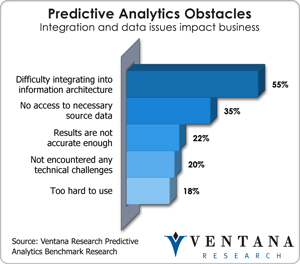 addressed only through data mining and techniques such as clustering and anomaly detection. Such approaches are needed to overcome statistical interpretation challenges such as Simpson’s paradox. In this context, we see a number of tools with different architectural approaches tackling this obstacle. For example, Information Builders, Datameer, BIRT Analytics and IBM’s new SPSS Analytic Catalyst tool all incorporate user-driven data mining directly with visual analysis. That is, they combine data mining technology with visual discovery for enhanced capability and more usability. Our research on predictive analytics shows that integrating predictive analytics into the existing architecture is the most pressing challenge (for 55% or organizations). Integrating data mining directly into the visual discovery process is one way to overcome this challenge.
The second trend is renewed focus on information discovery (i.e., search), especially among large enterprises with widely distributed systems as well as the big data vendors serving this market. IBM acquired Vivisimo and has incorporated the technology into its PureSystems and big data platform. Microsoft recently previewed its big data information discovery tool, Data Explorer. Oracle acquired Endeca and has made it a key component of its big data strategy. SAP added search to its latest Lumira platform. LucidWorks, an independent information discovery vendor that provides enterprise support for open source Lucene/Solr, adds search as an API and has received significant adoption. There are different levels of search, from documents to social media data to machine data, but I won’t drill into these here. Regardless of the type of search, in today’s era of distributed computing, in which there’s a need to explore a variety of data sources, information discovery is increasingly important.
More Read
The third trend in discovery analytics is a move to more embeddable system architectures. In parallel with the move to the cloud, architectures are becoming more service-oriented, and the interfaces are hardened in such a way that they can integrate more readily with other systems. For example, the visual discovery market was born on the client desktop with Qlik and Tableau, quickly moved to server-based apps and is now moving to the cloud. Embeddable tools such as D3, which is essentially a visualization-as-a-service offering, allow vendors such as Datameer to include an open source library of visualizations in their products. Lucene/Solr represents a similar embedded technology in the information discovery space. The broad trend we’re seeing is with RESTful-based architectures that promote a looser coupling of applications and therefore require less custom integration. This move runs in parallel with the decline in Internet Explorer, the rise of new browsers and the ability to render content using JavaScript Object Notation (JSON). This trend suggests a future for discovery analysis embedded in application tools (including, but not limited to, business intelligence). The environment is still fragmented and in its early stage. Instead of one cloud, we have a lot of little clouds. For the vendor community, which is building more platform-oriented applications that can work in an embeddable manner, a tough question is whether to go after the on-premises market or the cloud market. I think that each will have to make its own decision on how to support customer needs and their own business model constraints.