
Posted: April 1st, 2016 — but sadly, not really an April Fool’s
In 1989, Howard Dresner — later a Gartner Group analyst — proposed “business intelligence” as an umbrella term to describe “concepts and methods to improve business decision making by using fact-based support systems.”
This year, despite BI continuing to be the #1 priority for CIOs (for the 9th time in 11 years), Gartner has been using recent BI Summit keynotes to proclaim that BI is dead. As explained in a recent Magic Quadrant report,
“The BI and analytics platform market’s multiyear shift from IT-led enterprise reporting to business-led self-service analytics has passed the tipping point….During the past several years, the balance of power for business intelligence (BI) and analytics platform buying decisions has gradually shifted from IT to the business.”
IT involvement in BI is now deemed optional:

“The evolution and sophistication of the self-service data preparation and data discovery capabilities available in the market has shifted… toward tools that do not require… involvement from IT.”
A more detailed report explains:
“A traditional BI platform usually requires a lengthy, IT-led enterprise data warehouse development effort as a prerequisite… However, the democratization of analytics… has changed the paradigm of BI delivery… Users now prototype data models and test new data sources in the context of existing data structures without needing IT staff.”
Tools that do require some form of IT intervention are no longer considered BI*, and no longer appear on Gartner’s BI Magic Quadrant — they have been relegated to a Enterprise-Reporting Based Platforms Market Guide. (Although, somewhat confusingly, these tools are still considered by Gartner to make up the lion’s share (75%) of the $16Bn+ BI Market).
Analysts explain that traditional attempts to get a single view of data are pointless:
“Are you saying that we don’t need a centralized truth?”
“Absolutely, never worked, doesn’t work, will not work.”
And Business Intelligence Competency Centers (BICCs) are also now dead. The term was coined by Gartner in 2001 to indicate:
“A cross-functional organizational team that has defined tasks, roles, responsibilities and processes for supporting and promoting the effective use of Business Intelligence across an organization.”
But:
“When Gartner started to cover BICC as a trend over 10 years ago, it turned out to be one of the biggest success factors for BI programs. Consolidation, focus and centralization were key themes. Create critical mass for BI… But as we stated in our Summit keynote: “all good things must come to an end”.
Gartner says current BICC organizations that continue to talk about “users” are IT-centric laggards (despite the 148 mentions of the word in the latest Magic Quadrant report…) and refers to them as BI-nosaurs that must evolve or die.

The BICCs that persist, and who continue to get considerable value from IT-led reporting, have been compared to the main characters in the movie The Sixth Sense…

What’s happening here?
Since BI clearly isn’t dead — Gartner has just updated its definition of the term, under which the vast majority of today’s “BI” no longer qualifies — why is Gartner using the kind of hype that it typically condemns in vendor marketing?
The most charitable view is that Gartner feels it has to exaggerate the demise of BI in order to get customers to pay attention to the changes before it’s too late. And Gartner’s arguments are more subtle than the truncated quotes above would seem to indicate (but when you lead with “BI is dead”, you can’t really get defensive when people miss the subtleties).
Gartner has taken the bold step of saying that solutions only qualify as “BI” if it’s possible for business users to tackle the end-to-end journey without any IT help — while at the same time admitting that:
“IT-modeled data structures… promote governance and reusability across the organization” and “In many organizations, extending IT-modeled structures in an agile manner and combining them with any of the sources listed above is a core requirement”
It seems clear that most organizations intend to continue to deploy IT-led tools, while taking advantage of the new technologies. During a recent Gartner web seminar to explain the changes, attendees indicated that while more business agility was necessary and desirable, it would take some time to become reality in their organizations:
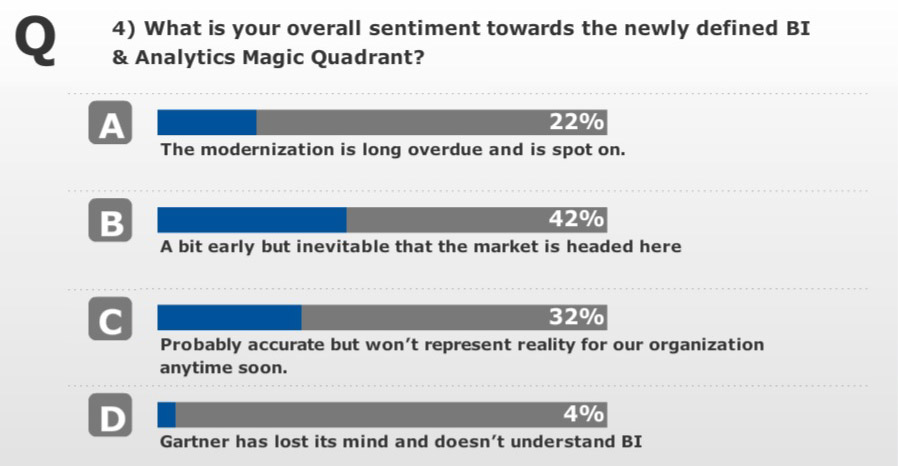
[note there was no “the MQ should have stayed the same” option…]
And they did not believe that IT-led BI would decrease — in fact, the exact opposite:
And that the ideal result would be a mix of IT-led and business-led BI:
[Note that Gartner is not against IT-led BI — but says IT should only use tools that could be used by business people directly]
Easy, self-service access to data has always been the goal of business intelligence. And doing that successfully has always meant balancing the needs of business people with the need of IT, as representatives of the organization as a whole.
In the past, the best solution available involved less-than-agile data warehouses, semantic layers and OLAP cubes. Modern technologies such as in-memory and data discovery go a long way to remove the barriers to agile BI — but there’s no magic wand to eliminate the core business problems of mis-aligned, bad-quality data, common business definitions, and data governance.
IT clearly still has an important role to play in providing data to business people. How important is it that they use the same tools as business people? Do the new approaches warrant a redefinition of the term BI? Do the upsides of new agile tools outweigh their relative lack of effective governance mechanisms? I’ll let you decide — but as Gartner itself emphasizes, it is important to:
“Separate hype from the real drivers of a technology’s commercial promise”
* The MQ uses “Modern BI”, but Gartner has made it clear it considers this term synonymous with BI & Analytics.



![CIOs and Big Data [INFOGRAPHIC]](https://www.smartdatacollective.com/wp-content/uploads/2013/06/cios-big-data-infographic-330x220.jpg)
![What Does a VC Look for in a Big Data Startup? [VIDEO]](https://www.smartdatacollective.com/wp-content/uploads/2014/02/vc-look-big-data-startup-video-330x220.jpg)