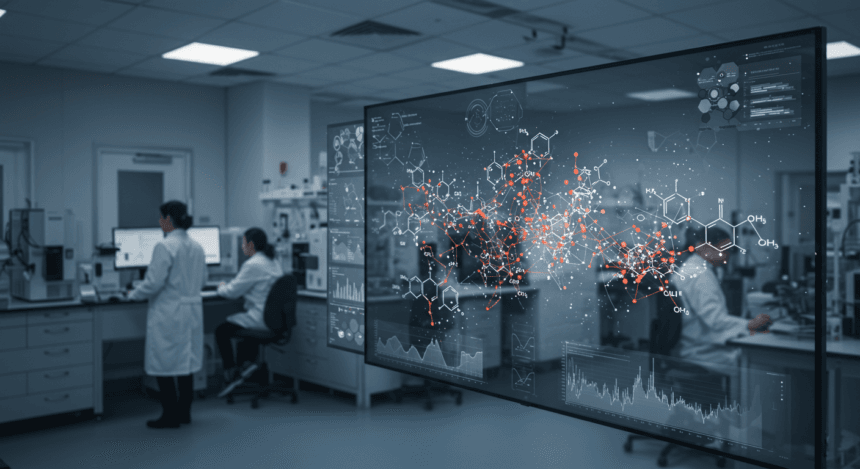
AI is changing countless industries. The impact in some industries is obvious, such as software development. However, it is also having a huge impact on the future of chemical production.
Artificial intelligence and data analytics are transforming chemical analysis, enabling faster, more precise results in all industries. In the pharmaceutical sector, AI is revolutionizing drug discovery, with QA consultant Damla Varol reporting that 80% of industry professionals already using it to accelerate research and screen for potential compounds more efficiently.
“The pharmaceutical industry is rapidly evolving, and the number of AI application integrations is increasing day by day, reshaping every facet of pharmaceutical processes from drug discovery to supply chain management. AI applications can potentially create between $350 billion and $410 billion in annual value for pharmaceutical companies by 2025. The pharmaceutical market is projected to grow at a CAGR of 42.68%, approximately equal to a $15 billion growth between 2024 to 2029.” Varol reports.
AI models can scan vast data sets, predict molecular interactions, and reduce the cost and time it takes to get new drugs to market. This skill accelerates decision-making and minimizes trial-and-error processes, and the results lead to innovation that would take decades using traditional methods.
More Read

The AI in chemicals market is experiencing robust expansion globally, valued at $943.0 million in 2023 and projected to attain a CAGR of 27.8% during 2024-2030. The growth indicates increased adoption of AI-based solutions for process optimization, material development, and quality checking. Data analytics and AI aid companies in refining manufacturing, detection of chemical composition irregularities, and regulatory compliance more precisely. As industries are embracing these technologies, AI-facilitated chemical analysis shall be the catalyst of innovation and efficiency, taking the future of material science and manufacturing to where it needs to be.
Precision and detail drive modern research and industry, making advanced chemical analysis tools essential. These technologies uncover patterns in complex substances, leading to pharmaceuticals, environmental science, and food safety breakthroughs. Understanding these tools is key to improving efficiency and effectiveness across industries as demand for innovation grows. It is going to have a huge impact on drug development.
The Power of Advanced Chemical Analysis
Chemical analysis is fundamental in diverse sectors, including pharmaceuticals and environmental science. Due to the increasing complexity of modern materials, traditional analytical techniques often fall short of revealing the intricate molecular details essential for innovation. This gap is bridged by advanced ion chromatography instruments and other chemical analysis tools, which provide an unparalleled depth of insight into the molecular structures of various substances.
These cutting-edge tools allow professionals to conduct detailed analyses at a molecular level, fostering innovations that can potentially transform entire industries. For example, the pharmaceutical sector benefits from enhanced drug discovery processes, pinpointing new compounds with remarkable precision. Concurrently, environmental scientists can detect minute pollutants, significantly improving pollution control efforts and ensuring compliance with stringent environmental regulations.
Uncovering Patterns with Ion Exchange Chromatography
Ion exchange chromatography is a standout technique within advanced chemical analysis, recognised for its ability to separate ions and polar molecules based on their charge. This method is crucial across numerous applications, including water quality testing, where it reveals trace impurities that could pose health risks. Additionally, in the food industry, ion exchange chromatography is utilised to monitor nutrient levels, ensuring products meet quality standards.
By breaking down complex mixtures into their parts, this technique uncovers patterns vital for setting new safety benchmarks and refining product formulations. These capabilities are essential for professionals in sectors like environmental monitoring, where maintaining regulatory compliance and safeguarding public safety are top priorities.
Integrating Data from Multiple Analytical Methods
A comprehensive understanding of a sample’s composition often requires integrating multiple analytical techniques. Methods such as mass spectrometry, nuclear magnetic resonance, and X-ray diffraction complement ion exchange chromatography to provide a holistic view of a material’s structure. This integration is critical in precision-focused industries like pharmaceuticals, where the exact composition of a compound is crucial for ensuring both safety and efficacy.
A multi-technique approach allows researchers to uncover relationships between components that might be overlooked when relying solely on a single method. As a result, this strategy leads to more informed decision-making, driving innovation and refinement in various applications.
The Role of Technology in Chemical Analysis
Technological advancements continually enhance chemical analysis capabilities, improving precision and efficiency. Automation and digital tools streamline these processes, making them more accessible across different industries. For instance, sophisticated data analytics software now processes the complex datasets generated by various analytical techniques, revealing crucial patterns instrumental in research and development.
These technologies enable real-time monitoring and remote analysis, which are indispensable in situations requiring immediate intervention. By harnessing cutting-edge technology in chemical analysis, industries boost productivity and open new avenues for research and development, paving the way for future breakthroughs.
Practical Applications and Future Insights
The reach of advanced chemical analysis tools extends well beyond traditional research boundaries. In agriculture, these tools facilitate the study of soil composition, leading to advancements in crop management and sustainable farming practices. The energy sector leverages these analyses to develop cleaner fuels and more efficient energy sources, while art restoration relies on chemical analysis to preserve historical artefacts through non-invasive techniques.
Their capacity to uncover hidden patterns will likely drive significant progress across multiple fields as analytical methods develop. By staying informed about these advances and integrating them into their workflows, professionals can maintain a competitive advantage, fostering progress and discovery in their respective industries.