Cookies help us display personalized product recommendations and ensure you have great shopping experience.

By using this site, you agree to the Privacy Policy and Terms of Use.
Accept
SmartData CollectiveSmartData Collective
  • Analytics
    AnalyticsShow More
    How Data Analytics Is Reshaping Patient Financing Decisions
    How Data Analytics Is Reshaping Patient Financing Decisions
    13 Min Read
    business using business intelligence
    How to Use a Competitive Intelligence Dashboard to Turn Market Data Into Smarter Marketing Decisions 
    9 Min Read
    unusual trading activity
    Signal Or Noise? A Decision Tree For Evaluating Unusual Trading Activity
    3 Min Read
    software developer using ai
    How Data Analytics Helps Developers Deliver Better Tech Services
    8 Min Read
    ai for stock trading
    Can Data Analytics Help Investors Outperform Warren Buffett
    9 Min Read
  • Big Data
  • BI
  • Exclusive
  • IT
  • Marketing
  • Software
Search
© 2008-25 SmartData Collective. All Rights Reserved.
Reading: How to compare two audio files quality wise?
Share
Notification
Font ResizerAa
SmartData CollectiveSmartData Collective
Font ResizerAa
Search
  • About
  • Help
  • Privacy
Follow US
© 2008-23 SmartData Collective. All Rights Reserved.
SmartData Collective > Big Data > Data Mining > How to compare two audio files quality wise?
Data Mining

How to compare two audio files quality wise?

Editor SDC
Editor SDC
3 Min Read
SHARE

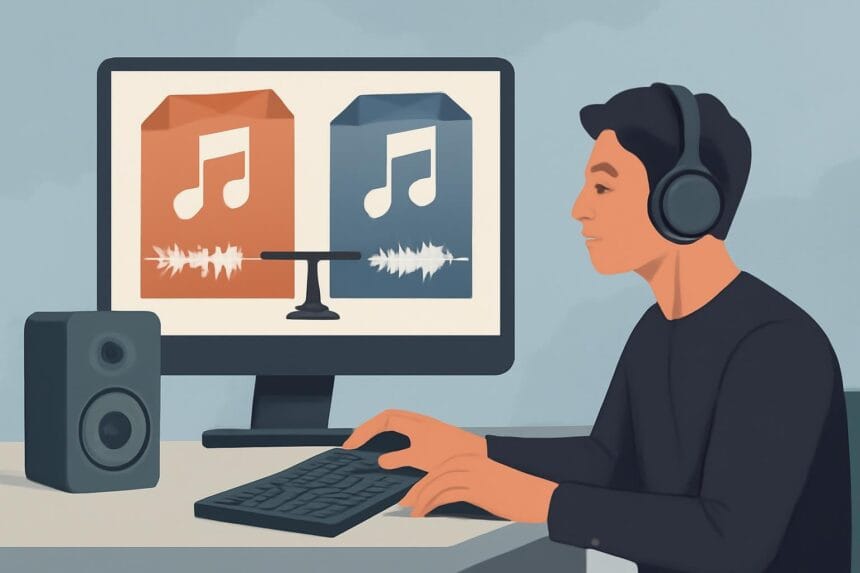
In order to compare two audio signals we introduce theanalytical module, which compares separately combined pairs of fragments ofactive and inactive phase signal that allows getting more accurate estimation.

For each fragment we determine integral spectrum by usingdiscrete cosine transformation (DCT). Spectrum integration is calculatedaccording to the proprietary formula. In the spectrum calculation the interpenetrationof windows comes to N/2 samples, and the Hamming or Blackmann-Harris windowfunction is applied to every window. Levels of spectrum energy on bands aredetermined for all sets of bands. Groups of critical bands, determined bydifferent authors resulting from different models of sound perception andspeech production.

Band boundaries (initial and terminal indices) as well asband energy values we determine by a set of proprietary formulas. The initialquality estimation value is taken as 100%, which decreases proportionally todistinction of energies on bands. The most interesting fact is that we canscale down our percentage of signals similarity to the well-known Mean OpinionScore (MOS) values, which correspond in tests to Cisco MOS or ITU P.862 asprecise as 97%. More intere…

More Read

Stratified Sampling vs. Posterior Probability Thresholds
“Reality mining … is all about paying attention to patterns in life and using that information…”
“These houses are part of a revolution in building design:…
Big Data: The Coming Sensor Data Driven Productivity Revolution
Amazon Elastic MapReduce, and other stuff I don’t have time to grok yet

In order to compare two audio signals we introduce theanalytical module, which compares separately combined pairs of fragments ofactive and inactive phase signal that allows getting more accurate estimation.

For each fragment we determine integral spectrum by usingdiscrete cosine transformation (DCT). Spectrum integration is calculatedaccording to the proprietary formula. In the spectrum calculation the interpenetrationof windows comes to N/2 samples, and the Hamming or Blackmann-Harris windowfunction is applied to every window. Levels of spectrum energy on bands aredetermined for all sets of bands. Groups of critical bands, determined bydifferent authors resulting from different models of sound perception andspeech production.

Band boundaries (initial and terminal indices) as well asband energy values we determine by a set of proprietary formulas. The initialquality estimation value is taken as 100%, which decreases proportionally todistinction of energies on bands. The most interesting fact is that we canscale down our percentage of signals similarity to the well-known Mean OpinionScore (MOS) values, which correspond in tests to Cisco MOS or ITU P.862 asprecise as 97%. More interesting facts to follow – stay in touch!


Share This Article
Facebook Pinterest LinkedIn
Share

Follow us on Facebook

Latest News

ai for social media
How AI Helps Businesses Get More From Social Media
Artificial Intelligence Exclusive
How Data Analytics Is Reshaping Patient Financing Decisions
Analytics Big Data Exclusive
AI driven big data company
How AI-Driven Workflows Are Changing the Way Companies Think About Data Risk
Artificial Intelligence Data Management Exclusive Risk Management
ai product development
Why Businesses Outsource AI Product Development Companies
Exclusive News

Stay Connected

1.2KFollowersLike
33.7KFollowersFollow
222FollowersPin

You Might also Like

Quick Visualization of irs.gov Search Queries

3 Min Read

iBi – Business Intelligence Applications on the iPhone

6 Min Read

PAW: SAS and the art and science of better

4 Min Read

Benefits of Using Data to Make Decisions: Guest Post by Erin Palmer

9 Min Read

SmartData Collective is one of the largest & trusted community covering technical content about Big Data, BI, Cloud, Analytics, Artificial Intelligence, IoT & more.

giveaway chatbots
How To Get An Award Winning Giveaway Bot
Big Data Chatbots Exclusive
data-driven web design
5 Great Tips for Using Data Analytics for Website UX
Big Data

Quick Link

  • About
  • Contact
  • Privacy
Follow US
© 2008-25 SmartData Collective. All Rights Reserved.
Welcome Back!

Sign in to your account

Username or Email Address
Password

Lost your password?