“What’s next?” is the perennially insistent question in information technology. One common observation about the industry holds that cycles of innovation alternate between hardware and software. New types and forms of hardware enable innovations in software that utilize the power of that hardware. These innovations create new markets, alter consumer behavior and change how work is performed.
“What’s next?” is the perennially insistent question in information technology. One common observation about the industry holds that cycles of innovation alternate between hardware and software. New types and forms of hardware enable innovations in software that utilize the power of that hardware. These innovations create new markets, alter consumer behavior and change how work is performed. This, in turn, sets the stage for new types and forms of hardware that complement these emerging product and service markets as well as the new ways of performing work, creating products and fashioning services that they engender. For example, the emerging collection of wearable computing devices seems likely to generate a new wave of software/hardware innovation, as my colleague Mark Smith has noted. This said, I think that the idea of alternating cycles no longer applies. It would be convenient if we could assign discrete time periods to hardware dominance and software dominance, but like echoes as they fade, the reverberations are no longer as neatly synchronized as they once were. Moreover, adoption and adaptation of technology by consumers reflected in the design of work, products and services always lags – and lags in different ways, further blurring the timing of cycles.
Adding to the messiness, technologies enter the market and evolve in ways that seem designed to embarrass pundits. In the 1990s, Bluetooth was supposed to be the next big thing for wireless connections; Wi-Fi wasn’t on most radar screens. Today, Bluetooth has an important role, but Wi-Fi is bigger. Some heralded technology breakthroughs sink without a trace. Sadly, that has been the case for multidimensional spreadsheets like Javelin and Lotus Improv. Other technologies appear, are used in trendy ways and then become mainstream. Instant messaging and chat immediately replaced passing paper notes in class for teenage girls. While somewhat passé in this role today, they have become an essential tool in the workplace. Of course the rate at which technology is incorporated into mainstream business use varies greatly. The Internet became central to business and commerce at an astonishingly fast pace while earlier inventions such as voice mail took about a decade to become universal.
 Software has dominated as a driver over the past two decades, but devices and business process changes have become increasingly important in amplifying the impact and producing knock-on effects that spur innovations of all sorts. Smartphones and other mobile devices might have become another Minitel except that there were programming tools and business models in place (including the absence of top-down control and regulation) that spurred ingenuity, substantially enhancing the value of these devices and making them highly adaptable to personal preferences and individual business needs. Rapid and broad adoption of mobile devices has been driving change in business software to enable companies to utilize the value of these devices. Yet there are plenty of examples of how organizations have failed to change how they conduct business. Our benchmark research finds that companies have been slow to adopt better methods facilitated by information technology for planning and budgeting, closing the books, managing the workforces or handling customer interactions. Software-driven change will come in these areas over the next decade, driven in part by a generational shift as baby boomers retire, and more attention will be paid to cognitive ergonomics and the resulting increased attention to the design of the user experience in business computing, such as gamification.
Innovation in business often takes longer to appear than futurists hope. One part of today’s answer to the “What’s next?” question includes all the things that software marketing departments have been promising over the past decade or so that haven’t come to pass yet. Usually, this is because there is some confusion on the part of vendors between “easier” and “easy.” Many innovations and enhancements in business software have made them easier to use but not easy enough for mainstream adoption or easy enough to spur process innovation or a change in management practices. One example is advanced analytics. There have been steady improvements making it possible for many kinds of users to employ them in business, but most users today require advanced degrees or specialized training (although I have some hope for new mass market tools on the horizon). Consequently, our research finds that two-thirds of companies make little or no use of advanced analytics.
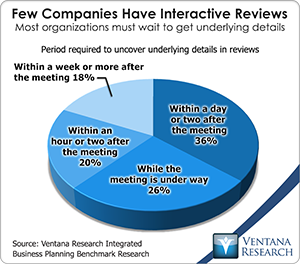 Another example is in business planning. For all the discussion about changing budgeting and planning, practices have remained pretty much the same over the past two decades. One way to make planning and budgeting more useful is to make reviewing results more actionable. This could be accomplished more easily if organizations could immediately drill down into the details of the results rather than having to wait for follow-up information or debate what the likely causes might have been. Yet only about one-fourth of participants in our business planning research are able to get to the numbers behind the numbers while the meeting is under way. Improved software technology is making this easier to do. For example, many ERP vendors have changed the basic architecture of their systems to make them capable of handling transaction processing and analytical tasks at the same time. But technology alone will not make a difference. It will take a change in management and demand that periodic reviews be highly interactive to make a difference.
Even with hidebound management techniques, it’s likely that new devices coming to the market will be major sources of innovation, either those that complement existing business practices and consumer demands (which are obvious candidates for rapid adoption) or as a speculative venture. The loudest buzz is around the Internet of Things. This is an amorphous concept at the moment, and there are considerable technology hurdles that must surmounted for it to become practical (notably the limited address capacity in the IPv4 standard). Still, the concept has a good deal of theoretical appeal when one extrapolates the value already realized by increasing the scope of people-to-machine connections (such as for monitoring processes or the health of devices) and the variety and number of machine-to-machine control and instrumentation (for example, automatically tracking physical assets and optimizing machine performance by monitoring conditions).
As I mentioned earlier, wearable computing is another emerging area of innovation. Thus far, it has had more allure than demand, but that was true also for the personal digital assistant, which had a few notable flops before catching on and becoming a mass-market device, eventually to be subsumed into the smartphone. Devices are already being worn for health, entertainment and augmented reality purposes. Bracelets, fobs and glasses have considerable scope for use in business settings, for consumer applications and for wellness. Glasses and wrist devices in particular have the ability to augment the utility of any computing device as sensors or for input/output. A computer screen is rather like a keyhole through which one “looks” into the computing device. Dual screens are now commonplace because this expands the breadth of view of the user. Glasses can broaden the scope of view considerably more, improving the ergonomics and expanding the utility of any computing device. Any of these devices could augment the capabilities of software applications. They will give software designers added scope to enhance the capabilities and usability of applications.
So the answer to “What’s next?” in business computing probably is “ A lot – and sooner rather than later.” There’s a tendency to view current technology in terms of the major advances of the past. If that is any guide, today’s information technology will soon appear pitifully primitive. Consumer use of technology has outstripped that of business, in part because multiple individual needs are generally less difficult to serve than that of an organization and the tasks the technology performs usually are far less complex: They’re apps, not applications. Yet business computing is on the cusp of a fundamental shift in which devices and software are powerful enough to adapt to the needs of users. In the past, business computing was defined by the limits of information technology and required that businesses adapt to those limitations. Everything from a richer and more enjoyable (or at least less painful) user experience to the transformation of accounting systems from paper-based analogs to a truly digital ledger has the power to change for the better how businesses operate.