The next audacious “off the cuff” statement your CEO makes could tank your company’s stock price in minutes. That’s because machines are increasingly analyzing press conferences, earnings calls and more for “linguistic biomarkers” and possibly placing sell orders accordingly. Indeed, with technology’s ability to mine speech patterns of corporate, political, and social leaders, the old proverb; “A careless talker destroys himself”, rings truer than ever.
Financial Times’ columnist Gillian Tett writes how researchers are starting to analyze corporate and political speech for signs of hubris. By analyzing historical speeches alongside existing speeches from today’s leaders, researchers are identifying “markers of hubris”, where a particular leader may be getting a bit too full of their own accomplishments.
Such communications, according to experts in Tett’s article, increasingly consist of words such as “I,” “me” and “sure” as tell-tale signs of leaders increasingly believing their own hype. And consequently, if such “markers of hubris” can increasingly be identified, they could indicate to stakeholder that it’s time to take a course of action (e.g. liquidating a given stock position).
Now as you can imagine, there are challenges with this approach. The first difficulty is in identifying which linguistic markers equate to hubris—an admittedly subjective process. The second challenge is establishing hubris as a negative trait. In other words, should increasing hubris and/or narcissism mean that the executive has lost touch with reality? Or that he or she is incapable of driving even better results for their company, agency or government? Surely, the jury is still out for these questions.
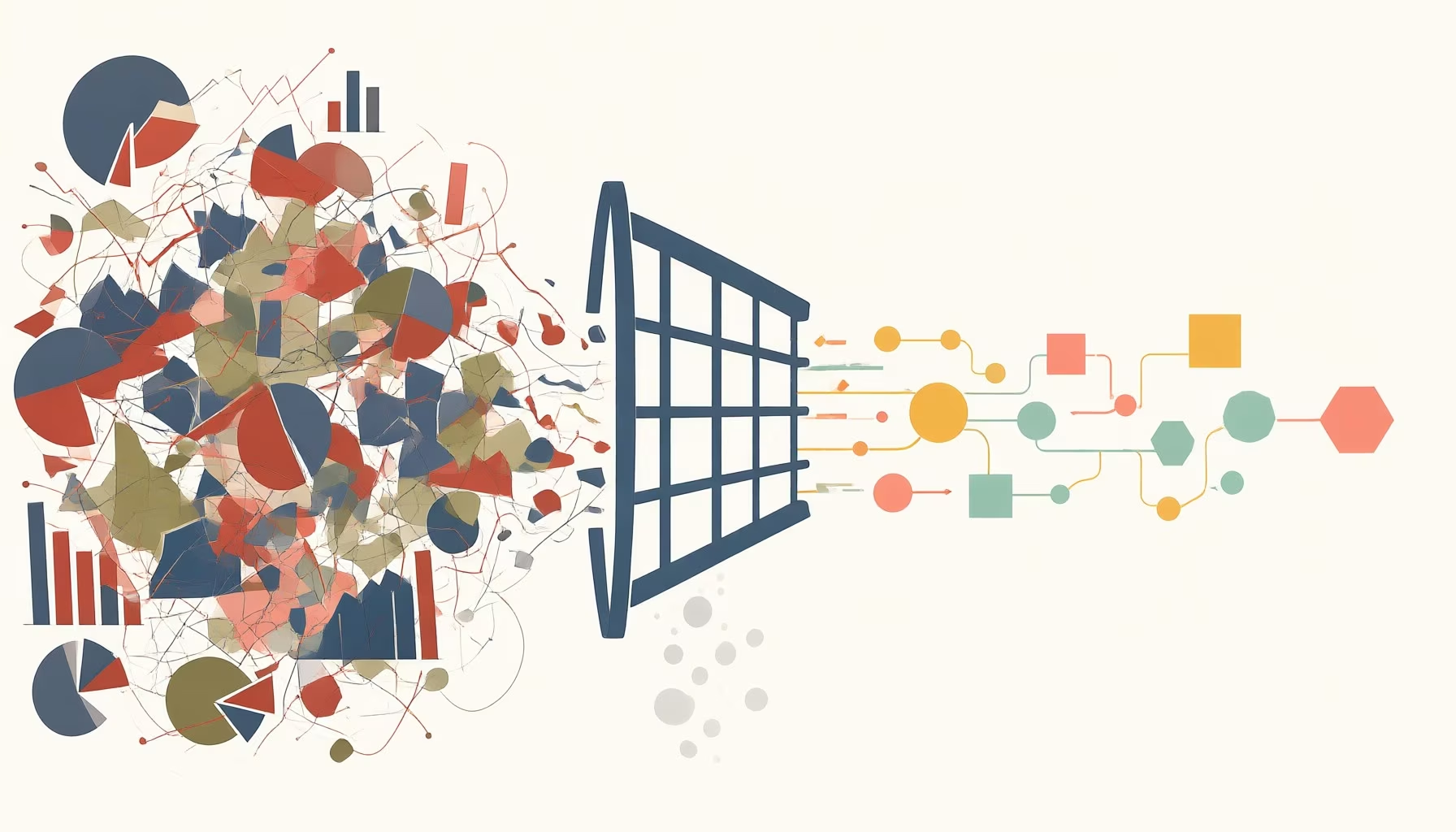
Today’s technology has made endeavors such as text mining of executive, political and other communications much more feasible en masse. Streaming technologies can enable near real time analysis, map-reduce type operators can be used for word counts and text analysis, and off the shelf sentiment applications can discern meaning and intent on a line-by-line basis.
When computers are tuned to pour through executive speeches, corporate communications, press interviews and more, such analysis could ultimately indicate whether a company is prone to “excessive optimism,” and help investors and other stakeholders “punch through the hype” of corporate speak. To the naked ear, speech patterns of executives, politicians and other global players probably change little over time. However, if data scientists are able to run current and past communications through text analytics processes, interesting patterns may emerge that could be actionable.
The largest challenge in analyzing executive hubris doesn’t appear to be standing up a technology infrastructure for analytics, especially when cloud based solutions are available. Nor does the actual sentiment analysis seem to be the sticking point, because with enough data scientists, such algorithms can be tweaked for accuracy over time.
The ultimate difficulty is deciding what—if anything to do—when analyses of leader’s speech patterns reveal a pattern of hubris. As an employee, does this mean it’s time to look for another job? As an investor, does this mean it’s time to sell? As a citizen, does this mean it’s time to pressure the government to change its course of action—and if so, how? All good questions for which there are few clear answers.
Regardless, with computers reading the news, it’s more important than ever for leaders of all stripes to be cognizant that stakeholders are watching and acting on their words—often in near real time.
Writer Gillian Tett says that we humans’ instinctively know, but often forget that power not only goes to the head, but also to the tongue.” With this in mind, leaders in political, business and social circles then need to understand that when it comes to signs of arrogance, we’ll not only be watching and listening, but counting too.