
The Performance Index analysis we performed as part of our next-generation predictive analytics benchmark research shows that only one in four organizations, those functioning at the highest Innovative level of performance, can use predictive analytics to compete effectively against others that use this technology less well. We analyze performance in detail in four dimensions (People, Process, Information and Technology), and for predictive analytics we find that organizations perform best in the Technology dimension, with 38 percent reaching the top Innovative level.
The Performance Index analysis we performed as part of our next-generation predictive analytics benchmark research shows that only one in four organizations, those functioning at the highest Innovative level of performance, can use predictive analytics to compete effectively against others that use this technology less well. We analyze performance in detail in four dimensions (People, Process, Information and Technology), and for predictive analytics we find that organizations perform best in the Technology dimension, with 38 percent reaching the top Innovative level. This is often the case in our analyses, as organizations initially perform better in the details of selecting and managing new tools than in the other dimensions. Predictive analytics is not a new technology per se, but the difference is that it is becoming more common in business units, as I have written.
In contrast to organizations’ performance in the Technology dimension, only 10 percent reach the Innovative level in People and only 11 percent in Process. This disparity uncovered by the research analysis suggests there is value in focusing on the skills that are used to design and deploy predictive analytics. In particular, we found that one of the two most-often cited reasons why participants are not fully satisfied with the organization’s use of predictive analytics is that there are not enough skilled resources (cited by 62%). In addition, 29 percent said that the need for too much training or customized skills is a barrier to changing their predictive analytics.
The challenge for many organizations is to find the combination of domain knowledge, statistical and mathematical knowledge, and technical knowledge that it needs to be able to integrate predictive analytics into other technology systems and into operations in the lines of business, which I also have discussed. The need for technical knowledge is evident in the research findings on the jobs held by individual participants: Three out of four require technical sophistication. More than one-third (35%) are data scientists who have a deep understanding of predictive analytics and its use as well as of data-related technology; one-fourth are data analysts who understand the organization’s data and systems but have limited knowledge of predictive analytics; and 16 percent described themselves as predictive analytics experts who have a deep understanding of this topic but not of technology in general. The research also finds that those most often primarily responsible for designing and deploying predictive analytics are data scientists (in 31% of organizations) or members of the business intelligence and data warehouse team (27%). This focus on business intelligence and data warehousing 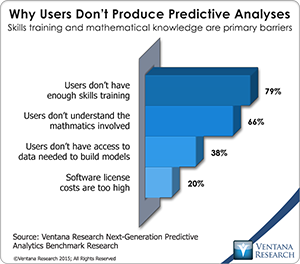 represents a shift toward integrating predictive analytics with other technologies and indicates a need to scale predictive analytics across the organization.

In only about half (52%) of organizations are the people who design and deploy predictive analytics the same people who utilize the output of these processes. The most common reasons cited by research participants that users of predictive analytics don’t produce their own analyses are that they don’t have enough skills training (79%) and don’t understand the mathematics involved (66%). The research also finds evidence that skills training pays off: Fully half of those who said they received adequate training in applying predictive analytics to business problems also said they are very satisfied with their predictive analytics; percentages dropped precipitously for those who said the training was somewhat adequate (8%) and inadequate (6%). It is clear that professionals trained in both business and technology are necessary for an organization to successfully understand, deploy and use predictive analytics.
To determine the technical skills and training necessary for predictive analytics, it is important to understand which languages and libraries are used. The research shows that the most common are SQL (used by 67% of organizations) and Microsoft Excel (64%), with which many people are familiar and which are relatively easy to use. The three next-most commonly used are much more sophisticated: the open source language R (by 58%), Java (42%) and Python (36%). Overall, many languages are in use: Three out of five organizations use four or more of them. This array reflects the diversity of approaches to predictive analytics. Organizations must assess what languages make sense for their uses, and vendors must support many languages for predictive analytics to meet the demands of all customers.
The research thus makes clear that organizations must pay attention to a variety of skills and how to combine them with technology to ensure success in using predictive analytics. Not all the skills necessary in an analytics-driven organization can be combined in one person, as I discussed in my analysis of analytic personas. We recommend that as organizations focus on the skills discussed above, they consider creating cross-functional teams from both business and technology groups.