Starting in the late 1960s, PLCs—programmable logic controllers—started to make their way into industrial automation. This took the place of relay-based systems with ladder logic, a graphical programming method that represents the wiring that it replaced. These systems revolutionized manufacturing, allowing changes that would have taken hours of fiddling with physical wires to be executed virtually on a keyboard. These systems are also extremely rugged, able to last for decades in harsh industrial environments.
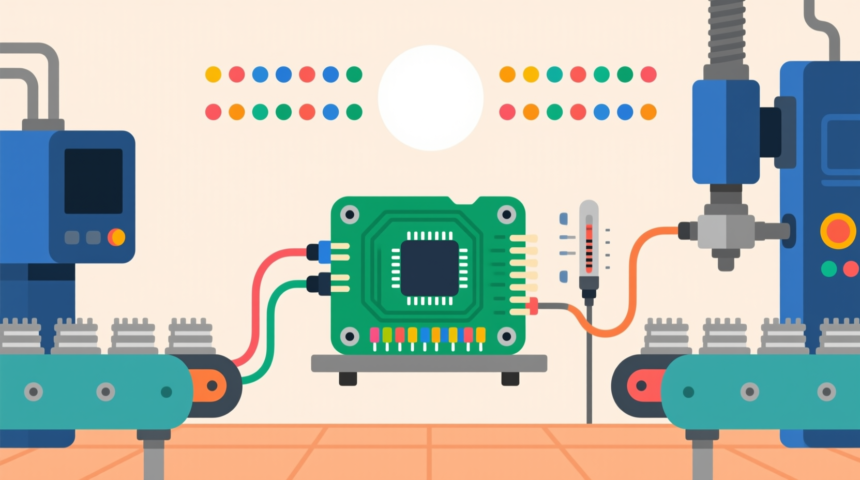
As computing systems progressed, the desire for more and more process information has led to data collection solutions that are extremely capable, yet also expensive and proprietary. With the advent of small and inexpensive computing systems, like the various iterations of Raspberry Pi, Arduino, and the like, engineers have begun to explore how they can be used in this arena.
Preventive Maintenance
One example of “maker board” data collection comes from Alex Wilson, who set up a Raspberry Pi board to monitor a series of PLC-based test stands at a safety equipment manufacturer. A Raspberry Pi 2B module was used inside a machine panel and used a wired Ethernet connection for data collection via TCP/IP and jsModbus on the Pi. This setup enabled it to communicate with the PLCs via the industry standard Modbus protocol. Data was then placed in an external database and displayed using D3, or Data-Driven Documents, JavaScript library.
While setup of the Pi in this situation can take some effort to get running effectively, it can also result in very good functionality. The idea is that using the Pi’s capabilities as a single-board computer allows it to create its own dashboard. This lets manufacturing engineers and other end-users interface with the system. Necessary process improvements and repairs could then be made theoretically before the machinery even breaks down.
More Read

Lab Testing
In another setup, Weston Catron of Heatworks Technologies Inc. has created a data collection system based on the Raspberry Pi to collect data from water heater test stations. Temperature data in this setup is collected using k-type thermocouples, then sent via MQTT to another system that creates an interface for data viewing.
The Pi uses custom PCBs for different types of data input, such as water flow and current consumption, and can also be used as an output to control tests via a MOSFET board. Catron’s project, pursued under the moniker of Heatworks Lab Services, has evolved from a prototype based on a Raspberry Pi 3, to a Pi Zero device refined to the point that they are even considering making it into a standalone product.
Ready-Made Industrial Adapters
What about an easy way to integrate Raspberry Pi or even Arduino-based solution for your industrial needs? If you’d like to jump into this maker-industrial world, then ThreeML has several products that merge “maker boards” into a DIN rail mountable package that won’t look out of place alongside an industrial PLC.
Their Raspberry Pi product, the Rhubarb, is something of an enhanced Pi breakout board. It features isolated digital inputs and analog inputs that can be setup to read 4-20mA or 0-10VDC. Additionally, a pair of relay outputs allow for simple process control. They also offer an Arduino Mega input module called Quince that breaks IO out and adds Ethernet capabilities. While an Arduino doesn’t give the same capabilities as Pi boards, they can act as cheap distributed IO nodes, pushing out JavaScript Object Notation (JSON) data to a server at a very reasonable unit price.
As with the other solutions here, ThreeML’s John Davis has seen these industrial boards used more in the role of data acquisition than full machine control. While theoretically they could replace a PLC in some applications, it’s tough to justify swapping out industrial controls with a board that many—correctly or not—consider to be something of a novelty. Davis, who founded ThreeML four years ago, has seen a steady interest in this type of maker tech, and anticipates this trend accelerating as students are exposed to it in tech schools and universities.