The maritime sector is an integral component of the global economy, and its necessity is emphasized more than ever because trade and relations between nations will halt without it. It serves as the hub for global cargo transportation, and the growth of a nation’s economy depends heavily on the effectiveness and efficiency of its marine transport system.
It is important to recognize that the maritime industry plays a crucial role in modern countries’ social and economic advancement and has significantly raised living standards worldwide.
While a large portion of the sector works with transporting commodities, products, and people by sea—including anything from container ships and oil tankers to small boats and passenger ferries— this is not the only purpose.
The maritime industry also includes the construction, repair, and maintenance of ships, the development of port facilities, and marine engineering. Around the world, the maritime sector is also a significant employer of labor.

The International Maritime Organization (IMO) estimates that more than 1.8 million sailors work worldwide. This excludes the estimated 20+ million workers, such as shore-based personnel, workers in the port facilities, constructors, and marine engineers, who serve or engage with the maritime industry in some way.
The fact that water transportation is one of the most environmentally friendly modes of transportation is also a positive.
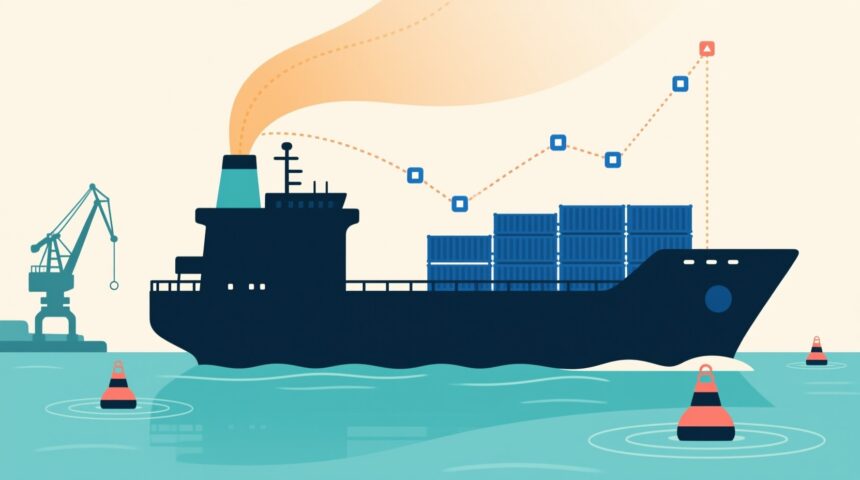
With the development of science and technology, we have witnessed the metamorphosis of all major industries, and the marine sector has had its fair share of change. Now, Big Data in the maritime industry is the new revolution.
An enormous amount of data is produced in an industry like the maritime industry, which manages many people and cargo. And data is everything in the twenty-first century. Data enables commercial decision-makers to base their choices on facts, statistical data, and trends.
In its most basic sense, Big Data refers to the enormous quantities of organized and unorganized data that give businesses and sectors evidence-based perspective into their present and future customer and market needs. Big data analytics are used to interpret large amounts of data, using a blend of Artificial Intelligence and Machine Learning-driven tools, Algorithms, and processing systems.
Industries like maritime have conventionally utilized enterprise resource planning (ERP) and other dispersed storage systems to utilize data. But, with the development of Big Data analytics, there is no better supply chain visibility.
Big Data offers the crucial clarity required in the complex supply chain landscape of the shipping industry. It enables industries to identify all of their problems, which may not be apparent if you only look at the fundamental data at a primary level.
Understanding how Big Data is reshaping an industry that fuels global trade is crucial for anybody interested in maritime. Here are some of the ways that Big Data is impacting the maritime industry:
Better Decision Making
Companies have more control over their shipping strategy and boost their overall key performances because every bit of information would be placed under a single cloud with Big Data, making the calculations much more straightforward. This is due to the availability of pertinent information at the appropriate time.
Making organized decisions with a strong foundation of available data is made easier with the relevant information. Every choice is data-driven, which enables an efficient industry. Nothing is left to chance or irrational intuition.
Improved Visibility
Visibility along transportation routes is becoming more and more necessary in the sector. Shipping managers are changing how they oversee the transport lines to ensure improved output.
From the origin to the destination, authentic freight analytics are required. With the constant real-time data stream, managers may quickly discover shortcomings and inefficiencies.
As a result of the data systems’ thorough and more frequent updates, all parties affected are automatically updated and informed. By offering an automated and proactive method that directly utilizes Big Data analytics, the supply chain may be made entirely immune to disruptions.
Enhanced Logistics:
Using data science in logistics can assist marine organizations in more effectively maximizing operations. This covers many concerns, such as the best delivery routes, better fuel management techniques, the best times of day to travel, and more precise supply and demand forecasting.
Applying data science to improve logistics can also assist businesses in using instantly supplied insights to make modifications along the route, as different dynamic elements like customer demand or gas costs can be acted on more quickly.
Using Big Data science and analytics is more efficient, less expensive, and faster to perform any required calculations or recalculations during operations.
Fraud Detection:
Analytics tools can be used to detect fraud in shipping operations. Some of these tools help to analyze purchasing patterns and payment data to spot fraudulent behavior.
This is a massively important activity for credit card firms, who can determine when spending slips outside a regular pattern for that consumer. The payment can then be flagged to prevent a possible case of fraud.
Online businesses can be approached in the same way. The shop can set up alerts if it notices multiple payment methods from the same IP address. In maritime, a string of bookings that deviates from a pattern may also be considered fraudulent activity.
Marketing and Advertising:
Big Data is advantageous even at the level of retailers since it can be used to identify trends in personalized marketing, which retailers can then utilize to create more individualized experiences by using targeted advertising.
The business can segment its audience to deliver customers more customized products and discount offers. Age, Sex, Location, and other demographic and socioeconomic data can all be used for segmentation.
This personalization can also encompass style and size of preferences and influence customers’ purchasing decisions.
Design and Tracking:
Ship design also makes use of big data. It may involve examining sensors on ships that are currently at sea. It may also involve looking at storage data, engine performance, cargo protection, and smoother operation.
While sensors, barcodes, and Radio frequency identification (RFID) Tags can be used in various ways to track and monitor shipments, integrating them with data on the weather and traffic can assist with making projections about arrival times, especially if there are delays.
Wrapping Up
Over the last several years, most other sectors have been utilizing Big Data’s power to speed up innovation and efficiency.
The marine sector is now also adopting digitization and appreciating the value of data and technology in making it a more vibrant, competitive sector of the 21st century.