Cookies help us display personalized product recommendations and ensure you have great shopping experience.

By using this site, you agree to the Privacy Policy and Terms of Use.
Accept
SmartData CollectiveSmartData Collective
  • Analytics
    AnalyticsShow More
    big data analytics in transporation
    Turning Data Into Decisions: How Analytics Improves Transportation Strategy
    3 Min Read
    sales and data analytics
    How Data Analytics Improves Lead Management and Sales Results
    9 Min Read
    data analytics and truck accident claims
    How Data Analytics Reduces Truck Accidents and Speeds Up Claims
    7 Min Read
    predictive analytics for interior designers
    Interior Designers Boost Profits with Predictive Analytics
    8 Min Read
    image fx (67)
    Improving LinkedIn Ad Strategies with Data Analytics
    9 Min Read
  • Big Data
  • BI
  • Exclusive
  • IT
  • Marketing
  • Software
Search
© 2008-25 SmartData Collective. All Rights Reserved.
Reading: The Case for Data Hoarding
Share
Notification
Font ResizerAa
SmartData CollectiveSmartData Collective
Font ResizerAa
Search
  • About
  • Help
  • Privacy
Follow US
© 2008-23 SmartData Collective. All Rights Reserved.
SmartData Collective > Big Data > Data Warehousing > The Case for Data Hoarding
Big DataData Warehousing

The Case for Data Hoarding

MIKE20
MIKE20
4 Min Read
SHARE

Do we really need all of this data?

Contents
  • Considerations
  • Simon Says
  • Feedback

It’s a question that I’ve heard more than a few times in my consulting career, especially as organizations have moved from legacy systems to more contemporary equivalents. Most of these improvements mean that organizations can consolidate data sources and, at least in theory, store all of their data in one place.

Do we really need all of this data?

It’s a question that I’ve heard more than a few times in my consulting career, especially as organizations have moved from legacy systems to more contemporary equivalents. Most of these improvements mean that organizations can consolidate data sources and, at least in theory, store all of their data in one place.

More Read

A peculiar quantum-physics property called entanglement can be…
Predictive Analytics World Recap
Can Salesforce.com Make Chatter Epicenter of Enterprise Collaboration?
Data, Data, Data: Communicating Successfully in the Deluge
How Big Data Helps Bar Owners Sell More Beer

Now, generally speaking, hoarding is not a healthy thing–and I don’t need reality shows to tell me as much. With respect to data management, though, is it really detrimental to an organization?

Amber Simonsen seems to think so. Simonsen is the PMP Executive Project Manager of Pierce Transit and talks about the perils of data hoards. ”What begins as an innocent desire to keep relevant information close at hand can turn into an unhealthy obsession that plagues IT departments and Records Managers in organizations everywhere,” Simonsen warns.

It’s a fair point, but think for a minute about data storage costs. To say that they’ve dropped in cost over the last three decades is the acme of understatement. Consider the following chart:
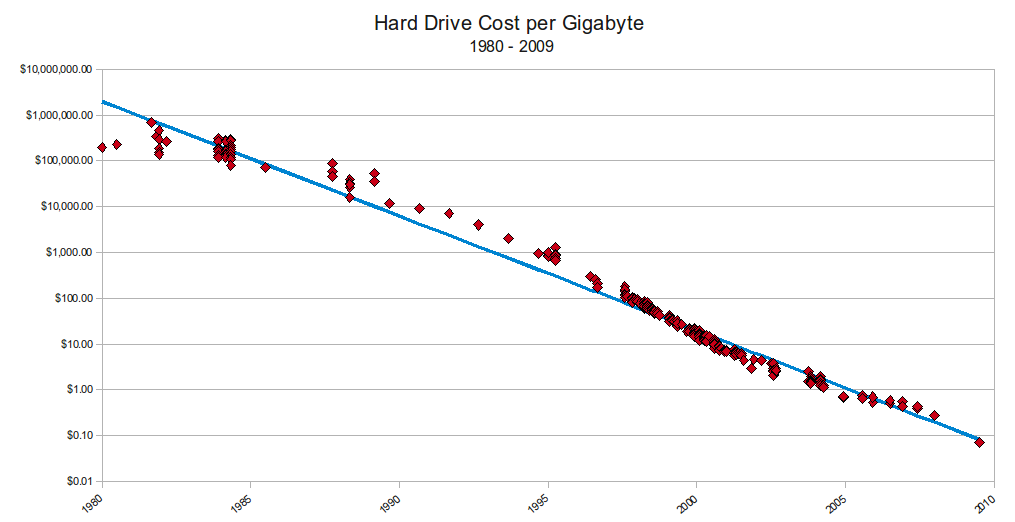
For more on the methodology used to derive these numbers, click here.

Considerations

So, the cost of data hoarding has dropped exponentially, even as the amount of data available has also risen exponentially. If you do the math, you’ll discover that organizations can store much more information these days than even five years ago for significantly lower costs. As a result, it’s hard to buy the “it’s too expensive to store this data” argument.

Of course, just because an organization can store a great deal of data doesn’t mean that it should. Data storage is a continuum, not a binary. What’s more, CIOs can actively decide not to store certain types of information for all sorts of reasons. Perhaps the most important consideration for an organization is what it uses to access and analyze new forms of data. If you’re trying to cram Big Data into Small Data solutions, then data gathering and storage (never mind) hoarding is going to pose a significant problem. As I write in my new book, you can’t write SQL statements against petabytes of unstructured data and expect to see meaningful results. New tools are needed to make sense of Big Data.

Simon Says

Data hoarding only makes sense if two conditions are met:

  1. Your organization has deployed the right tools–i.e., Hadoop, NoSQL and columnar databases, etc.
  2. Your organization actually does something with that data.

If that’s the case, hoard away.

Feedback

What say you?

TAGGED:Data Storage
Share This Article
Facebook Pinterest LinkedIn
Share

Follow us on Facebook

Latest News

AI role in medical industry
The Role Of AI In Transforming Medical Manufacturing
Artificial Intelligence Exclusive
b2b sales
Unseen Barriers: Identifying Bottlenecks In B2B Sales
Business Rules Exclusive Infographic
data intelligence in healthcare
How Data Is Powering Real-Time Intelligence in Health Systems
Big Data Exclusive
intersection of data
The Intersection of Data and Empathy in Modern Support Careers
Big Data Exclusive

Stay Connected

1.2kFollowersLike
33.7kFollowersFollow
222FollowersPin

You Might also Like

Online Tech Expert Interview: What Is High Availability?

9 Min Read
benefits of data lakes
Big DataData LakeExclusive

The Business And Technological Benefits Of Data Lakes

6 Min Read

Data hostages: The emerging business model of Web 2.0

5 Min Read
cloud servers
Cloud Computing

Cloud Servers Are Fundamentally Rewriting The Rules Of Data Storage

5 Min Read

SmartData Collective is one of the largest & trusted community covering technical content about Big Data, BI, Cloud, Analytics, Artificial Intelligence, IoT & more.

ai chatbot
The Art of Conversation: Enhancing Chatbots with Advanced AI Prompts
Chatbots
AI chatbots
AI Chatbots Can Help Retailers Convert Live Broadcast Viewers into Sales!
Chatbots

Quick Link

  • About
  • Contact
  • Privacy
Follow US
© 2008-25 SmartData Collective. All Rights Reserved.
Go to mobile version
Welcome Back!

Sign in to your account

Username or Email Address
Password

Lost your password?