One of the charitable causes to which I devote time puts on an annual vintage car show. The Concours d’Élegance dates back to 17th century France, when wealthy aristocrats gathered with judges on a field to determine who had the best carriages and the most beautiful horsepower. Our event serves as the centerpiece of a broader mission to raise money for several charitable organizations. One of my roles is to keep track of the cars entered in the show, and in that capacity I designed an online registration system.
One of the charitable causes to which I devote time puts on an annual vintage car show. The Concours d’Élegance dates back to 17th century France, when wealthy aristocrats gathered with judges on a field to determine who had the best carriages and the most beautiful horsepower. Our event serves as the centerpiece of a broader mission to raise money for several charitable organizations. One of my roles is to keep track of the cars entered in the show, and in that capacity I designed an online registration system. I’ve been struck by how my experiences with a simple IT system have been a microcosm of the issues that people encounter in designing, administering and using far more sophisticated ones. My most important take-away from this year’s event is the importance of self-service reporting. I suspect that most senior corporate executives – especially those in Finance – fail to appreciate the value of self-service reporting. It frees up the considerable resources organizations collectively waste on unproductive work, and it increases responsiveness and agility of the company as a whole.
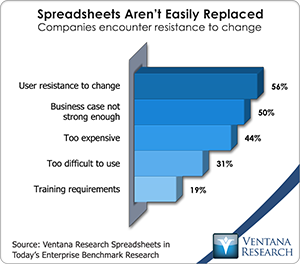 Electronic reporting began as a solution to paper print-outs, reducing the resources required to transmit information needed by individuals and making it easier for them to find information. Over the past couple of decades, these enterprise reports also have become much easier for IT professionals to create and maintain, but they are still time-consuming and aren’t particularly flexible. Rather than have their IT department create another version of a report, people often copy an electronic report, paste it into a spreadsheet, reconfigure the information to suit their needs and distribute the modified spreadsheet to a group of people. For this and other reasons IT departments have found it difficult to get business people to stop using spreadsheets. Our benchmark research on spreadsheets finds this is the number-one impediment to change. Spreadsheet users value control and flexibility. This is precisely what self-service reporting delivers without the time-consuming hassle of manually creating and distributing spreadsheet reports.
It’s useful to think of self-service reporting as an attitude and approach to using information technology than as a specific software product or category. It starts with the basic assumption that individuals in organizations must be able to retrieve information they need from the systems they use. This does not replace periodic enterprise reporting, dashboards, scorecards and other such “push” communication methods. This is not the once-voguish concept of “democratizing business intelligence” either; that was still too complicated for the vast majority of users. It’s more like replacing telephone operators with a direct dial system. (Note to readers under 40 years old: Once upon a time it required human intervention to connect your phone to someone else’s.) The goal of self-service reporting is to make broad sets of data readily available and give people the ability to access it (subject to permissions) as well as easily organize and display it in the form and format that works best for them.

In the early days of business computing, simply collecting and having access to company data was a breakthrough. Over the past decades, corporations automated and instrumented a broad range of functions, and the challenge lay in collecting and managing the data. Although companies still face many issues in data management, devolving reporting to the individual is now a critical issue companies must address. Well-designed self-service reporting improves the productivity of individuals in both IT and the rest of the organization. The controller of a midsize company recently told me people had been spending one-and-a-half days per month creating reports for senior executives and operating managers after the monthly and quarterly accounting close. Talk about unproductive use of resources! This is an extreme example but emblematic of time routinely wasted on something individuals ought be able to do on their own. From the IT side, far too much time is devoted to creating and maintaining reports – it’s akin to still having switchboard operators on staff to route calls.
Self-service reporting exists both as a feature of enterprise applications and in stand-alone products designed to work with applications that lack this capability. In deciding whether to replace existing software and in any vendor selection process, it’s important to assess benefits of self-service reporting capabilities. This is especially true as mobility increasingly is built into enterprise business applications. Anytime, anywhere access to information is one of the most important reasons why companies invest in mobility and demand this capability in the software they buy. Being able to drill down and around in the data contained in such reports provides a powerful incentive to replace spreadsheets. But there are also stand-alone products that can provide self-service reporting capabilities within legacy systems.
For our service organization this past year I still created a limited number of spreadsheets for individuals and groups that are not on our system. The only data issues we had were created when someone copied and pasted information from our reports into another spreadsheet. Errors are inevitable, and even in our local event there are unfortunate consequences when they occur. For example, telling someone who has just spent hundreds of hours preparing his or her car that the vehicle is not eligible for an award because it was not on the list of judged cars (even though our system showed that it was supposed to be judged) provokes the same level of irate response one might expect when a CFO is informed that there’s a material error in the published financial statements.
Self-service reporting is fast becoming a standard capability within businesses. It’s part of a generational change that is redefining corporate computing. People beyond a certain age still expect information to be given to them. Younger people want to get the information they need themselves and expect to have the ability to do so. IT departments must identify opportunities to offer self-service reporting and implement it wherever possible. Business users – especially those in finance roles – should familiarize themselves with self-service reporting – especially stand-alone tools that they can use and administer – and implement it wherever it is feasible.