Cookies help us display personalized product recommendations and ensure you have great shopping experience.

By using this site, you agree to the Privacy Policy and Terms of Use.
Accept
SmartData CollectiveSmartData Collective
  • Analytics
    AnalyticsShow More
    composable analytics
    How Composable Analytics Unlocks Modular Agility for Data Teams
    9 Min Read
    data mining to find the right poly bag makers
    Using Data Analytics to Choose the Best Poly Mailer Bags
    12 Min Read
    data analytics for pharmacy trends
    How Data Analytics Is Tracking Trends in the Pharmacy Industry
    5 Min Read
    car expense data analytics
    Data Analytics for Smarter Vehicle Expense Management
    10 Min Read
    image fx (60)
    Data Analytics Driving the Modern E-commerce Warehouse
    13 Min Read
  • Big Data
  • BI
  • Exclusive
  • IT
  • Marketing
  • Software
Search
© 2008-25 SmartData Collective. All Rights Reserved.
Reading: Are Smart Data Lakes the Answer to Data Warehouses?
Share
Notification
Font ResizerAa
SmartData CollectiveSmartData Collective
Font ResizerAa
Search
  • About
  • Help
  • Privacy
Follow US
© 2008-23 SmartData Collective. All Rights Reserved.
SmartData Collective > Big Data > Data Warehousing > Are Smart Data Lakes the Answer to Data Warehouses?
Big DataData ManagementData WarehousingExclusive

Are Smart Data Lakes the Answer to Data Warehouses?

Sean Martin
Sean Martin
5 Min Read
Image
SHARE

A phenomenal shift has occurred over the past few years in the enterprise data world. The ubiquitous data warehouses – the foundation for business intelligence and data discovery for several decades – are now becoming obsolete due to the emergence of data lakes.

While both data warehouses and data lakes have their pros and cons, a new era of ‘smart’ data lakes based on semantic technology is emerging that can reduce the disadvantages of either, creating a clear path for the industry.

A phenomenal shift has occurred over the past few years in the enterprise data world. The ubiquitous data warehouses – the foundation for business intelligence and data discovery for several decades – are now becoming obsolete due to the emergence of data lakes.

More Read

All Businesses Stand to Benefit from Big Data
Quality Control Tips for Data Collection with Drone Surveying
The Top AI-Based Web Design Trends For 2022
On Trees, Data Quality, and Big Data
The ABC of Data Capacity Management: Always Be (Thinking) Cloud

While both data warehouses and data lakes have their pros and cons, a new era of ‘smart’ data lakes based on semantic technology is emerging that can reduce the disadvantages of either, creating a clear path for the industry.

Before the evolution of the data lake, data warehouses were the only reliable solution for producing analytical reports on enterprise data. The benefits of a well-implemented data warehouse include effective governance and security, high data quality, and consistent analytics performance over time.

The downside of a data warehouse is it requires traditional, complex tools, like those from Oracle, IBM and Microsoft that typically require expensive resources and infrastructure.  Extensive preparation is also needed by skilled IT analysts to set up the warehouse, and there is very little flexibility in adapting to the rapidly changing business landscape. Many organizations also view data warehouses negatively due to their high failure rates and ongoing costs.

Due to the decreasing costs of data storage, enterprises began turning to data lakes as an alternative in recent years. Data lakes serve as large repositories of structured and unstructured data that many in the industry hoped could be accessed to extract value relatively quickly using big data tools.

However, like all first-generation solutions, data lakes presented some concerns as well. While data lakes enable business analysts to quickly and efficiently query unstructured data, the skills required of these analysts are scarce, often requiring extensive training.  In addition, it’s difficult to have data lakes adhere to critical rules of data governance, such as maintaining the security, access control and integrity of enterprise data.

Because of these issues, interest in “smart” data lakes has risen in an attempt to secure the benefits of data warehouses and first-generation data lakes while reducing their negatives.

Smart data lakes use semantic graph query engines that link and contextualize huge volumes of diverse enterprise data to determine meaning and value.  The graph models enable independent data discovery, analytics and visualization capabilities by users across all entities and relationships in the vast data lake repository.

The graph models of smart data lakes also eliminate the need for the extensive preparation required of data warehouses and the training required for effective analysis in first-generation data lakes.  There is generally some upfront preparation still required by IT personnel for smart data lakes, but it pales in comparison to the scale of work required for data warehouses.  In addition, the relative ease of working with graph-based models opens the door to a variety of business users querying the data, leading to a ‘democratization’ of big data discovery and analysis.

Semantic technologies also help maintain the necessary data governance needed for the long-term sustainability of data lakes. Organizations can implement access to data in accordance with governance protocols by specifying who can and cannot view data elements.  With these model-driven governance and access controls, restrictions and permissions are as enforceable as if the data were siloed according to governance mandates.  This empowers users to ask questions while retaining trust that the answers stem from high-quality, secure data.

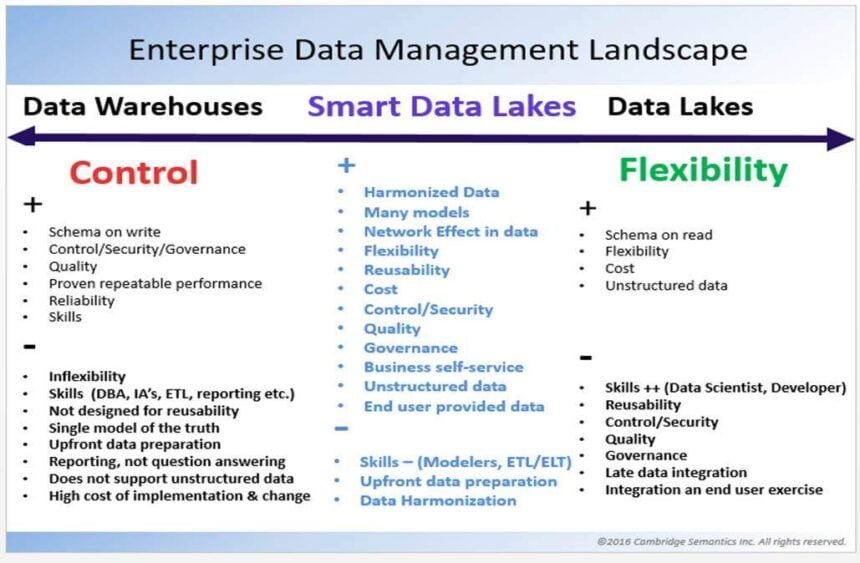
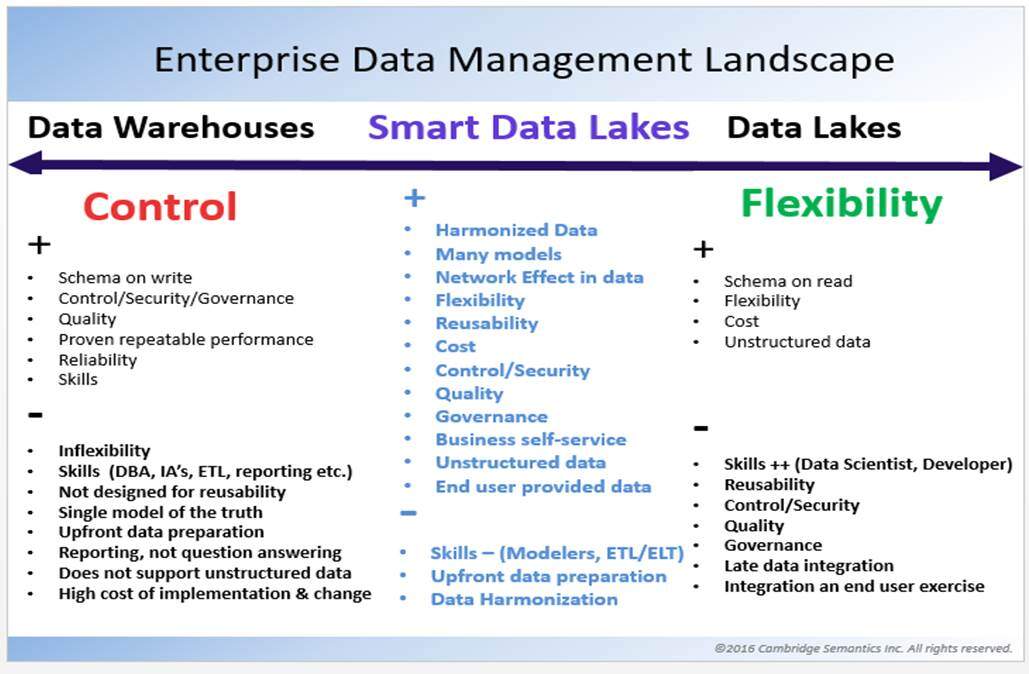
With key benefits of smart data lakes in the chart below, smart data lakes are well-positioned to displace data warehousing as the de facto means of storing data and facilitating analytics and discovery.

Image

Share This Article
Facebook Pinterest LinkedIn
Share
BySean Martin
Follow:
Sean Martin has been on the leading edge of Internet technology innovation since the early nineties. His greatest strength has been the identification and pioneering of next generation software & networking technologies and techniques. Prior to founding Cambridge Semantics, the leading provider of smart data solutions driven by semantic web technology, he spent fifteen years with IBM Corporation where he was a founder and the technology visionary for the IBM Advanced Internet Technology group.He is a native of South Africa, has lived for extended periods in London, England and Edinburgh, Scotland, but now makes his home in Boston, Mass.

Follow us on Facebook

Latest News

student learning AI
Advanced Degrees Still Matter in an AI-Driven Job Market
Artificial Intelligence Exclusive
mobile device farm
How Mobile Device Farms Strengthen Big Data Workflows
Big Data Exclusive
composable analytics
How Composable Analytics Unlocks Modular Agility for Data Teams
Analytics Big Data Exclusive
fintech startups
Why Fintech Start-Ups Struggle To Secure The Funding They Need
Infographic News

Stay Connected

1.2kFollowersLike
33.7kFollowersFollow
222FollowersPin

You Might also Like

data lakes importance
Data Lake

Understanding the Differences Between Data Lakes and Data Warehouses

6 Min Read
predictive analytics for emails
AnalyticsExclusivePredictive Analytics

Can Predictive Analytics Methods Make Innovation More Successful?

6 Min Read

If You Could Pick One Thing For Congress To Do Regarding CyberSecurity, What Would It Be?

3 Min Read
data governance
Culture/LeadershipData ManagementPolicy and Governance

What Does Your Information Governance Program Look Like?

9 Min Read

SmartData Collective is one of the largest & trusted community covering technical content about Big Data, BI, Cloud, Analytics, Artificial Intelligence, IoT & more.

ai is improving the safety of cars
From Bolts to Bots: How AI Is Fortifying the Automotive Industry
Artificial Intelligence
data-driven web design
5 Great Tips for Using Data Analytics for Website UX
Big Data

Quick Link

  • About
  • Contact
  • Privacy
Follow US
© 2008-25 SmartData Collective. All Rights Reserved.
Go to mobile version
Welcome Back!

Sign in to your account

Username or Email Address
Password

Lost your password?