We use cookies, including third-party cookies from Google to serve personalized ads through AdSense, to operate this site and understand how it is used. By continuing to browse, you accept this use. See our Privacy Policy and Terms of Use for details, including how to opt out of personalized advertising.
Accept
SmartData CollectiveSmartData Collective
  • Analytics
    AnalyticsShow More
    chatgpt image jul 21, 2026, 04 34 30 pm
    4 Core Benefits of Predictive Maintenance after Vibration Analysis
    10 Min Read
    How Does Data Mining Boost Customer Satisfaction in Logistics? Harnessing Analytics for Results -- AI-generated illustration
    How Does Data Mining Boost Customer Satisfaction in Logistics? Harnessing Analytics for Results
    11 Min Read
    chatgpt image jul 13, 2026, 04 23 45 pm
    How Data Analytics Helps Companies Improve User Engagement
    19 Min Read
    chatgpt image jul 13, 2026, 03 59 46 pm
    How Data Analytics Improves Multi-Location Search Strategies
    10 Min Read
    cybersecurity efforts
    How Behavioral Analytics and AI Are Redefining Cybersecurity for Boca Raton Businesses
    14 Min Read
  • Big Data
  • BI
  • Exclusive
  • IT
  • Marketing
  • Software
Search
© 2008-25 SmartData Collective. All Rights Reserved.
Reading: The analyst function is dead
Share
Notification
Font ResizerAa
SmartData CollectiveSmartData Collective
Font ResizerAa
Search
  • About
  • Help
  • Privacy
Follow US
© 2008-23 SmartData Collective. All Rights Reserved.
SmartData Collective > Big Data > Data Visualization > The analyst function is dead
AnalyticsBusiness IntelligenceData Visualization

The analyst function is dead

Editor SDC
Editor SDC
5 Min Read
The analyst function is dead
Photo by Pexels on Pixabay (https://pixabay.com/photos/technology-electronics-computer-1850021/)
SHARE

The role of the operational analyst has moved from the business into both Finance and into IT.  The Finance team typically focuses only upon the financial outcomes of the business and has left the operational side of the business to the IT team.

Here is a conversation a client of mine recently had with their analyst…

ANALYST: ” Here is the report on units sold this year.”

More Read

The Three Threes of BI Dashboards
Protecting Brand Reputation During Digital Expansion
Flipboard Harnesses Social Data to Individualize Online Media
Is Twitter Killing Blogging?
How Artificial Intelligence Can Improve Your Fundraising Efforts

BUSINESS:  “What happened here?”

ANALYST:  “That is a spike in the data.”

BUSINESS:  “Right.  But what happened?”

ANALYST:  “That is what the data is showing.”

Sadly, this is not uncommon in the business world today.  Billions of dollars are spent every year on Business Intelligence software to help us visualize what is happening within the business, yet we are really no better off in terms of insight.

WHY is this happening?

  1. The biggest reason why this is happening is we have changed the role of the analyst.  It used to be a marketing person looking at marketing data, or operations looking at manufacturing information.  We have now moved that role to IT, or IT has promised that that can do it better with their understanding of data structures.
  2. We have wrongly assumed that a picture is worth a thousand words.  In BI terms, a chart is worth a handful of questions. IT can not predict that next series of questions and is then left to prioritize what questions to tackle next.
  3. The pace of business, or at least the pace and variety of business questions (like the data we collect) has risen exponentially and scaled faster than our ability to respond.
  4. IT is over burdened and lacks the political power and will to say “no.”  They are in complete reaction mode and lack the resources to cover the demand.

WHAT can we do to fix this?

  • First off, we need to understand the analytical gap within the organization.  IT can manage the data and needs to partner with the business, but the business needs to own the intelligence.  It is easier to teach the business a little about technology, than teach the IT resources about the business.  The business side needs to find that type of person who understands a little about technology, but has a solid mathematical or statistical mind with a curiosity about improving the business.
  • The organization needs to find a better way to integrate better analysis back into the management process.  We need to give the analysts a frame of reference in which to explore ideas and present results.  Some of this will follow reporting upon weekly/monthly operational outcomes, while most will likely by ad-hoc hypothesis or what-if scenarios about some aspect of the business.
  • The culture has to reward critical thinking.  This is not true in most corporate cultures.  All to often, the analyst is criticized for not “going along” with the current belief.  If the culture does not reward new thinking, then the analysis will quickly fall in line with visualizations that support the status quo.
  • Invest in tools and training beyond just the core cubes and reports of the BI market.  While a good portion of analysis can be done with Microsoft Excel and a data dump, the more we want out of our analysts, the more we need to give them.  We need them to look at market baskets, threshold containment, frequency curves, optimization models, assumption testing, correlations, and many other types of analytical tools.

Filed under: Analytics, Analytics & Business Intelligence, Culture of Action, Visualization Tagged: analyst, charts, Data Visualization, graphs 

TAGGED:analyticsAnalytics & Business Intelligencevisualization
Share This Article
Facebook Pinterest LinkedIn
Share

Follow us on Facebook

Latest News

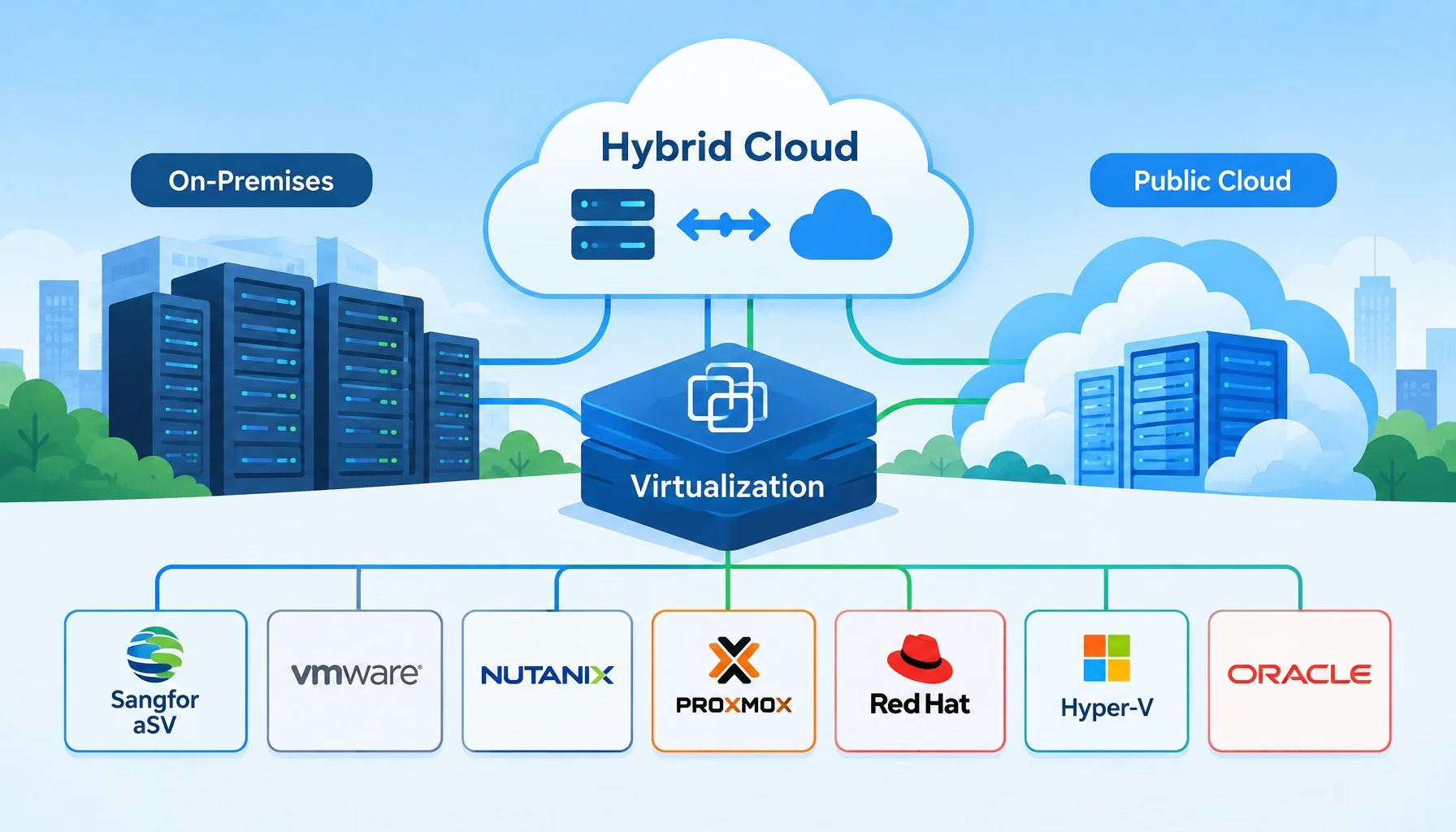
Server racks with cloud and user interface panels
Cloud Infrastructure and Workload Migration: A Data-Driven Look at VMware Alternatives in Europe
Cloud Computing Exclusive
Synthetic Data vs Real Web Data: Comparison, Limitations, and Collection Methods  -- AI-generated illustration
Synthetic Data vs Real Web Data: Comparison, Limitations, and Collection Methods 
Big Data Exclusive
Illustration of mobile analytics dashboards with ad performance charts connected to backend databases
11 Best Sisense Alternatives for Embedded Analytics
Business Intelligence Exclusive
Analyst points at colorful circular data dashboard on screen - information technology business metrics
How Fragmented Workplace Tech Undermines Reliable Business Metrics and Reporting
Cloud Computing Exclusive Infographic IT

Stay Connected

1.2KFollowersLike
33.7KFollowersFollow
222FollowersPin

You Might also Like

The Socialization of Data Analytics
Data Visualization

The Socialization of Data Analytics

3 Min Read
Analytics: What’s Passion Got to Do with It?
AnalyticsBest PracticesCommentaryCulture/LeadershipExclusive

Analytics: What’s Passion Got to Do with It?

6 Min Read
Automotive Industry Uses Analytics To Solve Pressing Supply Chain Issues
Analytics

Automotive Industry Uses Analytics To Solve Pressing Supply Chain Issues

6 Min Read
Analytics Moves To The Core: Reporting from the Gartner Summit
AnalyticsBusiness IntelligenceData WarehousingPredictive Analytics

Analytics Moves To The Core: Reporting from the Gartner Summit

5 Min Read

SmartData Collective is one of the largest & trusted community covering technical content about Big Data, BI, Cloud, Analytics, Artificial Intelligence, IoT & more.

How To Get An Award Winning Giveaway Bot
Big Data Chatbots Exclusive
5 Great Tips for Using Data Analytics for Website UX
Big Data

Quick Link

  • About
  • Contact
  • Privacy
Follow US
© 2008-26 SmartData Collective. All Rights Reserved.
Welcome Back!

Sign in to your account

Username or Email Address
Password

Lost your password?