
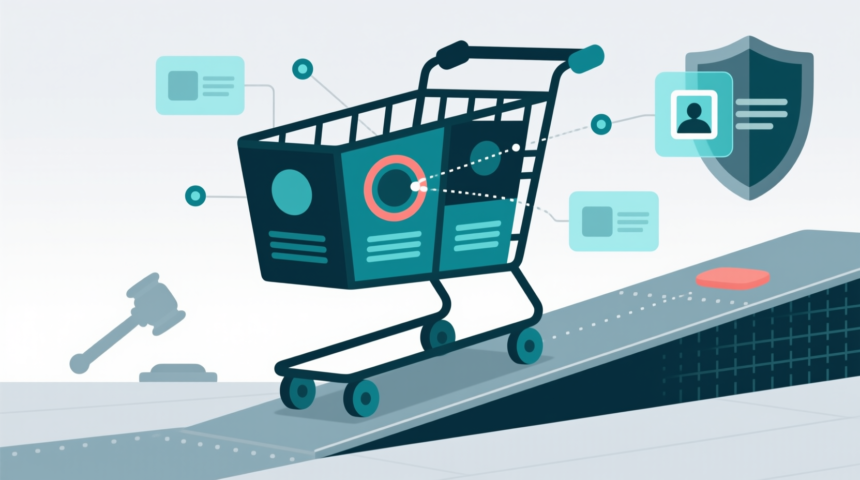
AI has become an important factor in the ecommerce industry. The benefits of AI in ecommerce include enhancing products, optimizing processes, identifying new markets and more. Now, a new benefit of AI is joining the list: avoiding the risk of website accessibility lawsuits.
Website accessibility lawsuits against ecommerce companies are becoming common. These companies need to understand the website accessibility requirements in the jurisdictions they serve, as well as the solutions that AI offers.
The Evolving Legal Framework of Website Accessibility Laws
The Americans with Disabilities Act (ADA) which became law in 1990, is “a civil rights law that prohibits discrimination against individuals with disabilities in all areas of public life, including jobs, schools, transportation, and all public and private places that are open to the general public”, as described by The ADA National Network. Since the world-wide-web has become an essential component of our day-to-day lives, it is listed as well among the places that must be accessible to individuals with disabilities.
The United States federal government has published updated regulations on accessibility requirements in Information and Communication Technologies (ICT) contained in two federal laws. The recently updated policies stipulate that software, hardware, customer support and all documentation must meet certain accessibility standards. This applies to all websites, mobile apps, and online applications.
More Read

Organizations must make sure that their platforms are accessible to people with any type of major cognitive, vision, hearing, speech, cognition or fine motor disabilities. In accordance to that, despite the fact that most business are unaware of website accessibility laws, failure to comply can result in serious litigation.
In 2018 alone, 2,258 website accessibility lawsuits were filed in federal court. The Bureau of Internet Accessibility expects this figure to triple in 2019.
According to a review by 3PlayMedia, ecommerce companies are one of the biggest targets of this emerging trend. This phenomenon can be explained after reviewing the following:
- More individuals are using ecommerce platforms to shop online. According to Oberlo, the number of online shoppers is estimated to reach 92 billion digital buyers in 2019.
- People with disabilities represent a critical mass in the ecommerce industry. According to research by Essential Accessibility, people with disabilities represent about 10% of total online spending.
Therefore, it’s essential to make sure that a basic and popular trend such as online shopping is open and accessible to all individuals in the population, including those with disabilities.
Ecommerce Companies Must Prepare for International Standards on Website Accessibility
The aforementioned updates made by the Unites States federal government allow the U.S. to align its website accessibility requirements with those of other countries, including those of the European Commission (EN 301 509) and the World Wide Web Consortium (W3C) Web Content Accessibility Guidelines (WCAG). These are internationally recognized but not mandatory guidelines. However, it is likely that the United States will continue to update its standards to reflect the evolving policies in other countries.
The amendment jointly reorganizes the ICT accessibility requirements contained in Section 508 of the U.S. Rehabilitation Act and those contained in Section 255 of the Communications Act.
The new rule began taking effect in 2018, but many organizations are still not familiar with the new policies. Smaller ecommerce companies are often unaware of the policies, because they don’t have the legal resources to familiarize themselves with them. Unfortunately, their negligence to understand these laws does not act as a valid defense method against a lawsuit.
Moreover, the companies that are aware of all of the above and wish to make their website accessible must go through an extremely tedious and complex procedure, which demands advanced knowledge in website development and various coding languages. Alternatively, for a hefty price of tens of thousands of dollars, companies can turn to service providers specializing in making websites accessible and compliant according to Section 508 and the WCAG. This not including necessary amendments to keep the dynamic website accessible, which is likely to occur on a regular basis.

AI Presents Real Solutions to eCommerce Companies Looking to Improve Website Accessibility
As website accessibility becomes a bigger issue, it is likely to be one of the dominant trends of 2020 in the Ecommerce space. With regulators and disabled users raising the bar for website accessibility, Ecommerce shop owners that fail to comply may face expensive lawsuits and lose disabled shop owners.
This is where AI steps in to help site owners comply with the WCAG and adhere to mandatory regulations. Aiming at helping site owners comply with the aforementioned regulations, website accessibility startup accessiBe launched an AI-based, automatic, website-accessibility solution. With clients like Avon, Volvo and Deloitte, accessiBe has already set out on a path “to make the entire internet fully accessible to people with disabilities by 2025”.
accessiBe aids site owners and E-commerce shop owners in particular to make their website accessible and compliant, by implementing an AI-powered background application which analyzes and learns the site’s structure and components. These include popups, dropdowns, forms and more windows that must be addressed in order to make the site fully accessible for disabled shoppers.
The tool generates keyboard navigation functionalities that the blind and motor impaired need in order to navigate the site, and provides text descriptions for images, which is essential for many disabled shoppers who need to understand the product they wish to purchase.
The foreground application on the site’s interface enables the user to adjust the UI according to the WCAG. These include fonts, sizing, spacing, color contrasts, cursors, emphasis and more. Disabled shoppers can use the accessibility interface to disable animations and flashing GIFs which is essential for the epileptic, and use a virtual keyboard which is essential for the motor-impaired.
Conclusion
For most ecommerce business, AI based web accessibility solutions are the only solution possible for them, as they cant afford a $30K+ manual website accessibility process that wont even help them, as they need to change their site daily with new products, promotions and sales.