I’ve been asked by several folks recently what they need to learn to succeed in data mining and predictive analytics. This is a different twist on the question I also get, namely what degree should one get to be a good (albeit “green”) data miner. Usually, the latter question gets the answer “it doesn’t matter” because I know so many great data miners without a statistic or mathematics degree who are great data miners. Understandably, there are many non-stats/math degrees that have a very strong statistics or mathematics component, such as psychology, political science, and engineering to name a few. But then again, you don’t necessarily have to load up on the stats/math courses in these disciplines either.
So the question of “what to learn” applies across majors whether undergraduate or graduate. Of course statistics and machine learning courses are directly applicable. However, the answer I’ve been giving recently to the question what do new data miners need to learn (assuming they will learn algorithms) have centered around two other topics: databases and business.
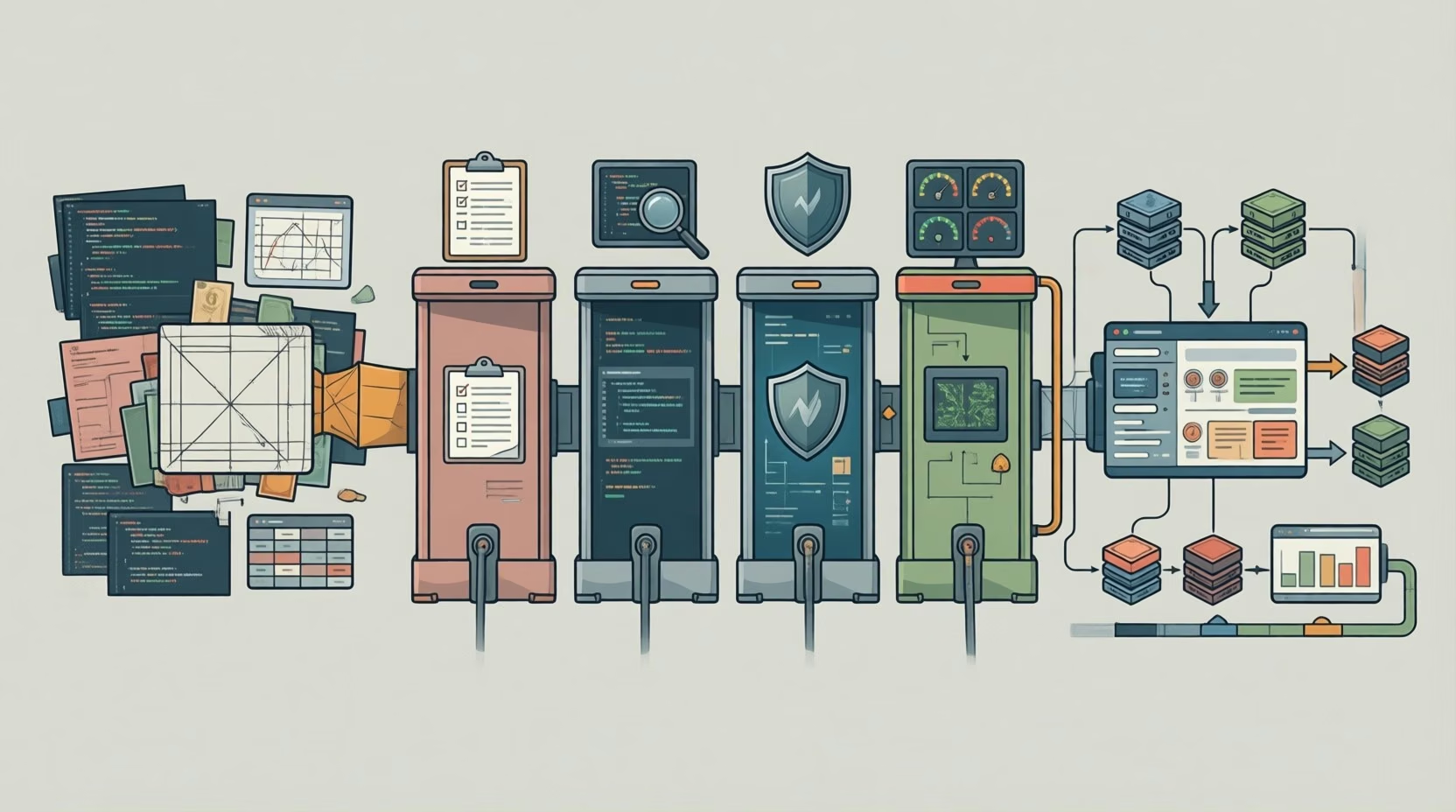
I had no specific coursework or experience in either when I began my career. In the 80s, databases were not as commonplace in the DoD world where I began my career; we usually worked with flat files provided to us by a customer, even if these files were quite large. Now, most customers I work with have their data stored in databases or data marts, and as a result, we data miners often must lean on DBAs or an IT layer of people to get at the data. This would be fine except that (1) the data that is provided to data miners is often not the complete data we need or at least would like to have before building models, (2) we sometimes won’t know how valuable data is until we look at it, and (3) communication with IT is often slow and laden with political issues inherent in many organizations.
On the other hand, IT is often reticent to give analysts significant freedom to query databases because of the harm they can do (wise!) because data miners have in general a poor understanding of how databases work and which queries are dangerous or computationally expensive.
More Read
Therefore, I am becoming more of the opinion that a masters program in data mining, or a data mining certificate program should contain at least one course on databases, which should contain at least some database design component, but for the most part should emphasize a users perspective). It is probably more realistic to require this for a degree than a certificate, but could be included in both. I know that for me, in considering new hires, this would be provide a candidate an advantage for me if he or she had SQL or SAS experience.
For the second issue, business experience, there are some that might be concerned that “experience” is too narrow for a degree program. After all, if someone has experience in building response models, what good would that do for Paypal if they are looking for building fraud models? My reply is “a lot”! Building models on real data (meaning messy) to solve a real problem (meaning identifying a target variable that conveys the business decision to be improved) requires a thought process that isn’t related to knowing algorithms or data.
Building “real-world” models requires a translation of business objectives to data mining objectives (as described in the Business Understanding section of CRISP-DM, pdf here). When I have interviewed young data miners in the past, it is those who have had to go through this process that are better prepared to begin the job right away, and it is those who recognize the value here who do better at solving problems in a way that impacts decisions rather than finding cool, innovative solutions that never see the light of day.
My challenge to the universities who are adding degree programs in data mining and predictive analytics, or are offering Certificate programs is then to include courses on how to access data (databases), and how to solve problems (business objectives, perhaps by offering a practicum with a local company).