Cookies help us display personalized product recommendations and ensure you have great shopping experience.

By using this site, you agree to the Privacy Policy and Terms of Use.
Accept
SmartData CollectiveSmartData Collective
  • Analytics
    AnalyticsShow More
    predictive analytics risk management
    How Predictive Analytics Is Redefining Risk Management Across Industries
    7 Min Read
    data analytics and gold trading
    Data Analytics and the New Era of Gold Trading
    9 Min Read
    composable analytics
    How Composable Analytics Unlocks Modular Agility for Data Teams
    9 Min Read
    data mining to find the right poly bag makers
    Using Data Analytics to Choose the Best Poly Mailer Bags
    12 Min Read
    data analytics for pharmacy trends
    How Data Analytics Is Tracking Trends in the Pharmacy Industry
    5 Min Read
  • Big Data
  • BI
  • Exclusive
  • IT
  • Marketing
  • Software
Search
© 2008-25 SmartData Collective. All Rights Reserved.
Reading: Is Data Science a Liberal Art?
Share
Notification
Font ResizerAa
SmartData CollectiveSmartData Collective
Font ResizerAa
Search
  • About
  • Help
  • Privacy
Follow US
© 2008-23 SmartData Collective. All Rights Reserved.
SmartData Collective > Big Data > Data Mining > Is Data Science a Liberal Art?
Big DataData Mining

Is Data Science a Liberal Art?

gjmount
gjmount
4 Min Read
SHARE

In the sense that all science is a liberal art, yes.

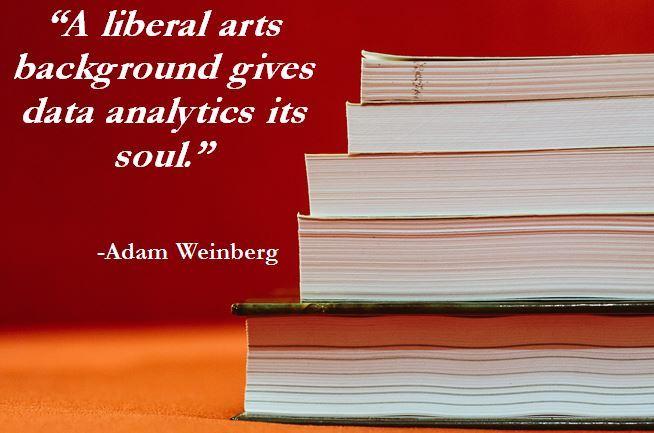
This week I read a great piece by Adam Weinberg, the president of Denison University, on his school’s initiatives to apply a liberal arts approach to data science.

This is shocking to most, but why? Let’s diagram this phrase “data science” (English skills!). Data is information — let’s leave it at that for now. But what about science?

More Read

Why Context Matters – Forget Real-Time, Achieve Right-Time
Resolving Many-to-Many Relationships
Testing the San Francisco Open Data Initiative [VIDEO]
What Will You Tolerate?
Expert Speak: 6 Highlights and Lessons from the 2015 CDO Summit

In the sense that all science is a liberal art, yes.

This week I read a great piece by Adam Weinberg, the president of Denison University, on his school’s initiatives to apply a liberal arts approach to data science.

This is shocking to most, but why? Let’s diagram this phrase “data science” (English skills!). Data is information — let’s leave it at that for now. But what about science?

Science is the testing of observable phenomena. It is built on the scientific method of observing, making hypotheses, and testing them.

a97f2fd3-1cbb-41f5-9b3e-97c2bc5a68ba-original

So the “data mining” approach of pointing out quirky relationships in data with no guiding theory is one thing. “Data science” is another. Because as a science, it must be grounded in the scientific method.

And science has long been a part of any liberal arts education. I took two in college — they were some of my easier classes, but I still took them. In fact, I was required to take them to graduate.

In the meantime, I also took classes in literature and history. I learned what’s worked and what hasn’t in human history through studying the great books.

I learned how to write and communicate. And in my science classes, I learned how to make hypotheses from these observations, and test them. An economics major, I was able to examine what worked and hasn’t in terms of human flourishing, for example.

This can’t be said about many pre-professional or even many STEM programs — they’re more concerned with passing off knowledge to you and not showing you how to test and generate ideas of your own.

Data science vs data mining: Liberal arts makes the difference

In my career I’ve been presented with huge amounts of data concerning everything from retail sales to hospital cleaning times. While it’s been a challenge to learn the technical chops to handle the data’s size and scope, the liberal arts taught me how to use it.

How to frame problems? How to communicate your theories and conclusions? Study the liberal arts. Learn how to attack problems from various angles. Communicate in ways that other well-educated people can evaluate your research.

Theory-based data science will always beat willy-nilly data mining. Sure, statistical techniques will change now that we don’t have to worry about small sample size.

This doesn’t mean that we should retreat from the scientific method that has driven much of our advances over the past few centuries.

It’s encouraging to see data science and the liberal arts teaming up — liberal arts are the basis for any science, after all.

 

Share This Article
Facebook Pinterest LinkedIn
Share

Follow us on Facebook

Latest News

street address database
Why Data-Driven Companies Rely on Accurate Street Address Databases
Big Data Exclusive
predictive analytics risk management
How Predictive Analytics Is Redefining Risk Management Across Industries
Analytics Exclusive Predictive Analytics
data analytics and gold trading
Data Analytics and the New Era of Gold Trading
Analytics Big Data Exclusive
student learning AI
Advanced Degrees Still Matter in an AI-Driven Job Market
Artificial Intelligence Exclusive

Stay Connected

1.2kFollowersLike
33.7kFollowersFollow
222FollowersPin

You Might also Like

Great BI, or Getting By? [Webinar] – Today at 2pm ET

2 Min Read

Focusing on decisions to improve the software end product

3 Min Read

The Internet of Things – What an opportunity!

5 Min Read

The Smarter Enterprise and the Age of Analytics (via…

1 Min Read

SmartData Collective is one of the largest & trusted community covering technical content about Big Data, BI, Cloud, Analytics, Artificial Intelligence, IoT & more.

ai in ecommerce
Artificial Intelligence for eCommerce: A Closer Look
Artificial Intelligence
AI and chatbots
Chatbots and SEO: How Can Chatbots Improve Your SEO Ranking?
Artificial Intelligence Chatbots Exclusive

Quick Link

  • About
  • Contact
  • Privacy
Follow US
© 2008-25 SmartData Collective. All Rights Reserved.
Go to mobile version
Welcome Back!

Sign in to your account

Username or Email Address
Password

Lost your password?