
We use cookies, including third-party cookies from Google to serve personalized ads through AdSense, to operate this site and understand how it is used. By continuing to browse, you accept this use. See our Privacy Policy and Terms of Use for details, including how to opt out of personalized advertising.
Accept
SmartData CollectiveSmartData Collective
  • Analytics
    AnalyticsShow More
    chatgpt image jul 21, 2026, 04 34 30 pm
    4 Core Benefits of Predictive Maintenance after Vibration Analysis
    10 Min Read
    How Does Data Mining Boost Customer Satisfaction in Logistics? Harnessing Analytics for Results -- AI-generated illustration
    How Does Data Mining Boost Customer Satisfaction in Logistics? Harnessing Analytics for Results
    11 Min Read
    chatgpt image jul 13, 2026, 04 23 45 pm
    How Data Analytics Helps Companies Improve User Engagement
    19 Min Read
    chatgpt image jul 13, 2026, 03 59 46 pm
    How Data Analytics Improves Multi-Location Search Strategies
    10 Min Read
    cybersecurity efforts
    How Behavioral Analytics and AI Are Redefining Cybersecurity for Boca Raton Businesses
    14 Min Read
  • Big Data
  • BI
  • Exclusive
  • IT
  • Marketing
  • Software
Search
© 2008-25 SmartData Collective. All Rights Reserved.
Reading: 5 Principles of Analytical Hub Architecture (Part 2)
Share
Notification
Font ResizerAa
SmartData CollectiveSmartData Collective
Font ResizerAa
Search
  • About
  • Help
  • Privacy
Follow US
© 2008-23 SmartData Collective. All Rights Reserved.
SmartData Collective > IT > Hardware > 5 Principles of Analytical Hub Architecture (Part 2)
AnalyticsHardwareIT

5 Principles of Analytical Hub Architecture (Part 2)

RickSherman
RickSherman
2 Min Read
5 Principles of Analytical Hub Architecture (Part 2)
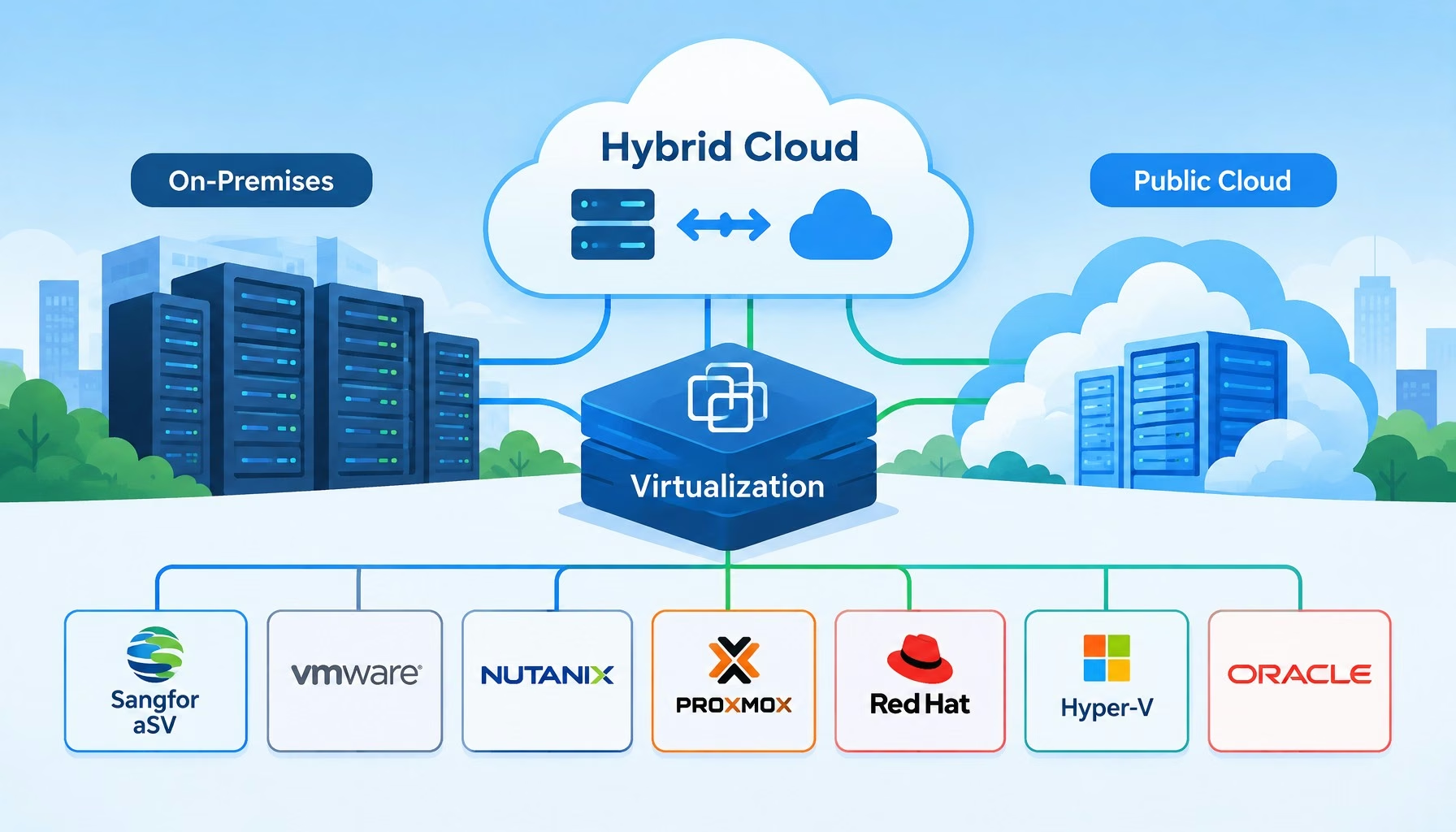
Illustrative image generated with OpenAI gpt-image-1.
SHARE

Continuing the discussion on analytical hub design, here’s the second part of my post on the architecture principles. If you missed the first two principles (1. Data from everywhere needs to be accessible and integrated and 2. Building solutions must be fast, iterative and repeatable) see this earlier blog post.

3. The advanced analytics elite needs to “run the show”

Continuing the discussion on analytical hub design, here’s the second part of my post on the architecture principles. If you missed the first two principles (1. Data from everywhere needs to be accessible and integrated and 2. Building solutions must be fast, iterative and repeatable) see this earlier blog post.

3. The advanced analytics elite needs to “run the show”

More Read

Could You Be POTUS?
Could You Be POTUS?
Analytics, Semantics & Sense: Q&A with Elliot Turner, AlchemyAPI
Examining Big Data’s Potential In Predictive Marketing
Why Sentiment Analysis Engines Need Customization
How I Estimate (Social/Sentiment/Text Analytics) Market Size

IT has traditionally managed the data and application environments. In this custodial role, IT has controlled access and has gone through a rigorous process to ensure that data is managed and integrated as an enterprise asset. The enterprise, and IT, needs to entrust data scientists with the responsibility to understand and appropriately use data of varying quality in creating their analytical solutions. Data is often imperfect, but data scientists are the business’s trusted advisors who have the knowledge required to be the decision-makers.

4. Solutions’ models must be integrated back into business processes

When predictive models are built, they often need to be integrated into business processes to enable more informed decision-making. After the data scientists build the models, there is a hand-off to IT to perform the necessary integration and support their ongoing operation.

5. Sufficient infrastructure must be available for conducting advanced analytics

This infrastructure must be scalable and expandable as the data volumes, integration needs and analytical complexities naturally increase.  Insufficient infrastructure has historically limited the depth, breadth and timeliness of advanced analytics as data scientists often used makeshift environments.

Read more about this in my free white paper on Analytic Data Hub design entitled Analytics Best Practices: The Analytical Hub.

TAGGED:hubsystem architecture
Share This Article
Facebook Pinterest LinkedIn
Share

Follow us on Facebook

Latest News

How Search Engine Indexing Lags Behind Large-Scale Website Domain Migrations -- AI-generated illustration
How Search Engine Indexing Lags Behind Large-Scale Website Domain Migrations
News
How Great Content Moves Through A Marketing Ecosystem -- AI-generated illustration
How Great Content Moves Through A Marketing Ecosystem
Exclusive Infographic Marketing
What Your Brand Misses That Data Reveals -- AI-generated illustration
What Your Brand Misses That Data Reveals
Big Data Exclusive Infographic
5 Common Mistakes Businesses Make During the Risk Assessment Process -- AI-generated illustration
5 Common Mistakes Businesses Make During the Risk Assessment Process
Business Intelligence Exclusive Risk Management

Stay Connected

1.2KFollowersLike
33.7KFollowersFollow
222FollowersPin

You Might also Like

Monitoring a System
Uncategorized

Monitoring a System

5 Min Read

5 Principles of Analytical Hub Architecture (Part 1)

3 Min Read
Design Patterns
Uncategorized

Design Patterns

9 Min Read

SmartData Collective is one of the largest & trusted community covering technical content about Big Data, BI, Cloud, Analytics, Artificial Intelligence, IoT & more.

Artificial Intelligence for eCommerce: A Closer Look
Artificial Intelligence
The Art of Conversation: Enhancing Chatbots with Advanced AI Prompts
Chatbots

Quick Link

  • About
  • Contact
  • Privacy
Follow US
© 2008-26 SmartData Collective. All Rights Reserved.
Welcome Back!

Sign in to your account

Username or Email Address
Password

Lost your password?