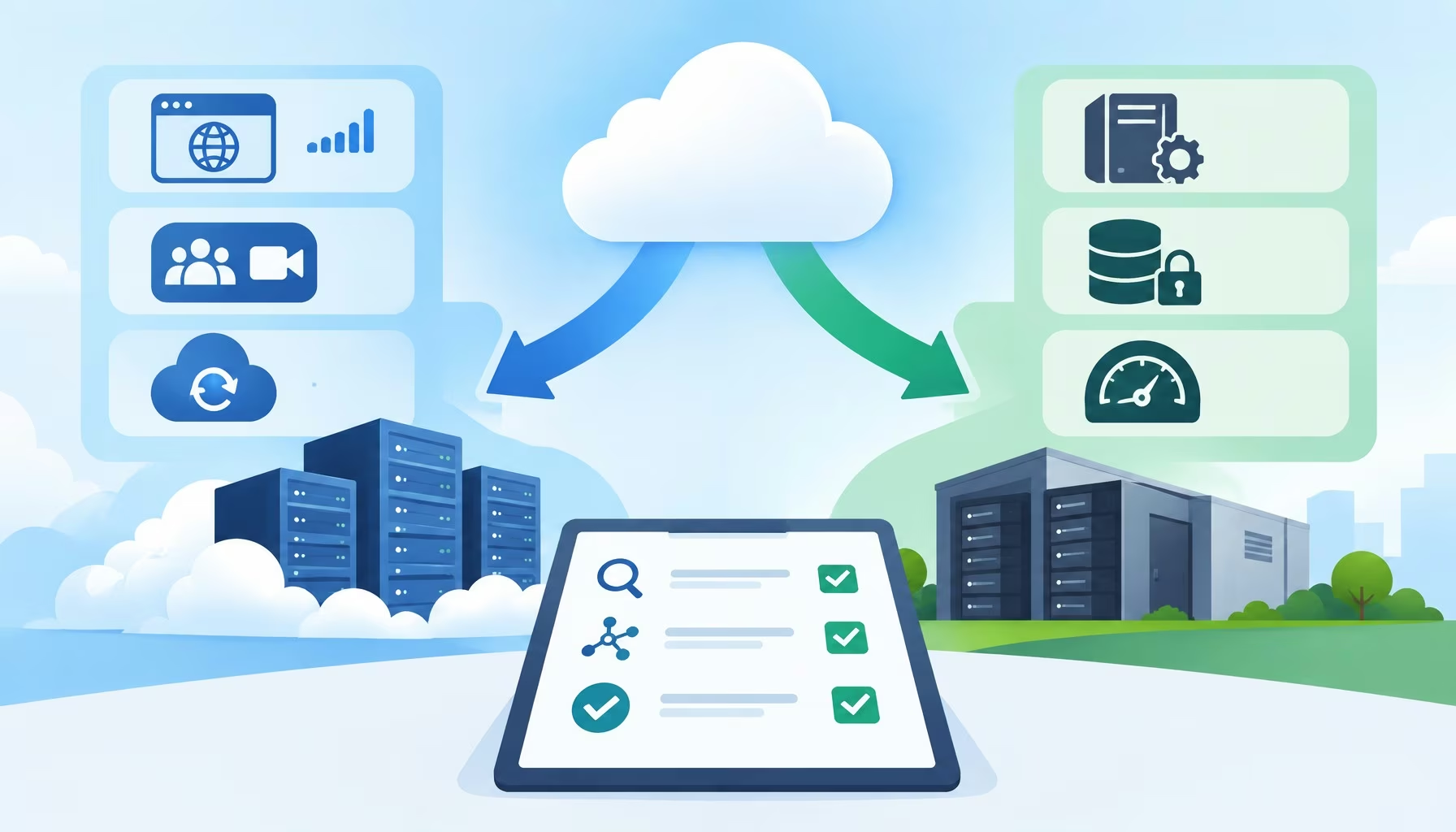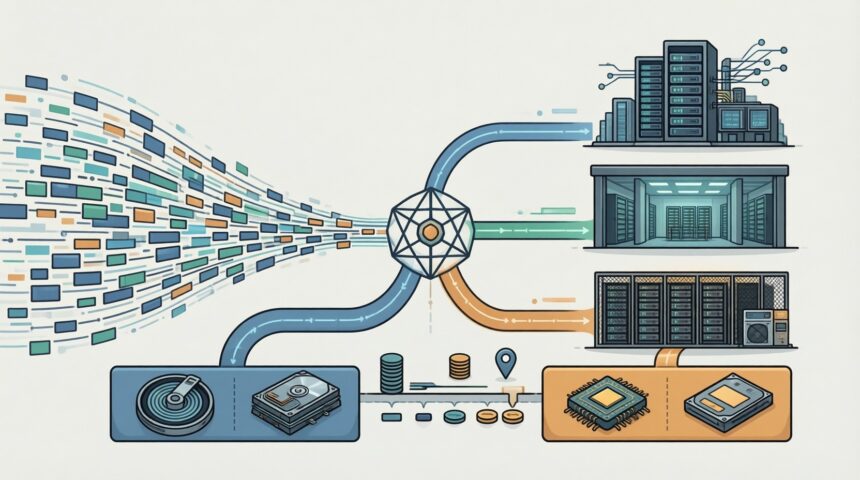
Modern enterprise data architectures decouple storage from compute, pairing elastic object stores with high-throughput NVMe caching layers to process petabyte-scale pipelines without runaway egress fees. Deciding where workloads reside—distributed public cloud, dedicated colocation, or private on-premises clusters—dictates your latency floor, compliance posture, and long-term cost trajectory.
- What Is Big Data Storage?
- The Five Defining Traits of Big Data
- Cloud-based Storage
- On-premises Storage
- Colocation
- Hard Disk Drives
- Solid-state drives
- Market Trends and Forecasts for Big Data Storage
- Hybrid and Multi-Cloud Deployment Patterns for Enterprise Data
- Data Lakes, Warehouses, and Object Storage Architectures
- Cost, Latency, and Durability Trade-Offs
- Calculate a Monthly Storage Cost Subtotal
- Frequently Asked Questions
- Designing Your Long-Term Storage Tiering Strategy
Although big data can be advantageous, the sheer volume of computer power and software services needed to support big data initiatives can impose a serious burden.
Modern data pipelines require robust, scalable infrastructure to capture, secure, and process high-velocity inputs. Five architectural tiers form the backbone of modern big data storage systems:
- Cloud-based Object & Lakehouse Storage
- Private On-premises SAN/NAS Infrastructure
- Carrier-Neutral Colocation Facilities
- High-Density Enterprise Hard Disk Drives (HDDs)
- PCIe NVMe Solid-State Drives (SSDs)
What Is Big Data Storage?
Big data storage represents the foundational infrastructure engineered to ingest, persist, and govern high-volume, multi-structured datasets across distributed clusters. As enterprise data platform architect Cloudian explains, scalable architectures must decouple compute resources from persistent storage nodes to ingest unstructured streams without bottlenecking transactional engines. Beyond raw gigabyte capacity, modern storage platforms must satisfy strict throughput baselines, horizontal scale-out demands, and sub-millisecond retrieval latencies for distributed analytical engines like Apache Spark, Trino, and Snowflake.
The Five Defining Traits of Big Data
Storage engineering specifications are shaped by five core workload dimensions, widely formalized in systems literature as the 5 V’s detailed by Characteristics of Big Data:
- Volume: The absolute magnitude of retained data, scaling from petabytes into exabytes, which dictates erasure coding strategies and tiering policies.
- Velocity: Ingestion rates across streaming event queues (e.g. Apache Kafka), defining buffer sizing and required write IOPS.
- Variety: Diverse structural formats spanning parquet tables, JSON payloads, time-series telemetry, and raw media objects.
- Veracity: Data integrity, schema validation, and checksum verification routines essential for reliable business intelligence and AI model training.
- Value: The analytical return on investment, which must outweigh media acquisition, electrical power, cooling, and operational engineering overhead.
Cloud-based Storage
Cloud-based object stores provide globally distributed, elastically expandable repositories designed for asynchronous analytics and long-term retention. By abstracting physical drive provisioning into managed HTTP API endpoints, cloud architectures enable organizations to scale storage pools dynamically without capital provisioning delays. Cloud service providers operate hyper-scale facilities interconnected by dedicated private network backbones, offering multi-region redundancy and continuous hardware replacement cycles.
Elastic subscription models allow teams to match expenditure directly to active ingestion volume rather than over-provisioning peak headroom years in advance. Even so, operating at petabyte scale requires diligent lifecycle management: continuous cold-tier archival, automated transition rules, and careful monitoring of cross-region replication fees ensure that elastic convenience does not transform into unbounded operational expenditure during sustained network reads.
Resilience planning requires treating cloud elasticity with rigorous operational controls. Engineering teams establish strict capacity quotas, per-bucket API rate throttles, and separate egress cost models. Distributed disaster recovery plans account for regional backbone disruptions by maintaining active-passive replicas across cloud availability zones.
On-premises Storage
On-premises enterprise storage anchors data within owned corporate data centers, delivering bare-metal Storage Area Network (SAN) and Network Attached Storage (NAS) fabrics directly to local compute clusters. Organizations operating under strict sovereign regulatory constraints, defense-grade air-gapped isolation, or deterministic microsecond I/O requirements deploy on-premises arrays to retain full mechanical and cryptographic governance over their storage estate.

Internal infrastructure guarantees unmetered local network throughput, completely eliminating the continuous egress and API request billing associated with public cloud queries. For organizations processing predictable, high-frequency read/write workloads around the clock, bare-metal arrays frequently offer a lower total cost of ownership per terabyte once initial capital expenditure has amortized.
Nevertheless, on-premises architectures demand substantial operational engineering commitments. Scaling storage requires physical rack expansion, SAS/SATA fabric reconfiguration, and power/cooling management. System engineers must oversee continuous firmware patching, wear-leveling monitoring, and multi-chassis RAID or ZFS pool topologies to ensure unbroken operational continuity across hardware lifecycle refreshes.
Colocation
Colocation bridges dedicated private infrastructure ownership with enterprise-grade carrier-neutral data centers. In a colocation deployment, organizations purchase and configure their own server, networking, and storage hardware while leasing secure cage space, redundant cooling infrastructure, and uninterruptible power systems within a specialized third-party facility.
This hybrid model eliminates the immense capital investment required to construct raised-floor data center facilities while preserving complete administrative control over proprietary storage appliances. Crucially, major colocation hubs offer direct, dedicated fiber cross-connects (such as AWS Direct Connect and Azure ExpressRoute), enabling organizations to establish high-bandwidth, sub-millisecond interconnects between their private storage clusters and public cloud analytics engines.
By pairing colocated private clusters with public cloud burst capacity, technology leaders build high-throughput hybrid topologies. High-volume, predictable analytical datasets remain on high-density private storage pools without egress penalties, while burst machine learning workloads scale dynamically into the cloud over private peering links.
Hard Disk Drives
High-capacity magnetic hard disk drives (HDDs)—specifically enterprise helium-sealed 18TB to 24TB SAS/SATA drives utilizing CMR (Conventional Magnetic Recording) and SMR (Shingled Magnetic Recording) platters—remain the bedrock of high-density capacity tiers and cold archival data lakes. Their unmatched cost-per-terabyte profile makes spinning media the standard choice for sequential read/write pipelines where raw capacity outweighs random access latency.
Magnetic drives retain magnetic states across power interruptions, ensuring persistent data preservation when electrical power is removed. Still, rotational spindle speeds (typically 7,200 RPM) constrain random access performance to approximately 75 to 100 IOPS per drive. In petabyte-scale big data architectures, systems architects counter these mechanical limitations by deploying distributed erasure coding (such as Reed-Solomon 8+4 configurations) and striped RAIDZ2/3 topologies across dense multi-chassis JBOD enclosures.
Because HDDs rely on mechanical spindles and actuator arms, they remain inherently vulnerable to physical shock and wear over time. Production data platforms mitigate drive failure risk through automated SMART telemetry tracking, hot-standby drive rebuild pools, and distributed block replication across disparate server racks.
Solid-state drives
Solid-state drives (SSDs) utilize non-volatile NAND flash memory interconnected via NVMe (Non-Volatile Memory Express) over PCIe Gen4 and Gen5 interfaces, delivering hundreds of thousands of random read/write IOPS with sub-millisecond access latencies. In big data analytics environments, enterprise flash storage forms the primary Tier-0 and Tier-1 engines for real-time stream ingestion, distributed caching layers, and high-frequency indexing tables.
This solid-state architecture significantly improves mechanical durability and delivers superior rack-density efficiency compared to magnetic platters. While upfront capital expenditure per raw terabyte exceeds spinning media by 3x to 5x, the total elimination of rotational seek latency, combined with substantial electrical and thermal efficiency gains, makes NVMe flash the indispensable foundation for latency-sensitive query engines like ClickHouse, Elasticsearch, and RocksDB.
Production enterprise SSDs incorporate onboard power-loss protection (PLP) capacitors to flush volatile write buffers to persistent NAND cells during abrupt utility disruptions. Storage administrators configure TRIM parameters, monitor Terabytes Written (TBW) endurance ratings, and provision over-provisioning space to maintain consistent write throughput across sustained 24/7 ingestion cycles.
Market Trends and Forecasts for Big Data Storage
Independent industry analyses highlight rapid capital investment in scalable big data storage platforms as enterprise telemetry and AI ingestion workloads expand exponentially. Comprehensive research by Market Research Future projects the global big data storage sector to reach USD 31.09 billion by 2035, progressing at a 13.26% compound annual growth rate through 2035. This trajectory is propelled by the continuous expansion of connected IoT endpoints and deep learning model training datasets.
Complementary infrastructure tracking by Persistence Market Research estimates the broader enterprise storage infrastructure market at US$63.4 billion in 2025, climbing to US$132 billion by 2032 at a steady 13.0% CAGR. Enterprise engineering organizations utilize these macro-economic trends to benchmark multi-year infrastructure roadmaps, balancing the ongoing migration toward managed cloud object tiers with targeted on-premises flash deployments for latency-critical core assets.
Hybrid and Multi-Cloud Deployment Patterns for Enterprise Data
Modern enterprise architectures rarely rely on a single deployment medium, increasingly adopting hybrid and multi-cloud topologies that unify on-premises clusters, edge nodes, and public cloud regions under centralized control planes. Frameworks like the Azure Cloud Adoption Framework emphasize uniform security governance, consistent identity management, and cost transparency across heterogeneous environments.
By implementing open table formats (such as Apache Iceberg and Delta Lake) over standardized S3-compatible APIs, technology teams prevent vendor lock-in. Workloads seamlessly query data stored in private colocation arrays, edge caching appliances, or multiple public cloud storage accounts using unified SQL query engines, ensuring optimal placement for both compliance and compute proximity.
Data Lakes, Warehouses, and Object Storage Architectures
Decoupling storage from compute has established object storage as the default foundation for enterprise data lakes. As detailed in AWS cloud storage architectural guides, object stores persist semi-structured and unstructured data in raw formats alongside rich metadata tags, allowing diverse analytical engines to query the same underlying files concurrently.
The modern data lakehouse architecture combines the low-cost elasticity of object storage with the ACID transactions, schema enforcement, and indexing performance of traditional relational data warehouses. Immutable write-once-read-many (WORM) configurations, automated snapshot versioning, and partition pruning enable analytical platforms to query historical data across billions of records with predictable execution latency.
Cost, Latency, and Durability Trade-Offs
Designing a sustainable big data storage environment requires balancing three interdependent engineering constraints: financial expenditure, I/O latency, and long-term durability. The matrix below outlines how primary architectural choices compare across operational parameters:
| Solution | Target Workload | Read/Write Latency | Cost Model | Durability & Governance |
|---|---|---|---|---|
| Cloud Object Storage | Scalable data lakes, asynchronous analytics, cloud-native pipelines | 10–50 ms (first-byte) | Variable OpEx; GB-month storage plus egress & API requests | 11 9s durability; managed cross-region replication & WORM policies |
| On-premises SAN/NAS | Air-gapped data, compliance archives, sub-millisecond local processing | <1 ms (SAN) / 2–5 ms (NAS) | High upfront CapEx; ongoing power, cooling & staffing | Customer-managed RAID/ZFS pools; absolute physical isolation |
| Carrier Colocation | Predictable compute clusters, hybrid egress minimization, private peering | 1–3 ms (Direct Connect) | Predictable CapEx/OpEx; rack lease plus power & cross-connects | Customer hardware; dual-feed utility power & carrier-neutral security |
| Enterprise HDD Arrays | Cold archival pools, bulk sequential ingest, secondary backups | 10–20 ms (seek-bound) | Lowest raw media CapEx/GB; higher power & rack footprint | High MTTDL with 8+4 erasure coding; mechanical wear monitoring |
| PCIe NVMe SSD Pools | Real-time streaming, time-series indexing, active lakehouse caching | <100 µs | Premium CapEx/GB; superior density & electrical efficiency | Power-loss capacitors; wear-leveling & endurance telemetry tracking |
Engineering teams optimize total infrastructure expenditure by aligning storage tiers directly with data lifecycle stages. Hot transactional tables and streaming ingest reside on high-speed NVMe flash, warm analytical queries transition to general-purpose cloud object storage, and aged compliance logs demote automatically to deep magnetic or tape archives, minimizing long-term data management overhead.
Calculate a Monthly Storage Cost Subtotal
To evaluate baseline storage tier expenses before committing production data, engineers can utilize the following lightweight Python script. It models monthly capacity fees alongside estimated analytical retrieval and egress operations without requiring external dependencies:
def calculate_storage_monthly(
    capacity_tb: float,
    rate_per_gb: float,
    egress_tb: float = 0.0,
    egress_rate_per_gb: float = 0.08,
    api_requests_thousands: int = 0,
    rate_per_10k_requests: float = 0.05
) -> dict:
    """Calculates baseline monthly cloud object storage expenditure."""
    stored_gb = capacity_tb * 1024.0
    storage_cost = stored_gb * rate_per_gb
    egress_cost = (egress_tb * 1024.0) * egress_rate_per_gb
    request_cost = (api_requests_thousands / 10.0) * rate_per_10k_requests
    total_cost = storage_cost + egress_cost + request_cost

    return {
        "storage_gb": round(stored_gb, 2),
        "storage_cost_usd": round(storage_cost, 2),
        "egress_cost_usd": round(egress_cost, 2),
        "request_cost_usd": round(request_cost, 2),
        "total_monthly_usd": round(total_cost, 2)
    }

# Example: 100 TB stored at $0.023/GB, with 10 TB analytical egress
estimate = calculate_storage_monthly(
    capacity_tb=100.0,
    rate_per_gb=0.023,
    egress_tb=10.0,
    egress_rate_per_gb=0.08,
    api_requests_thousands=500,
    rate_per_10k_requests=0.005
)
print(f"Total Projected Monthly: ${estimate['total_monthly_usd']:,.2f}")
Frequently Asked Questions
Is big data storage still relevant in modern analytics?
Yes. As enterprise organizations scale AI model training, autonomous vehicle telemetry, and global IoT pipelines, unstructured data volumes consistently outgrow conventional relational database engines. Published forecasts confirm continued capital allocation toward distributed storage systems: Persistence Market Research tracks the infrastructure market expanding toward US$132 billion by 2032, while Market Research Future anticipates 13.26% compound annual growth. Modern big data architectures prioritize decoupled storage-compute lakehouses and open table formats to query multi-petabyte datasets with high cost efficiency.
Designing Your Long-Term Storage Tiering Strategy
Selecting an optimal big data storage architecture is rarely an all-or-nothing choice between public cloud services and private data centers. High-performing engineering organizations succeed by implementing hybrid tiering: pairing high-throughput NVMe flash for active distributed pipelines, cost-effective magnetic arrays or colocation for predictable base capacity, and elastic cloud object stores for dynamic burst analytics. By establishing automated lifecycle migration rules and auditing egress bandwidth early, you protect your data infrastructure against unexpected cost spikes while guaranteeing the deterministic throughput your analytical workloads demand.