Now that prediction season is coming to an end, it’s time to reflect on how technology always changes, but the underlying business needs remain the same from year to year, or even decade to decade.
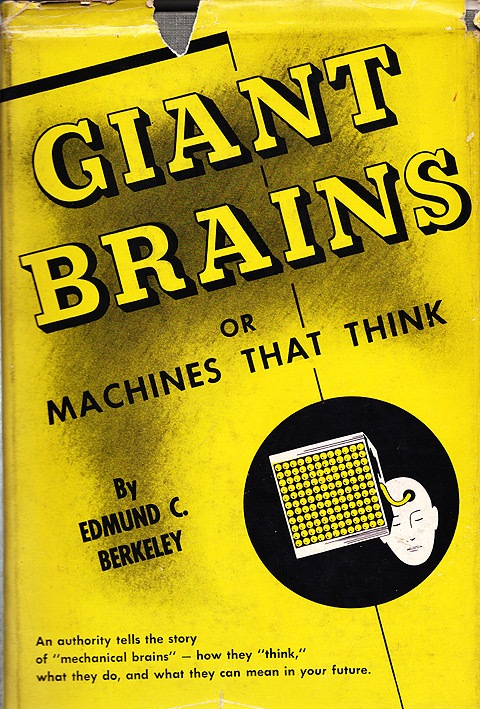 I recently stumbled across a second-hand book in the American Library in Paris titled "Giant Brains or Machines That Think" by Edmund C. Berkeley.
Edmund Berkeley was an early computing pioneer, and the book includes a description of one of the world’s first (very basic) personal computers, Simon. But what’s more interesting to me are his long-term predictions on how "machines that think" will affect our lives.
The prediction problem
The book illustrates the key problem with predictions: like so many authors over the years, Berkeley "gets it right while getting it very wrong." The underlying idea is proven valid over time, but the technology and timescale required to achieve it is completely off the mark.

Here are some of Mr. Berkeley’s predictions, each headed by the current technology that I think best fits the vision:
"Nowadays when we wish to send out announcements of an event, like going to South America for a year, we may copy…
Now that prediction season is coming to an end, it’s time to reflect on how technology always changes, but the underlying business needs remain the same from year to year, or even decade to decade.
I recently stumbled across a second-hand book in the American Library in Paris titled "Giant Brains or Machines That Think" by Edmund C. Berkeley.
Edmund Berkeley was an early computing pioneer, and the book includes a description of one of the world’s first (very basic) personal computers, Simon. But what’s more interesting to me are his long-term predictions on how "machines that think" will affect our lives.
The prediction problem
The book illustrates the key problem with predictions: like so many authors over the years, Berkeley "gets it right while getting it very wrong." The underlying idea is proven valid over time, but the technology and timescale required to achieve it is completely off the mark.
Here are some of Mr. Berkeley’s predictions, each headed by the current technology that I think best fits the vision:
"Nowadays when we wish to send out announcements of an event, like going to South America for a year, we may copy the addresses of our friends onto the envelope by hand. In the future, we can see our address book as a spool of magnetic tape. When we wish to send out announcements, we put a stack of blank envelopes into the machine that will read the magnetic tape, and we press a button. Out will come the envelopes addressed."
Internet
"We can foresee the development of machinery that will make it possible to consult information in a library automatically. Suppose that you go into the library of the future and wish to look up ways for making biscuits. You will be able to dial into the catalogue machine "making biscuits." There will be a flutter of movie film in the machine. Soon it will stop, and, in front of you on the screen, will be projected the part of the catalogue which shows the names of three or four books containing recipes for biscuits. If you are satisfied, you will press a button; a copy of what you saw will me bade for you and come out of the machine."
“After further development, all the pages of all books will be available by machine. Then, when you press the right button, you will be able to get from the machine a copy of the exact recipe for biscuits that you choose. "
ERP Systems
"Another large group of problems for which we can foresee the use of machines that think is found in business and economics."
"For example, consider production scheduling in a business or a factory. The machine takes in a description of each order received by the business and a description of its relative urgency. The machine knows (that is, has in its memory) how much of each kind of raw material is needed to fill the order and what equipment and manpower are needed to produce it. The machine makes a schedule showing what particular men and what particular equipment are to be set to work to produce the order. The machine turns out the best possible production schedule, showing who should do what when, so that all the orders will be filled in the best sequence. What is the "best" sequence? We can decide what we think is the best sequence, and we can set the machine for making that kind of selection, in the same way as we decide what is "warm" and set the thermostat to produce it!"
IPhone
"What about the ordinary everyday effects of these machines up on you and me as in individual? We can see that the new machinery will apply on a small scale even to us. Small machines using a few electronic tubes — much like a radio set, for example — and containing spools of magnetic wire or magnetic tape will doubtless be available to us. We shall be able to use them to keep addresses and telephone numbers, to figure out the income tax we should pay, to help us keep accounts and make ends meet, to remember many things we need to know, and perhaps even to give us more information. For there are a great many things that all of us could do much better if we could only apply what the wisest of us knows."
"We can even imagine what new machinery for handling information may some day become: a small pocket instrument that we carry around with us, talking to it whenever we need to, and either storing information in it or receiving information from it. Thus the brain with a motor will guide and advise the man just as the armor with a motor carries and protects him."
Other problems that aren’t yet fixed
The book goes on to talk about lots of other potential business problems that the "giant brains" could help with which are still a problem today:
- Automatic translator
- Automatic typist
- Automatic stenographer
- Automatic recognizer
If you liked this post you might like:
The Real Pioneer of Business Intelligence (and BI 2.0)? Hans-Peter Luhn and his seminal 1958 article called “Business Intelligence”.