We use cookies, including third-party cookies from Google to serve personalized ads through AdSense, to operate this site and understand how it is used. By continuing to browse, you accept this use. See our Privacy Policy and Terms of Use for details, including how to opt out of personalized advertising.
Accept
SmartData CollectiveSmartData Collective
  • Analytics
    AnalyticsShow More
    chatgpt image jul 21, 2026, 04 34 30 pm
    4 Core Benefits of Predictive Maintenance after Vibration Analysis
    10 Min Read
    How Does Data Mining Boost Customer Satisfaction in Logistics? Harnessing Analytics for Results -- AI-generated illustration
    How Does Data Mining Boost Customer Satisfaction in Logistics? Harnessing Analytics for Results
    11 Min Read
    chatgpt image jul 13, 2026, 04 23 45 pm
    How Data Analytics Helps Companies Improve User Engagement
    19 Min Read
    chatgpt image jul 13, 2026, 03 59 46 pm
    How Data Analytics Improves Multi-Location Search Strategies
    10 Min Read
    cybersecurity efforts
    How Behavioral Analytics and AI Are Redefining Cybersecurity for Boca Raton Businesses
    14 Min Read
  • Big Data
  • BI
  • Exclusive
  • IT
  • Marketing
  • Software
Search
© 2008-25 SmartData Collective. All Rights Reserved.
Reading: Why it should be “target & test”, not “test & target”
Share
Notification
Font ResizerAa
SmartData CollectiveSmartData Collective
Font ResizerAa
Search
  • About
  • Help
  • Privacy
Follow US
© 2008-23 SmartData Collective. All Rights Reserved.
SmartData Collective > Big Data > Data Mining > Why it should be “target & test”, not “test & target”
Data Mining

Why it should be “target & test”, not “test & target”

AkinArikan
AkinArikan
6 Min Read
Why it should be “target & test”, not “test & target”
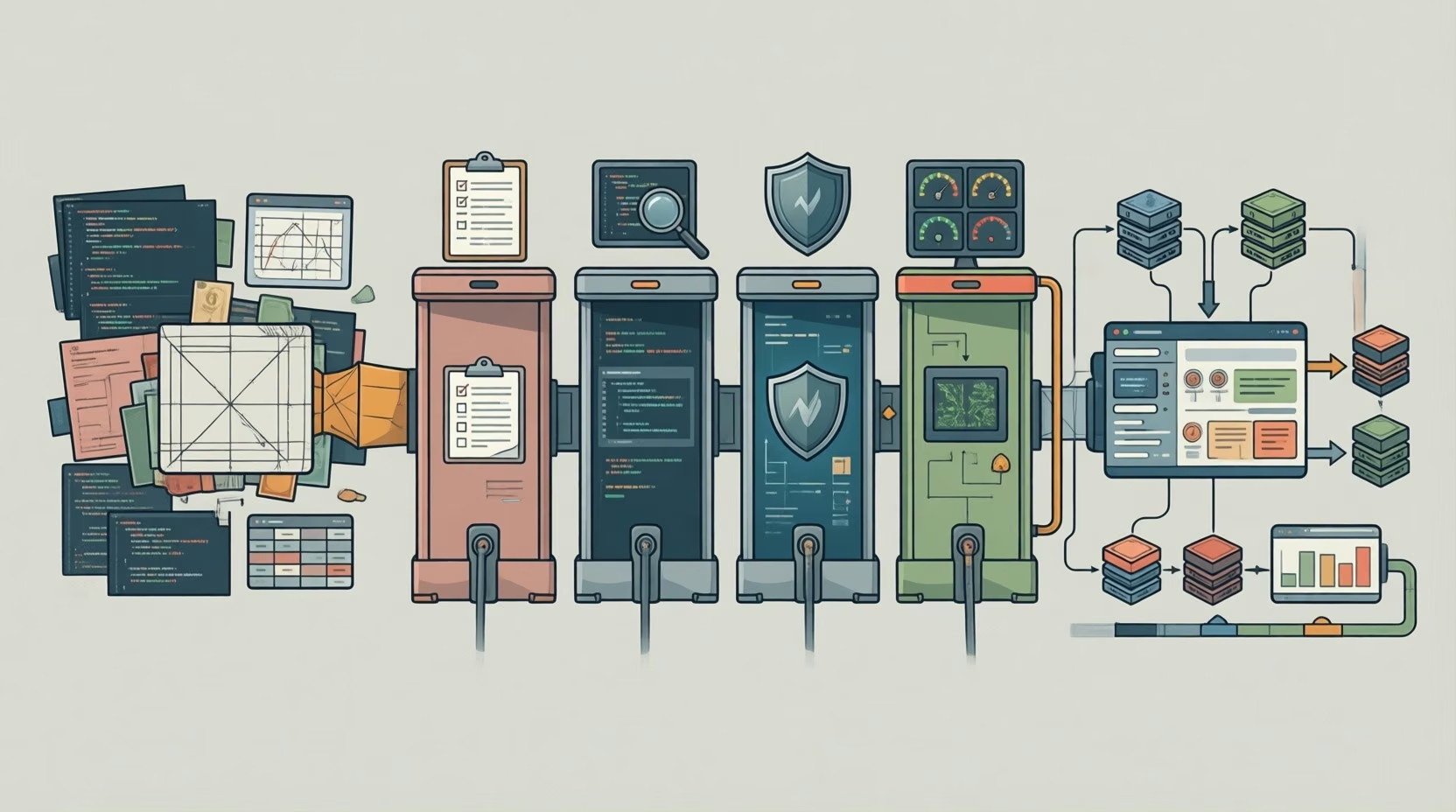
Illustration generated with FLUX.2 [klein 4B] via Cloudflare Workers AI.
SHARE

Here is a small nugget from the Feb 5th Webinar with Josh Manion and Bryan Eisenberg. I touched on this in my little intro during the webcast because it is the source of a fascinating disagreement. It is also in the Multichannel Metrics book in chapter 3.

When an online and an offline direct marketer discuss their approach to outbound marketing, this is the one that they disagree about. I am talking about email or SMS channels for the online marketer and direct mail, telemarketing, or direct sales for the offline direct marketer.

Say that you want to cross-sell brokerage accounts to customers who have nothing but a checking account at your bank. This will grow the wallet share that you have with customers and make them less likely to leave to competitors. You design an attractive offer with appealing creative.

More Read

How Habitat UK *should* have used Twitter
Mobile Advertising, Clustering Algorithms, and Your Ticket for a Free Ride
Software Dependence & Model Accuracy
Using R and Excel Together
Expanding the Data Stream

But who should you send that offer to? Everybody for whom you have contact information and permission to market?

Certainly not, says the offline direct marketer. The table below shows different sizes of mailings and their effect on your profits. Click the table to expand it in a separate window.

The big apparent difference between online and offline is that offline marketing has a higher variable cost per contact, e.g. call center costs, postage and production fees for mailings or direct sales costs. In contrast, sending an extra email or SMS or serving an extra banner, mistakenly, seem close to free.

Therefore, the offline direct marketer has to take these costs into account from the beginning. 

The cost per contact is the economic pressure for targeting before testing.

  1. Look at column 1 of the table, This is the untargeted and untested campaign. Since the target group has been selected too broadly, you will have no chance to break even. The campaign is simply too costly and typical conversion rates these days are too low.
  2. Column 2 is after applying super star testing. We now increased the conversion rate to 1%, a whopping five-fold increase!!! Yet, the untargeted campaign still loses money because it is too costly.
  3. This is why the offline marketer has been obsessed with improving conversion rates by targeting the most promising segments.  Column 3 shows that. Reduce the campaign to the most interested 10%. Costs go down and conversion rate for this segment goes up. Now we have a profit.

How to Target? 

Various ways of targeting campaigns range from predictive analytics at the high end to simple common sense list selections, suppression rules, etc at the minimum end of the spectrum. There is a lot to be said about the data to use for better targeting. May I recommend a new whitepaper on just that subject: Making Web data personal.

What’s it to me, says the Email and SMS marketer

Having a negligible cost per contact for email and SMS, the default approach online has widely been to ignore targeting, especially predictive analytics.

But there is a hidden cost that we have too often ignored online, namely the opportunity costs inucrred by spamming audiences and wasting our future permission to market.

In the sense that Peppers and Rogers emphasize in their recent books we incurr a real cost when we spam. Namely, the future potential purchases by a prospect become a little less likely since they aren’t listening to us. Peppers and Rogers would say that our expected life time value probably goes down for those recipients who feel spammed.

If the online marketer takes that cost into account, the economic pressure is now very similar to offline marketers. There now is a real variable cost per contact to reckon with.

Therefore, the calculation in the table above is just as relevant to the online and shows why targeting has to come before testing.

Share This Article
Facebook Pinterest LinkedIn
Share

Follow us on Facebook

Latest News

How Search Engine Indexing Lags Behind Large-Scale Website Domain Migrations -- AI-generated illustration
How Search Engine Indexing Lags Behind Large-Scale Website Domain Migrations
News
How Great Content Moves Through A Marketing Ecosystem -- AI-generated illustration
How Great Content Moves Through A Marketing Ecosystem
Exclusive Infographic Marketing
What Your Brand Misses That Data Reveals -- AI-generated illustration
What Your Brand Misses That Data Reveals
Big Data Exclusive Infographic
5 Common Mistakes Businesses Make During the Risk Assessment Process -- AI-generated illustration
5 Common Mistakes Businesses Make During the Risk Assessment Process
Business Intelligence Exclusive Risk Management

Stay Connected

1.2KFollowersLike
33.7KFollowersFollow
222FollowersPin

You Might also Like

Interview –Michael Zeller CEO,Zementis
Data Mining

Interview –Michael Zeller CEO,Zementis

11 Min Read
IBM - Conversations for a Smarter Planet: 6 in a...
Business IntelligenceData MiningData WarehousingPredictive Analytics

IBM – Conversations for a Smarter Planet: 6 in a…

1 Min Read
Design a Successful Business Dashboard: 3 Essential Tips
Best PracticesBusiness IntelligenceData MiningData VisualizationDecision Management

Design a Successful Business Dashboard: 3 Essential Tips

6 Min Read

That’s Sick! Text Mining and Words with Multiple Definitions

4 Min Read

SmartData Collective is one of the largest & trusted community covering technical content about Big Data, BI, Cloud, Analytics, Artificial Intelligence, IoT & more.

5 Great Tips for Using Data Analytics for Website UX
Big Data
The Art of Conversation: Enhancing Chatbots with Advanced AI Prompts
Chatbots

Quick Link

  • About
  • Contact
  • Privacy
Follow US
© 2008-26 SmartData Collective. All Rights Reserved.
Welcome Back!

Sign in to your account

Username or Email Address
Password

Lost your password?