We use cookies, including third-party cookies from Google to serve personalized ads through AdSense, to operate this site and understand how it is used. By continuing to browse, you accept this use. See our Privacy Policy and Terms of Use for details, including how to opt out of personalized advertising.
Accept
SmartData CollectiveSmartData Collective
  • Analytics
    AnalyticsShow More
    chatgpt image jul 21, 2026, 04 34 30 pm
    4 Core Benefits of Predictive Maintenance after Vibration Analysis
    10 Min Read
    How Does Data Mining Boost Customer Satisfaction in Logistics? Harnessing Analytics for Results -- AI-generated illustration
    How Does Data Mining Boost Customer Satisfaction in Logistics? Harnessing Analytics for Results
    11 Min Read
    chatgpt image jul 13, 2026, 04 23 45 pm
    How Data Analytics Helps Companies Improve User Engagement
    19 Min Read
    chatgpt image jul 13, 2026, 03 59 46 pm
    How Data Analytics Improves Multi-Location Search Strategies
    10 Min Read
    cybersecurity efforts
    How Behavioral Analytics and AI Are Redefining Cybersecurity for Boca Raton Businesses
    14 Min Read
  • Big Data
  • BI
  • Exclusive
  • IT
  • Marketing
  • Software
Search
© 2008-25 SmartData Collective. All Rights Reserved.
Reading: Utilizing Data to Discover Shortcomings Within Your Business Model
Share
Notification
Font ResizerAa
SmartData CollectiveSmartData Collective
Font ResizerAa
Search
  • About
  • Help
  • Privacy
Follow US
© 2008-23 SmartData Collective. All Rights Reserved.
SmartData Collective > Big Data > Utilizing Data to Discover Shortcomings Within Your Business Model
Big DataBusiness IntelligenceExclusive

Utilizing Data to Discover Shortcomings Within Your Business Model

Discover how to use data to identify areas of improvement in your business model. Learn effective strategies for uncovering potential issues and solutions to ensure continued success.

Ryan Ayers
Ryan Ayers
6 Min Read
Utilizing Data to Discover Shortcomings Within Your Business Model
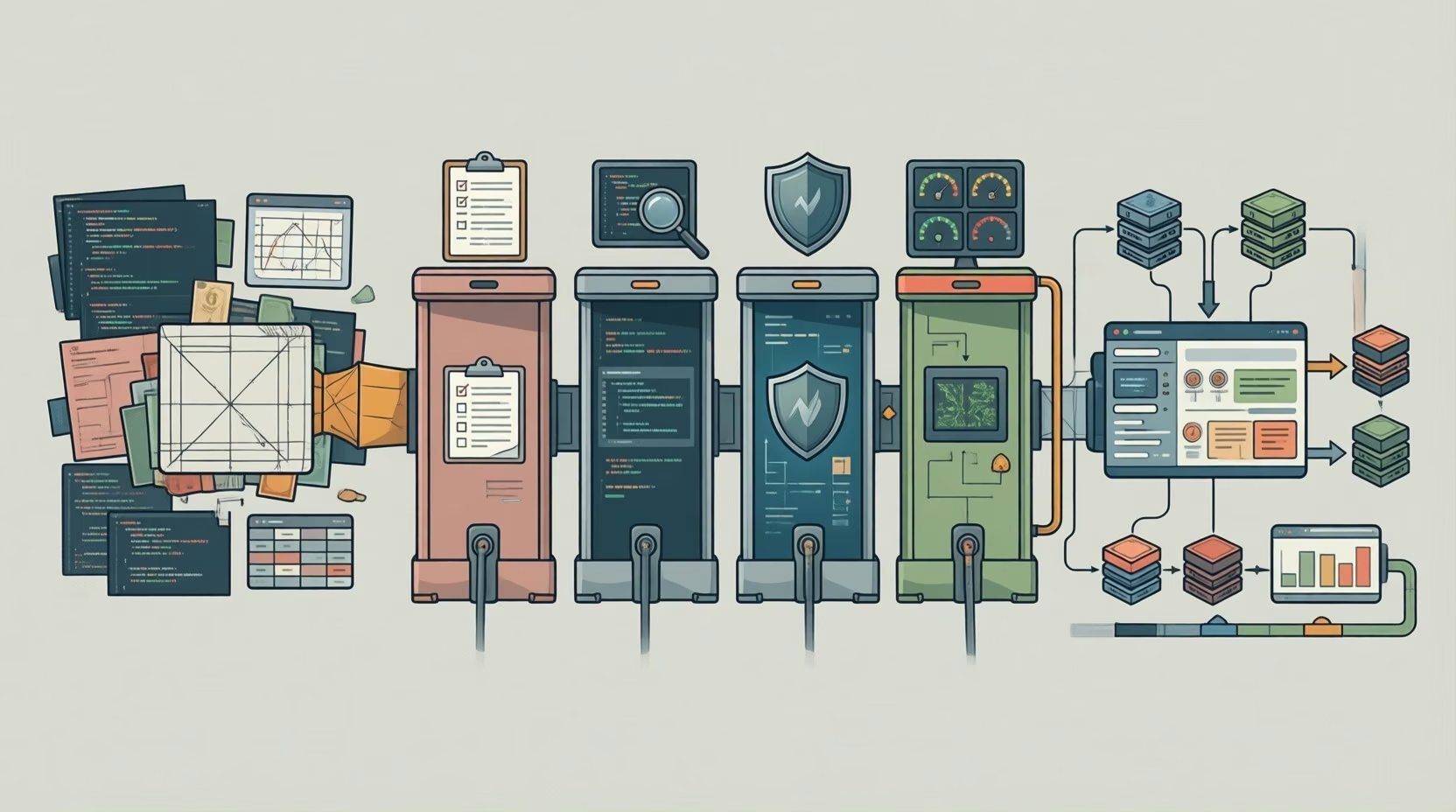
Illustration generated with Qwen Image.
SHARE

To some extent, business is a practice in trial and error. You start with a business plan and try to cover all your bases. Then, you make adjustments based on what’s working within your business model— and what isn’t.

Contents
  • Data is An Important Tool for Businesses
  • Setting Up Your Data Collection
  • Using Data to Find Shortcomings & Opportunities
  • Understand That Not All Data is Useful
    • Data Can Help You Gain a Competitive Edge

Sometimes, however, the factors that are slowing down your business’s growth aren’t obvious. It’s important to get an objective look at where there are shortcomings in your business model. That’s where modern data tools come in.

Here’s what you need to know about using data to improve your business model and boost your company’s growth.

Data is An Important Tool for Businesses

Businesses are creating data all the time. Data points might include the number of pageviews on a website, the length of time it takes an employee to complete a specific task, or social media likes. Each business creates different data points, which can be collected and used to help guide strategy.

More Read

Why You Must Leverage Encryption for Data Protection in the Digital Transformation Era
Unstructured Data: A Contrarian’s View
Data Security Standards Are Evolving in Response to Rising Threats
Social CRM and Customer Advocacy Programs: Case Study
New Case Studies Show Promising Potential for Writing Content with Machine Learning

Data is an important tool for businesses because it allows them to identify opportunities, track trends, and gain powerful insights. It can be used for all kinds of applications, from solving a business’s operational problems to improving its marketing strategy. It can even be used to detect fraud.  

Business data analysis used to be extremely expensive and impractical for all but the largest corporations. Fortunately, however, it’s become much more accessible, even for small businesses. Today, there is user-friendly software available that even the smallest business can use.

Setting Up Your Data Collection

If you haven’t done so already, the first step is to pick out software that will collect your data so you can use it. Some website builders have analytics built in, but many businesses need something more robust.

There are lots of great options to choose from and many are quite affordable. It’s a good idea to do a little research before you choose the software you want to use, as it might be difficult to switch later.

Using Data to Find Shortcomings & Opportunities

No business model is perfect. All you can do is use the data that’s available to you at the time you start your business and make your best projections. However, once your business is up and running, it’s important to reevaluate your business model on a continual basis.

Data analysis begins with a dataset— and usually, the bigger the better. More data typically makes the insights you’ll gain more reliable. However, if you’ve only just started to track your data, you can still use it to find shortcomings in your business model.

Next, you need to ask a question. For example: where could we improve efficiency in everyday operations? Then, you would be able to turn to the data and see where time (and money) was wasted.

For example, a doctor’s office might notice that the wait times when patients arrive at their appointments is excessive and it’s causing frustration for both staff and patients. If they collect enough data, they can see the average wait time and see which variables affect how long a patient will have to wait. Then, they could adjust how they schedule or check patients in to help solve the problem and increase customer happiness while decreasing staff stress.

Hospitals also frequently use data to lower the cost of care and find operational inefficiencies. It’s important to be specific in regards to your goals and the questions you use to guide your analysis. That way, you can isolate problems and better understand what is causing them.

Understand That Not All Data is Useful

Data can be the most valuable tool for your business, period. It can also be completely useless if you don’t recognize poor-quality data. Analyzing poor-quality data is a waste of time that can cost your business.

It’s important to understand that not all data is useful. Concentrate on the data that can help you solve problems or otherwise improve your business and don’t worry about the rest.

Data Can Help You Gain a Competitive Edge

Business data analysis has many potential benefits, regardless of your industry and business model. Large companies rely on data to help guide decision-making and improve overall performance.

Small businesses can gain a competitive edge by using data in their decision-making process. It can be difficult to compete in today’s marketplace if you’re relying on instinct alone. Data can help your business survive and thrive in a competitive landscape!

TAGGED:big databusiness modelutilizing data
Share This Article
Facebook Pinterest LinkedIn
Share
ByRyan Ayers
Follow:
Ryan Ayers has consulted a number of Fortune 500 companies within multiple industries including information technology and big data. After earning his MBA in 2010, Ayers also began working with start-up companies and aspiring entrepreneurs, with a keen focus on data collection and analysis.

Follow us on Facebook

Latest News

Flat editorial illustration: The article presents a bifurcated enterprise decision: European organizations evaluating VMware alte
Cloud Infrastructure and Workload Migration: A Data-Driven Look at VMware Alternatives in Europe
Cloud Computing Exclusive
Synthetic Data vs Real Web Data: Comparison, Limitations, and Collection Methods  -- AI-generated illustration
Synthetic Data vs Real Web Data: Comparison, Limitations, and Collection Methods 
Big Data Exclusive
Illustration of mobile analytics dashboards with ad performance charts connected to backend databases
11 Best Sisense Alternatives for Embedded Analytics
Business Intelligence Exclusive
Analyst points at colorful circular data dashboard on screen - information technology business metrics
How Fragmented Workplace Tech Undermines Reliable Business Metrics and Reporting
Cloud Computing Exclusive Infographic IT

Stay Connected

1.2KFollowersLike
33.7KFollowersFollow
222FollowersPin

You Might also Like

Why Good Management is Still Essential in the Age of Big Data and ML
Artificial IntelligenceExclusiveMachine Learning

Why Good Management is Still Essential in the Age of Big Data and ML

7 Min Read
3 Essential Big Data Security Protocols To Be Aware Of
Big DataExclusiveSecurity

3 Essential Big Data Security Protocols To Be Aware Of

8 Min Read
Big Data Advances Lead To Impressive Fintech Opportunities
Big DataExclusiveFintech

Big Data Advances Lead To Impressive Fintech Opportunities

5 Min Read
Could Big Data DevOps Tools Spur Need For A UBI?
Big DataDevelopmentExclusive

Could Big Data DevOps Tools Spur Need For A UBI?

5 Min Read

SmartData Collective is one of the largest & trusted community covering technical content about Big Data, BI, Cloud, Analytics, Artificial Intelligence, IoT & more.

ai chatbot
How AI Website Chatbots Improve Customer Support and Lead Generation
Chatbots Exclusive
The Art of Conversation: Enhancing Chatbots with Advanced AI Prompts
Chatbots

Quick Link

  • About
  • Contact
  • Privacy
Follow US
© 2008-26 SmartData Collective. All Rights Reserved.
Welcome Back!

Sign in to your account

Username or Email Address
Password

Lost your password?