AI is driving major changes in the financial world. It is estimated that Fintech companies spent over $9.5 billion on AI in 2021, but small businesses may spend even more on AI-driven financial management software.
The banking industry is among those most heavily affected by AI. Smart solutions can give banks an advantage over competitors. Some of the benefits of AI in banking include:
- Banks use AI bots to onboard clients and analyze borrower risk. Forbes author Rob Shevlin reports that chatbots will actually make bank branches obsolete.
- They have also started integrated computer vision and deep learning technology to identify inefficiencies.
- AI-based anti-money laundering solutions are also being used to prevent fraud. Patrick Craig, the Ernst and Young EMEIA Financial Crime Technology Lead stated that AI can help financial institutions better keep up with their efforts to fight fraud.
Banks and other financial institutions are combining AI with other technologies to transform their business models. For example, Infosys helped an Australian bank predict demand, consumption, and price for trading companies. The dashboard streamlined their business trading and procurement process.
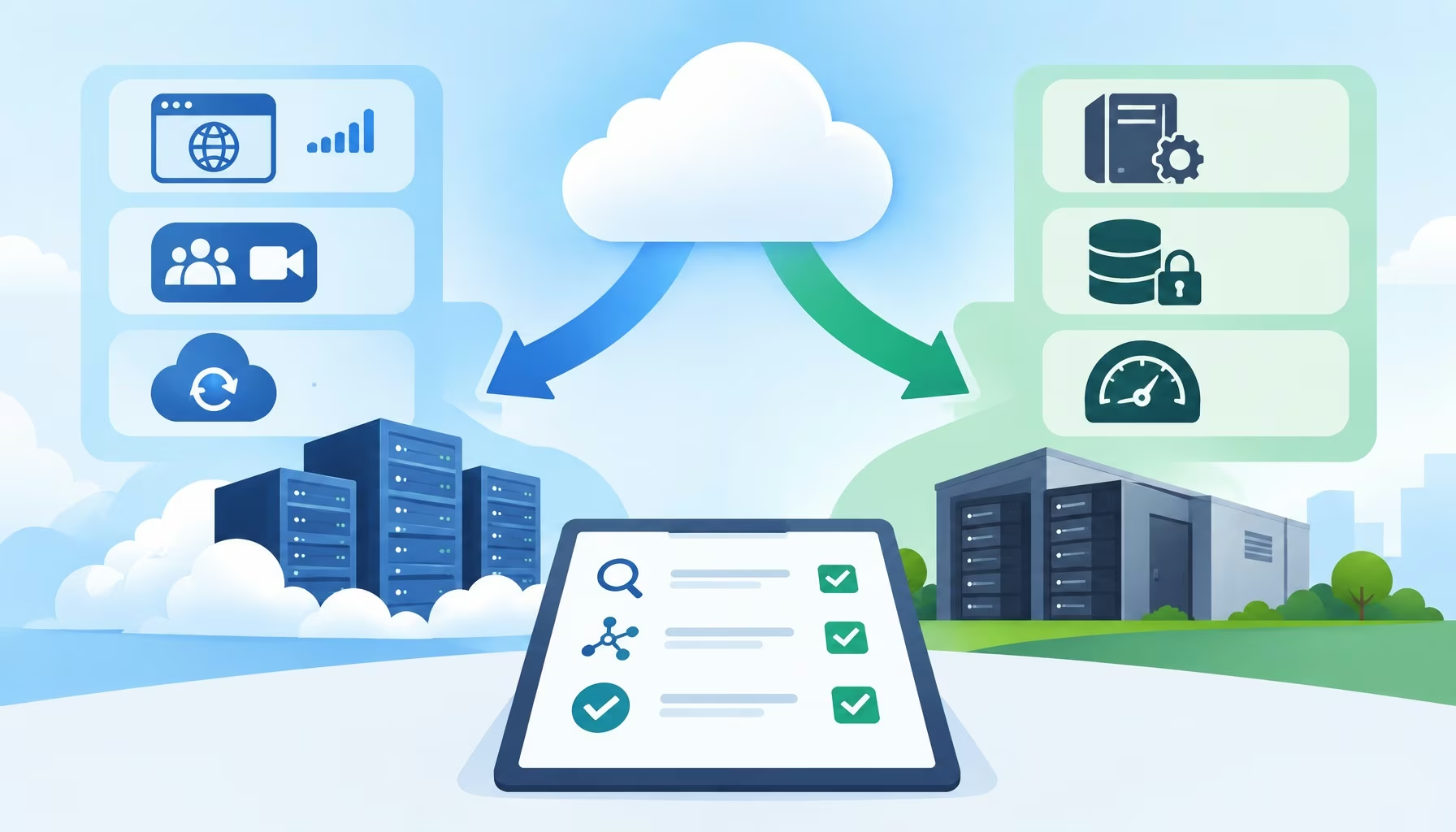
While AI can have huge implications for large financial institutions, it is also changing the financial strategy for small businesses as well. Many small businesses are investing in AI-driven financial management software. Upgrading your tech stack is a big undertaking. Many businesses fail to take full advantage of the resources that are available to them simply because they aren’t sure how to get started. The problem is you don’t want to stay analog while your competitors are up in the “Cloud.”
AI-based financial tools aren’t just for your accountants. They can be an invaluable asset for your entire business. In this article, we look at the importance of financial software and discuss how you can use it to secure better business outcomes. Keep reading to learn more about the relevance of AI in finance.
The Evolution of Fintech
For decades the most important technological innovation in finance was the calculator. As AI technology began to work its way into offices all across the country, experts made bold predictions. Financial technology (FinTec) wouldn’t just make accountants’ lives easier. It would replace them altogether.
In the early 2000s, articles were being written that suggested accounting would no longer exist as a profession in the next several decades (in other words, right about now). Obviously, that did not happen. However, AI has changed the state of the profession for better or worse.
Part of the reason for that is that FinTec isn’t quite there yet. Automation is good for taking on repetitive tasks, so AI is a lifesaver for companies with many monotonous tasks. When variables enter the equation, manual effort and human oversite are both necessary.
The other thing? These accountants who now have digitalized their jobs aren’t sitting around useless. They use their free time to focus on more fruitful efforts, so AI has helped them do more important things.
That is often the end game for digital tech implementation. A good financial tech stack that incorporates AI into its models allows you to:
- Scale: Growing pains are very real. When a company begins to expand its business things start to change. Suddenly, you have all of your previous responsibilities, plus a new challenge: How do we operate at the same peak efficiency while serving twice as many people? Digital technology allows you to transition into growth without endlessly expanding your departments.
- Focus on the bigger picture: While the software handles small stuff, your accountants and other financial professionals can help leverage their time toward bigger goals. Planning out an expansion. Thinking about the financial components of product development, etc. Of course, you would need their help for these things eventually, but now it can happen quicker and with fewer distractions.
A great Fintech lineup may trim your staff somewhat. This is particularly true for companies that were previously making lots of hires to keep up with their growing businesses’ new demands. However, digital technology hasn’t been nearly as much of a job killer as many people once assumed.
Examples of AI in Fintech
Like so many other aspects of workplace digitization, your Fintech stack will usually be made up of many tools that utilize AI. Your accounts will have software specific to accounting. Your analysts might have software designed to help with business forecasting. Billing will have software to manage invoices and payment processing.
It sounds expensive.
It is! Software is now typically a monthly recurring cost. Each tool you acquire may have a relatively low subscription fee, but these costs add up. The benefits of the Software as a Service model (wherein you never own your software but simply rent it) do tend to outweigh the cons. Benefits include:
- Free updates: It used to be that you would buy software, and hang on to it for as long as you could. This might mean using the same program for ten-plus years. Frugal, sure, but also a bit of a hindrance. Tech companies are constantly updating their products. Keeping your software up-to-date can help you secure a competitive advantage.
- Easier startup cost: Instead of spending tens of thousands of dollars on the front end to acquire all of your tools, you can instead lease them at a much more achievable price. Better yet, because you’re just a renter, it’s easy to pivot into new tools if your first choice doesn’t work out the way you hoped it would.
You’ll still pay a pretty penny for tech. However, part of the promise is that when you use digital technology the right way, it usually pays for itself.
The Right Way
Unfortunately, acquiring software isn’t only about finding the best of every product. You do want excellent tech solutions, but you also want programs that work well together. Unfortunately, that is often easier said than done.
The key word here is “integrations.” That’s the phrase tech folk use to describe how well various tools interact and communicate with one another. Some tools are designed specifically to link up and integrate. These tools will be well adapted for sharing data between departments and generally optimizing your operations.
Tools that don’t integrate can result in “data siloes.” In these situations, your business has all of the data it could ever want, but not in places that are accessible. Accounting has data here, sales has data there, and never shall the two meet.
Why does sales need to be able to look at billing’s data?
Let’s say you want to start focusing more on upsells. You need your sales team to go out, and find the people most willing to not only buy your products but buy the premium version. First, you need to figure out what sort of person is currently doing that the most.
Guess who has the information? Billing.
Separation between departments is largely an imaginary concept. Your business has a broad set of goals, and every department is contributing toward said goals in the best way that they can. Integrations make this job much easier.
If you don’t feel up to the task of choosing the right tech solutions, some consultants can help advise you. They will charge a fee, of course, but it will be much less expensive than the cost of constantly revamping your tech stack.
AI is Changing Finance
AI is certainly the future. There is no doubt that it is changing the state of finance. More companies will need to use AI-driven software to improve their financial services models.