Cookies help us display personalized product recommendations and ensure you have great shopping experience.

By using this site, you agree to the Privacy Policy and Terms of Use.
Accept
SmartData CollectiveSmartData Collective
  • Analytics
    AnalyticsShow More
    warehouse accidents
    Data Analytics and the Future of Warehouse Safety
    10 Min Read
    stock investing and data analytics
    How Data Analytics Supports Smarter Stock Trading Strategies
    4 Min Read
    predictive analytics risk management
    How Predictive Analytics Is Redefining Risk Management Across Industries
    7 Min Read
    data analytics and gold trading
    Data Analytics and the New Era of Gold Trading
    9 Min Read
    composable analytics
    How Composable Analytics Unlocks Modular Agility for Data Teams
    9 Min Read
  • Big Data
  • BI
  • Exclusive
  • IT
  • Marketing
  • Software
Search
© 2008-25 SmartData Collective. All Rights Reserved.
Reading: Science Needs to Be Less Certain
Share
Notification
Font ResizerAa
SmartData CollectiveSmartData Collective
Font ResizerAa
Search
  • About
  • Help
  • Privacy
Follow US
© 2008-23 SmartData Collective. All Rights Reserved.
SmartData Collective > Big Data > Data Visualization > Science Needs to Be Less Certain
AnalyticsBig DataCommentaryData VisualizationData WarehousingExclusiveModelingPredictive AnalyticsRisk Management

Science Needs to Be Less Certain

paulbarsch
paulbarsch
5 Min Read
Image
SHARE

Image

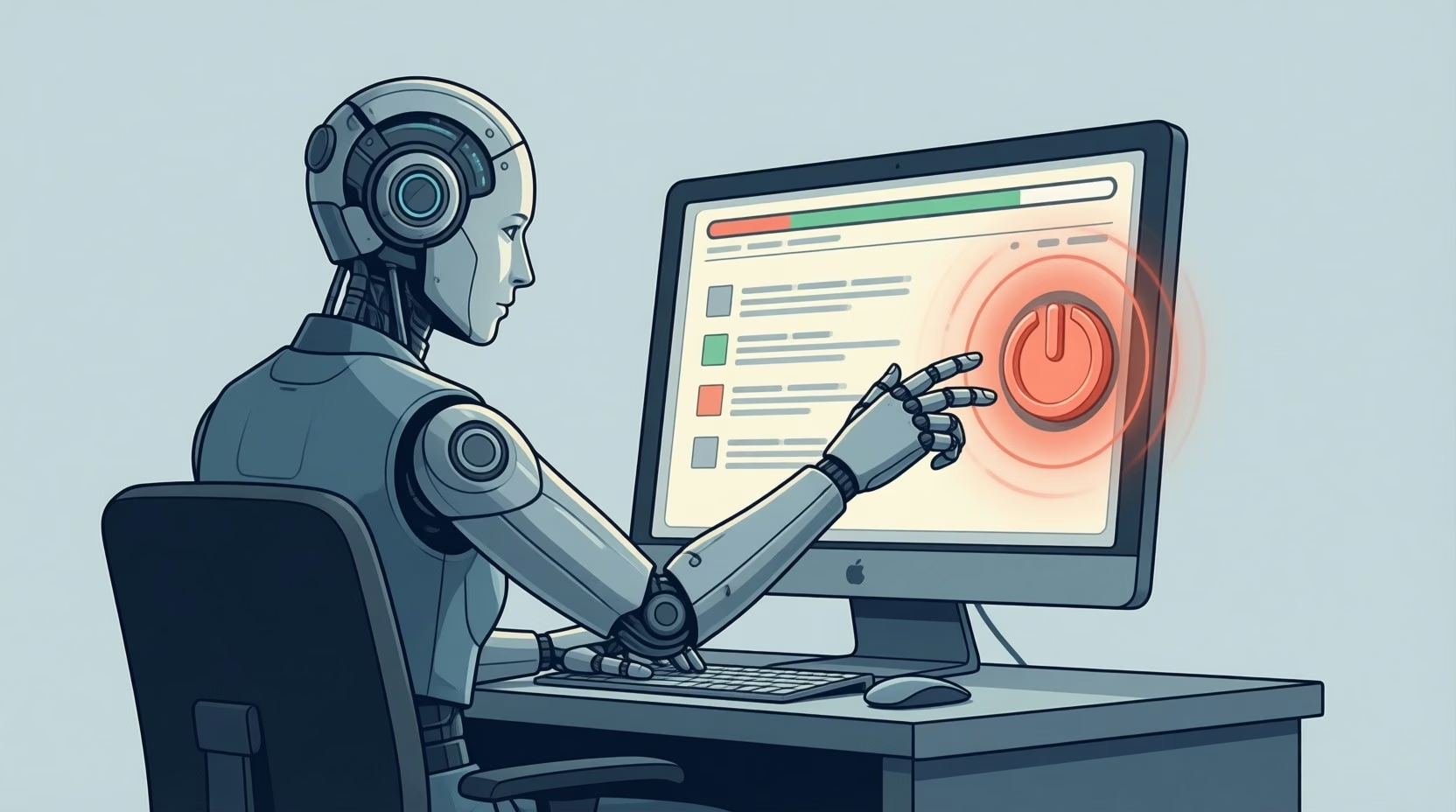
A disturbing trend is afoot, where key topics in science are increasingly considered beyond debate—or in other words settled. However, good science isn’t without question, discovery and even a bit of “humility”—something that scientists of all stripes (chemists, mathematicians, physicists and yes even data scientists) should remember.

Image

A disturbing trend is afoot, where key topics in science are increasingly considered beyond debate—or in other words settled. However, good science isn’t without question, discovery and even a bit of “humility”—something that scientists of all stripes (chemists, mathematicians, physicists and yes even data scientists) should remember.

More Read

Asia remains lucrative BI market
dataFUD: Manage your information resources
Decision Management and software development III – DSLs
2012 Health IT Spending & Trends
Improving LinkedIn Ad Strategies with Data Analytics

ImageRecently, the online site for Popular Science discontinued its online comments for certain topics. The reasoning for such a policy was clear according to an editor; “A politically motivated, decades-long war on expertise has eroded the popular consensus on a wide variety of scientifically validated topics. Everything, from evolution to the origins of climate change, is mistakenly up for grabs again. Scientific certainty is just another thing for two people to “debate” on television.”

Thus, it was clear that because the science behind a smattering of topics was settled, there was no need for further debate. Instead, the magazine promised to open comments for topics on “select articles that lend themselves to vigorous and intelligent discussion.”

Now one can hardly blame Popular Science. Commenting online has been out of hand for some time, especially when denizens of the internet choose character assassination and cheap shots to prove a point. And to be sure, instead of enlightened discussion, sometimes comment sections devolve to least common denominator thinking.

That said, Popular Science couldn’t be any more wrong. Last I checked, good science was all about hypothesizing, testing, discovery and repeatability. It was about debate on fresh and ancient ideas, with an understanding that there was little certitude and more probabilities in play, especially because the world around us is constantly changing. We’re learning more, discovering more, and changing our theories to reflect the latest evidence. We’re testing ideas, failing fast and moving on to the next experiment. And things we believe to be true today are sometimes proven either less true or completely false tomorrow.

However, it disturbs me to see debate cut off—on any topic—because we know the facts and the numbers prove them true. Facts change—as Christopher Columbus would attest, were he alive today. And worse, we have scientists who disparage others because 97% of “the collective” agree on a given topic. As if consensus determined what is true.

The blogger Epicurean Dealmaker laments on the same topic; “The undeniable strength of science as a domain of human thought is that it embeds skepticism…science is not science if it does not consist of theorems and hypotheses which are only—always and forever more—taken as potentially true until they are proven otherwise. And science itself declares its ambition to constantly test and retest its theories and assumptions for completeness, accuracy, and truth, even if this happens more often in theory than in fact.”

As we travel down the path of the next big thing –the transformation of multiple disciplines including business, medicine, artificial intelligence and more with “Big Data,” let us not forget that in a complex world—while our analysis and numbers prove one thing today—they may be woefully inadequate for tomorrow’s challenges.

So let’s encourage debate, discussion, testing and re-testing of theories and experimentation using data and analytic platforms to learn more about our customers, our companies and ourselves. And don’t shut off debate because everyone agrees—chances are they do not. The old adage, ‘conflict creates’ holds true, whether in the chemistry or data lab. The future of our companies, economies and societies depends on it.

TAGGED:risky business
Share This Article
Facebook Pinterest LinkedIn
Share

Follow us on Facebook

Latest News

macro intelligence and ai
How Permutable AI is Advancing Macro Intelligence for Complex Global Markets
Artificial Intelligence Exclusive
warehouse accidents
Data Analytics and the Future of Warehouse Safety
Analytics Commentary Exclusive
stock investing and data analytics
How Data Analytics Supports Smarter Stock Trading Strategies
Analytics Exclusive
qr codes for data-driven marketing
Role of QR Codes in Data-Driven Marketing
Big Data Exclusive

Stay Connected

1.2KFollowersLike
33.7KFollowersFollow
222FollowersPin

You Might also Like

Image
AnalyticsBest PracticesCommentaryExclusiveKnowledge ManagementRisk ManagementSoftware

Technology Training Needs a Hands-On Approach

5 Min Read
Image
Uncategorized

Is Cloud Sameness Dangerous to Competitive Advantage?

5 Min Read
Image
Predictive Analytics

3 Tips to Make You a Genius Forecaster

6 Min Read
Image
AnalyticsCloud ComputingCommentaryData MiningExclusiveMapReducePredictive AnalyticsRisk ManagementSentiment AnalyticsText Analytics

Text Analytics for Tracking Executive Hubris?

5 Min Read

SmartData Collective is one of the largest & trusted community covering technical content about Big Data, BI, Cloud, Analytics, Artificial Intelligence, IoT & more.

data-driven web design
5 Great Tips for Using Data Analytics for Website UX
Big Data
AI chatbots
AI Chatbots Can Help Retailers Convert Live Broadcast Viewers into Sales!
Chatbots

Quick Link

  • About
  • Contact
  • Privacy
Follow US
© 2008-25 SmartData Collective. All Rights Reserved.
Go to mobile version
Welcome Back!

Sign in to your account

Username or Email Address
Password

Lost your password?