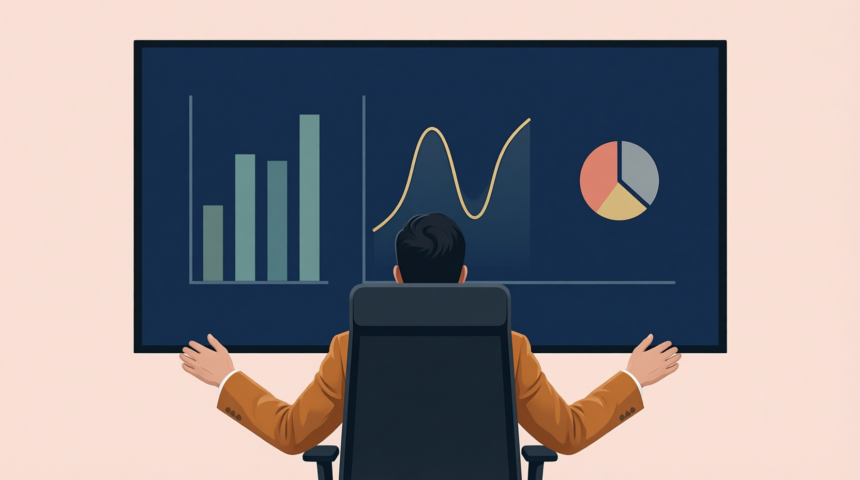
Have you ever wondered about how well boards of directors do their job? I have. And I do not have a good answer. But I was stimulated by an article written by Donald Delves, President of The Delves Group, titled “Dashboards for Boards.”
Ever since the Enron meltdown and numerous other companies with governance problems, my perception is that being a board member is no longer a ceremonious job where you simply show up for a board meeting and receive a nice paycheck. I believe that boards are now much more activists in defending the interests of shareholders and investors.
By accepting this perception, I presumed boards have their act fully together. But Delve’s article introduced some doubt with me.
Confusion between scorecards and dashboards

Delves’ observation is that younger board members are more shrewd and comfortable with using and deploying information, and they desire access to deeper and more robust information to perform business analytics. However, he states “Truly enlightening dashboards are still a rarity.” To complicate matters, there is confusion about what the difference is between a balanced scorecard and a dashboard. There is similar confusion differentiating key performance indicators (KPIs) from normal and routine measures that we can refer to as just performance indicators (PIs). Both types of measures are important, but they serve different purposes. The adjective “key” of a KPI is the operative term.
When an organization proudly proclaims they have three hundred KPIs, one must ask them the question, “How can they all be a K?” To use a radio analogy, KPIs are what distinguish the signal from the noise – the measures of progress toward strategy execution. As a negative result of this confusion, organizations are including an excessive amount of PIs in their balanced scorecard that should be restricted only to KPIs.
The difference between a scorecard and dashboards comes from the context in how they are applied. Here are some guidelines and definitions for understanding the differences:
- Scorecards monitor progress toward accomplishing strategic objectives. A scorecard displays periodic snapshots of performance associated with an organization’s strategic objectives and plans. It measures organizational activity at a summary level against pre-defined targets to see if performance is within acceptable ranges and favorable or unfavorable relative to the targets.
- Dashboards monitor and measure processes. A dashboard, however, is operational and reports information typically more frequently than scorecards and usually with measures. Each dashboard displays PIs which are reported with little regard to their relationship to other dashboard measures. Dashboard measures do not directly reflect the context of strategic objectives.
In summary, a scorecard serves as a feedback mechanism to allow everyone in the organization, from front-line workers up to the executive team and board directors, to answer the question: “How are we doing on what is important?” More importantly, the scorecard should facilitate analysis to also know why. The idea is not to just monitor the dials but to move the dials.
Board members and business intelligence and analytics
Delves writes this: “Board members do not have to limit themselves to the 30,000 ft. view of the company. Vast amounts of data can be assembled on a regular basis to provide meaningful insight quickly. Given the size and highly complex nature of so many companies, board members have a responsibility to dig deep, be curious, and satisfy that baby boomer urge for the truth.”
But this raises the issue of how easily and flexible is the access to the data and the ability to manipulate it. This is the same conundrum of experienced business analysts. Board members need much more than “drill-down” capabilities. So do managers and employees of the companies that board members provide oversight for.
The problem is many organizations have disparate data sources, “dirty” data quality, and allegedly effective data warehouses. Until these obstacles are fixed, dashboards for boards will remain an elusive goal.