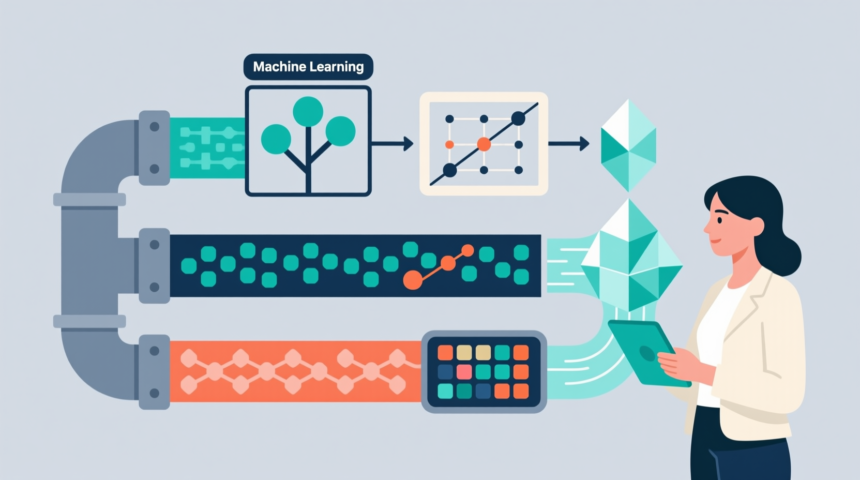
Machine learning is an upcoming field in the world of digital science, which allows you to create algorithms to make your device learn to operate on data and also to make predictions based on collected data. Machine learning course is possible through various languages like Python, Java, C++, R, etc. Apache Spark is considered to be a convenient option as a general engine for SQL based functions, creating algorithms for Machine learning using various languages and further processing of graphs and data. Spark is also known for its integrated framework to operate both on real-time streaming and Machine learning. As such, it is a great tool for beginners to introduce themselves to Machine Learning from the basics.
One must know about the various techniques to make predictions in machine learning by Spark. Supervised learning is to direct the data towards a specific label by training a certain set of unlabelled dataset. It is used to classify data- for example spam filtering or image recognition. Unsupervised learning is used for clustering data based on certain similar features in the set of unlabelled data. This is used to predict purchase patterns of customers on sites like Amazon and also for applications on social networking sites. Semi-supervised learning uses both supervised and unsupervised techniques to perform certain predictions like voice recognitions. Another method is reinforcement technique which analyses previous datasets into maximizing a certain result. This is also called the forecasting method. As one may notice that the basic principles among all these techniques is to locate a matching set among existing data to extract future predictions.
There are certain steps involved in determining an algorithm for a dataset which can do more than just data prediction. Feature extraction is the method to filter out the data meant to be tested because the entire data is usually not required to process. This is the first step to extract input data for the algorithm which can be done manually or automatically. Manual method is time consuming so automation is preferred. Principal component analysis is used for automatic feature extraction. The next step is to split the dataset into training set or test set such that errors can be detected. Some common methods for this process are random subsampling, K-fold and leave-one-out. Training the model set is the core process for which the algorithm needs to be selected according to the task in hand. Spark has a set of algorithms in its Machine learning engine which can be used for these purposes, called the MLlib or the Machine Learning library. The algorithms include functions like classification, regression, formation of decision trees, recommendation by ALS (Alternating Least Squares), clustering and topic modelling among several others. Models are eventually evaluated to check the accuracy of the algorithms.
The best thing about Mllib is that it provides machine learning API?s in different languages like Scala, Java & Python. You can develop your machine learning application in any of these languages.
More Read

The algorithms can be used individually or by grouping them to create a more accurate model. One must have an idea about the actions of these basic MLlib algorithms. Classification is a supervised technique which is used for applications like fraud detection in banks, email spam detection, etc. Regression analysis is to understand the linkages between independent and dependent variables. Decision tree learning analyses a set of data to come at a target prediction following a structure like a tree?s branches. The recommendation function uses cumulative filtering to decide user?s preferences based on their previous data. You must have come across recommendations on shopping websites, which produce lists based on your previous searches. Clustering is an unsupervised method to cluster data into similar patches. Topic modelling is also an important algorithm used to determine abstract information from a data set.
Machine learning provides a number of algorithms to work on so here you need to select the appropriate algorithm to build your application. For example, to develop a spam classifier we can use Naive Bayes or logistic regression or any other.