Ryan wanted to talk about a new topic today, which I think is very interesting. You will discover how artificial intelligence is improving video surveillance for companies that want stronger protection. There are clear reasons businesses are turning to smarter systems that can monitor activity, flag concerns, and reduce risk in real time.
- The Growing Role of AI in Business Security
- Proactive Deterrence vs. Reactive Recording
- Integrated Solutions and Centralized Management
- Advanced Analytics and Alerts
- Professional Monitoring and Support
- The Top 5 Video Surveillance Systems for Businesses
- Legal Considerations When Implementing Business Surveillance
Something that many business owners are noticing is the rapid shift toward AI-driven tools in daily operations. Keep reading to learn more.
The Growing Role of AI in Business Security
There are major technology firms and small companies alike investing in AI agents to support security teams. A recent survey from McKinsey and Company found that sixty-two percent of survey respondents say their organizations are at least experimenting with AI agents. You can see from this data that AI is no longer a distant concept but a current priority for decision makers. These experiments often include automated video monitoring that learns patterns and detects unusual behavior.
It is becoming more common for surveillance cameras to include built-in analytics that review footage as it is captured. Business owners benefit from systems that do more than simply record video.
More Read

Another thing driving adoption is the strong support from security professionals for AI-based monitoring. Syracuse University states that 95% of security professionals agree that AI-powered solutions improve the speed and effectiveness of threat detection and response. You will find that this level of agreement highlights how trusted these tools have become in high-risk environments.
There are practical advantages to having software that can distinguish between routine activity and suspicious movement. Teams can focus on serious alerts instead of scanning hours of uneventful footage.
Something that stands out in industry research is the emphasis on both safety and business growth. A white paper from Brivo features Dean Drako, CEO of Brivo, and author of the white paper, who wrote, “AI-powered video surveillance enables enterprises to protect people and property, improve business performance, and drive revenue growth. This paper is designed to help enterprises evaluate their priorities and understand the many uses of video surveillance so they can achieve their objectives.” It is clear from this statement that AI systems are meant to support wider company goals beyond security alone. Companies are looking at surveillance not just as a cost center but as a tool that can support long-term planning.
You can strengthen workplace safety when cameras are paired with AI models that recognize faces, track movement, and detect unusual patterns. Early warnings allow managers to respond before minor issues escalate into serious incidents.
There are many reasons businesses are reassessing how they approach surveillance in a world where risks can appear without warning. AI-driven systems provide constant analysis that human teams alone cannot match. You can build a safer environment when technology works alongside trained professionals to identify and address threats quickly.
It is clear that artificial intelligence is changing how companies protect their assets, staff, and customers. Organizations that adopt these systems position themselves to stay alert and prepared in an increasingly complex security climate.
As business needs evolve, so have the demands for modern video surveillance systems. Today’s organizations need systems that prevent incidents and integrate seamlessly with broader security strategies. The right video surveillance system should actively protect assets and provide reliable insights that support smarter decisions.Key Features of a Modern Business Security System
Physical security is a key priority for many businesses. A Pro-Vigil report found that 88% of businesses saw physical security incidents increase or stay the same from 2024 to 2025, making a modern security system essential for safety and continuity. Here are some features you should consider in your search.
Proactive Deterrence vs. Reactive Recording
Traditional systems can be reactive, only recording incidents for later review. While documentation is important, preventing theft or trespassing requires action.
A modern system uses proactive deterrence. Visible cameras, warning signage, perimeter barriers or motion-triggered lighting discourage intruders before they cause real damage. When detection triggers lighting or alarms in real time, the system can actively prevent unauthorized access.
For businesses operating warehouses, logistics hubs, construction yards or large outdoor facilities, this distinction can significantly reduce risk.
Integrated Solutions and Centralized Management
Running separate systems for cameras, access control, motion detection and alarms can create blind spots and operational inefficiencies. Integration ensures all security components work together.
An integrated platform allows businesses to:
- Monitor multiple locations from a single dashboard
- Automate responses, like triggering cameras when a door alarm activates
- Standardize reporting and compliance documentation
Centralized management reduces training time and administrative costs while improving response speed, which can be critical for large areas or multisite operations.
Advanced Analytics and Alerts
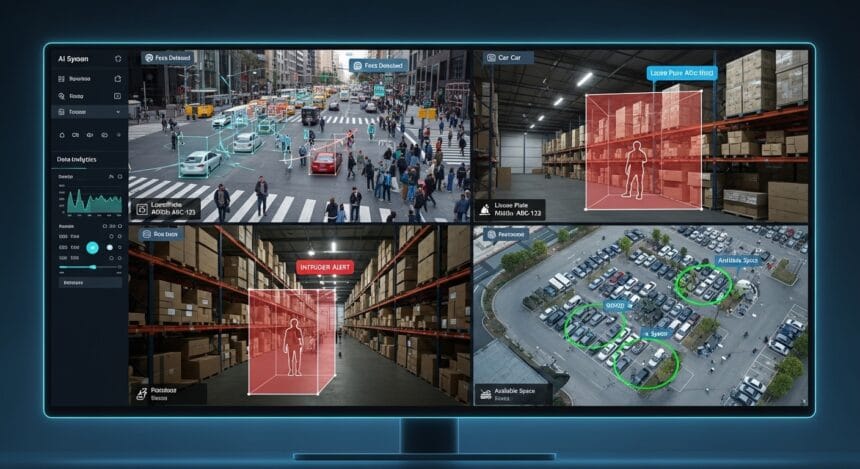
AI-powered analytics convert stored video footage into actionable insights. Modern systems can detect line-crossing, loitering, object interference and license plates. Some platforms also support facial recognition when legally permitted.
These capabilities reduce false alarms and help security teams focus on verified threats. Over time, analytics can also uncover patterns, like repeated access attempts or traffic flow trends, which can help teams make targeted improvements beyond security measures.
Professional Monitoring and Support
Self-monitoring can be efficient, but it can also have some blind spots. Internal teams may not always be able to respond in real time, especially outside business hours.
A professionally monitored system provides continuous oversight, allowing real-time verification or emergency dispatch coordination when necessary. Regular maintenance is also important. System updates and inspections ensure long-term reliability, even in high-pressure environments.
The Top 5 Video Surveillance Systems for Businesses
The right provider can strengthen your company’s security posture and effectively keep intruders at bay. These top-rated video surveillance systems for businesses help protect your people and assets and streamline security operations.
1. AMAROK
AMAROK tops the list for its comprehensive approach to video surveillance. It stands out by focusing on prevention as well as observation.
While it sells stand-alone cameras, the company delivers a layered security solution that combines video surveillance with physical perimeter deterrents like electrified fencing and motion-triggered lighting. This strategy helps stop incidents before they occur, making it especially valuable for businesses with exposed outdoor assets or high theft risk.
AMAROK surveillance systems include professional installation and ongoing maintenance. For companies without the staff for 24/7 surveillance, it provides remote monitoring services around the clock while keeping you in the loop. Overall, the company offers a unique blend of technology and proactive defense.
2. Avigilon
Avigilon is known for high-definition video systems and powerful analytics. Its solutions support detailed investigations and security operations at scale.
With features like advanced search and object recognition, Avigilon enables security teams to quickly locate individuals or vehicles of interest across multiple cameras, which can be useful for enterprise-level applications.
The platform integrates well with access control and alarm systems, providing a unified security experience. While Avigilon can require more technical investment than basic camera packages, its depth of functionality makes it a strong contender for companies requiring detailed investigative capabilities.
3. ADT
ADT offers a broad portfolio of business surveillance solutions ranging from high-definition cameras to advanced analytics and professional monitoring services.
Its systems help businesses monitor operations and enhance employee and customer safety through features like remote access, smart alerts, night vision video feeds and perimeter protection. ADT’s offerings can integrate with its intrusion detection and access control products, providing a unified security experience.
Aside from video capture, ADT supports cloud and on-site storage options, enabling businesses to archive and access footage according to their preferences and compliance requirements. Its decades of experience and nationwide infrastructure may appeal to companies seeking a comprehensive and professional security partner.
4. Verkada
Verkada takes a cloud-native approach to business surveillance, enabling easy deployment and centralized management.
Hosting video and analytics in the cloud allows administrators to access live and recorded footage from anywhere with an internet connection. These systems can also automatically apply updates, eliminating the need for manual patching.
While user-friendly, Verkada systems also have robust features. Its AI-powered analytics platform supports face search, reverse image search, motion detection and other relevant insights. Its security system scales well across multiple locations, making it attractive to businesses prioritizing remote access and user-friendliness.
5. Lorex
Lorex is a well-established provider of video surveillance hardware, offering a solid product lineup of 4K cameras and network video recorders. Businesses that need reliable recording and solid visual quality often find Lorex systems meet these needs effectively.
Its more advanced offerings now include an AI-powered analytics platform, boasting features like object classification, incident management and traffic flow analysis. Coupled with its robust hardware, Lorex’s equipment elevates the capabilities of its overall security system.
Lorex’s solutions are practical and accessible for small to midsized businesses, prioritizing straightforward monitoring and documentation.
Legal Considerations When Implementing Business Surveillance
Organizations must balance security objectives with regulatory compliance and industry standards to protect customers and the company from legal disputes or reputational harm.
Customer and Public Privacy
In most jurisdictions, businesses can record video in public-facing areas. However, private spaces like restrooms or locker rooms should not have cameras or recording equipment. Businesses should verify local regulations before installing security cameras and put up clear signage notifying customers of surveillance.
Employee Monitoring
While employers generally have the right to monitor activity on company premises, transparency is essential. Businesses should communicate where the cameras are located and what activities they record. Some jurisdictions require written employee consent to ensure all parties stay informed.
Data Security
Surveillance footage is sensitive data. Improper storage or access can lead to legal trouble. Businesses should leverage security measures like encryption, restricted access controls, audit logs and regular updates to prevent breaches.
Securing Your Business
The right surveillance system actively deters threats and integrates seamlessly into everyday operations. When evaluating a surveillance system for your business, focus on threat prevention, integration, intelligence and long-term reliability. Strengthening your physical security is essential to supporting overall growth.